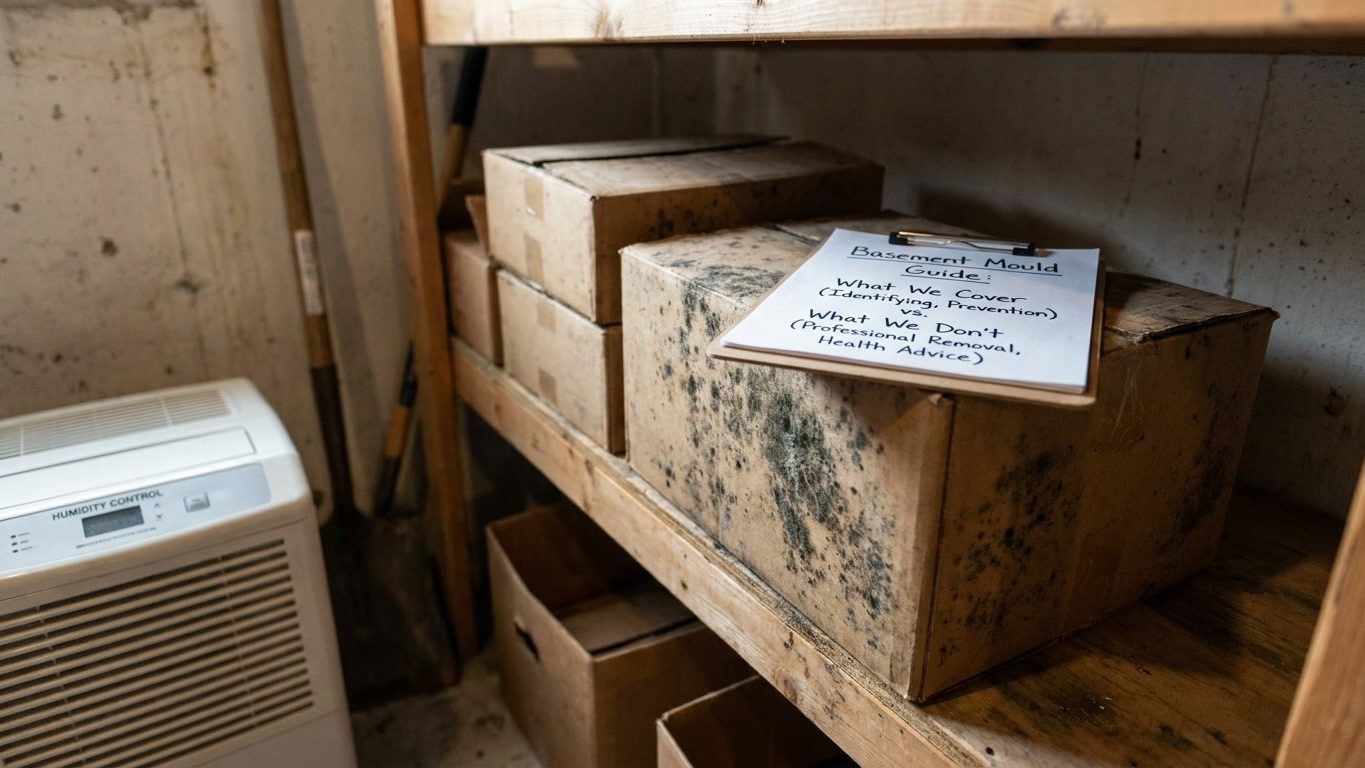

A gray-black smudge creeping up the drywall a few inches above the basement floor is not a puzzle a home test kit can solve. It means water has been reaching that wall, and the mold is only the visible evidence of it. The one action that matters right now is tracing where the water is coming from, not identifying what is growing on the surface.
What is actually going on

Mold needs two things to grow: moisture and something organic to feed on. A basement gives it both without trying. Drywall paper, wood framing, cardboard boxes, the dust on a concrete floor: all of it is food once it stays damp long enough. Take away the moisture and the mold stops growing, no matter what species it is or what color it happens to be. That is the entire mechanism, and everything else on this page follows from it.
This is also why sealing the inside of a basement wall on its own so often fails. A coating or a sealant applied to the interior face can hide staining and can cut down on surface humidity, but it does nothing about water pushing in from outside under pressure. That water simply finds another path around the treated surface, often reappearing a season or two later somewhere the paint didn’t reach. The order that actually holds up is drainage first, interior finishing second. Doing it the other way round is one of the most common ways homeowners spend money on a basement problem twice.
Why there is no number to reach for
There is no federal standard for how much indoor mold is acceptable, no home test that gives a pass or fail result, and no square footage of visible growth that is officially considered safe. Anyone selling a specific mold count or a certified safe threshold is selling a number that does not exist in any regulation. That is not this site being cautious. It is the honest state of the science: mold exposure and reaction to it vary enormously between people, and there is no agency that has drawn a line and said “below this, fine.”
People also react to mold very differently from one another. Some households live for years next to a damp corner and notice nothing. Others develop coughing, headaches, or worsening asthma from what looks like a small patch. Anyone with an existing respiratory condition, allergies, or a compromised immune system should not be the one cleaning the mold or working in the space while it’s disturbed. That job should go to someone else in the household, or to a professional, while that person stays out of the area.
Nothing in this section recommends a cleaning product, a bleach mix, or a spray to buy. This site’s answer is narrower and more useful: remove the water source, let the material dry completely, and only then decide whether the affected material needs to be removed or can be cleaned. Chemistry does not fix a wet wall. Drainage does.
What to look at, and in what order
Work from the cheapest and least invasive check to the most involved one. Each step below either confirms a cause or rules one out before you move to the next.
| Check | What it involves | What it suggests or rules out |
|---|---|---|
| Grading around the foundation | Look at the soil next to the house after a dry spell. It should slope away from the walls, not toward them. | Soil sloping toward the house explains surface water reaching the wall without pointing to a structural problem. |
| Gutters and downspouts | Check where downspouts discharge, and whether extensions carry water away from the foundation rather than dumping it at the base. | Rules out roof runoff as the source if downspouts already carry water well clear of the walls. |
| Window wells | Look for wells filling with water or debris, and check whether they have a functioning cover. | A wet, uncovered well points to a localized entry point rather than a whole-wall drainage failure. |
| Interior humidity and condensation | Note where moisture appears relative to plumbing, exterior walls, and vents, and whether it tracks with weather or with laundry and shower use. | Condensation patterns tied to household activity point to humidity control, not to water entering from outside. |
| Staining and mold location on the wall | Note whether growth follows a horizontal line, a vertical crack, or a corner near a pipe. | A pattern following a crack or pipe rules out general humidity as the sole cause and points to a specific entry path. |
| Standing water after rain | Check the floor, especially at the base of walls and around floor drains, during or right after a heavy rain. | Water appearing only during storms rules out a slow, constant leak and points to surface or groundwater pressure instead. |
None of these checks require digging next to the foundation. Excavating along a foundation wall is not something to attempt as a homeowner project, since it can undermine the footing and the trench itself can collapse on the person standing in it. If the checks above point to a problem at the footing or below grade, that is exactly the point where the job passes to a professional, covered in the next section.
If cracking shows up alongside the moisture, that’s a separate but related question worth understanding on its own. The Cracks in a Basement or Garage Floor guide walks through which cracks are cosmetic and which need an engineer’s eye.
Watch it, or get someone in
Some basement moisture is genuinely something to monitor rather than act on immediately. A patch of surface condensation on a cold water pipe in summer, or a faint musty smell in an unfinished storage area that clears up once a dehumidifier runs for a few days, falls into that category. Track it over a few weeks. If it doesn’t grow, doesn’t reappear after drying, and isn’t near framing or finished materials, watching it is a reasonable response.
When it stops being a watch-and-wait situation
Recurring water after every rain, mold that keeps coming back in the same spot after cleaning, a musty smell that never fully clears, or any staining near a structural crack all move past monitoring. At that point the right call is not a general handyman and it is not the company that answers the phone first. The three professionals involved in a basement moisture problem do different jobs, and confusing them wastes money.
- A structural engineer assesses the foundation and the cause of any cracking, and does not sell or perform the repair. Their report is independent of any waterproofing quote.
- A drainage contractor addresses grading, gutters, downspouts, and exterior water management, the layer of work that should come before anything interior.
- A waterproofing salesperson is often the first call homeowners make, but their recommendation is also their sale. That doesn’t make it wrong, but it means the diagnosis and the pitch are coming from the same conversation.
Getting the engineer’s read before the waterproofing quote is the cheapest insurance available in this whole process. An engineer has no reason to recommend a system that isn’t needed, because they are not the one installing it. If a crack, a bowing wall, or settling shows up alongside the mold, that independent opinion should come before any signed contract, not after.
If the basement problem coincides with a plan to test for other soil gases, that’s a separate and unrelated system worth checking at the same time rather than assuming water and air quality are connected. The Radon: The Reason to Test a Basement guide explains why a radon test belongs on the list regardless of what the moisture check turns up.
What has to happen first
The order of operations is where money gets wasted on this particular problem more than almost any other in the house. Exterior drainage comes before interior treatment, and water control comes before finishes. A finished basement with new drywall and paint over a wall that’s still taking on water from outside is a repeat expense waiting to happen, not a repair.
Start outside. Gutters that discharge close to the foundation and downspouts without extensions are covered in the roofing guides on this site, and they are usually the cheapest fix in the whole sequence. Inside, a sump pump handling groundwater or a persistent wet floor drain is a plumbing question, covered in the plumbing guides. Once the water is under control, insulation choices for basement walls change: a wall that used to stay damp needs a different approach than one that’s now reliably dry, which the insulation guides address directly. The same logic applies to what eventually goes down on the slab. Flooring choices for a basement depend entirely on whether moisture is still a live issue, a question the flooring guides walk through material by material.
Where this page stops
This page will not tell you a mold count is safe, because no such number exists to give. It will not give you a bleach ratio, because the fix for a wet basement is never a cleaning recipe. And it will not walk you through digging next to your foundation, because that is a job for people with the equipment and training to do it without collapsing the trench on themselves. What it will do is send you to the right starting point. That starting point is almost always outside the house, at the gutters and the grading, and the broader picture of how a foundation actually manages water is laid out in Foundations and Basements: Almost Everything Here Is Water.
Common questions
Do I need to get the mold tested to know what kind it is?
No test result changes what you do next. Every type of household mold needs the same fix, which is removing the moisture it’s feeding on, so identifying the species mostly satisfies curiosity rather than changing the repair.
Can I just run a dehumidifier instead of fixing the water source?
A dehumidifier helps with ambient humidity and condensation, but it does nothing for a wall that’s actively taking on water from outside. If the moisture is tied to rain events rather than general dampness, a dehumidifier will run constantly without solving the actual problem.
Is it safe to clean small patches of mold myself?
It can be, for small areas on hard, non-porous surfaces, as long as the person doing it has no respiratory condition and the moisture source has already been addressed. Porous material like drywall or carpet that’s stayed wet is a different situation and usually needs to be removed rather than cleaned.
How do I know if it’s actually mold and not just a water stain?
A water stain is flat, usually a ring or a discoloured patch with no texture, and it doesn’t come back after the surface dries and is repainted. Mold has some texture or fuzziness even in early stages, and it tends to reappear in the same spot if the moisture problem hasn’t been fixed.