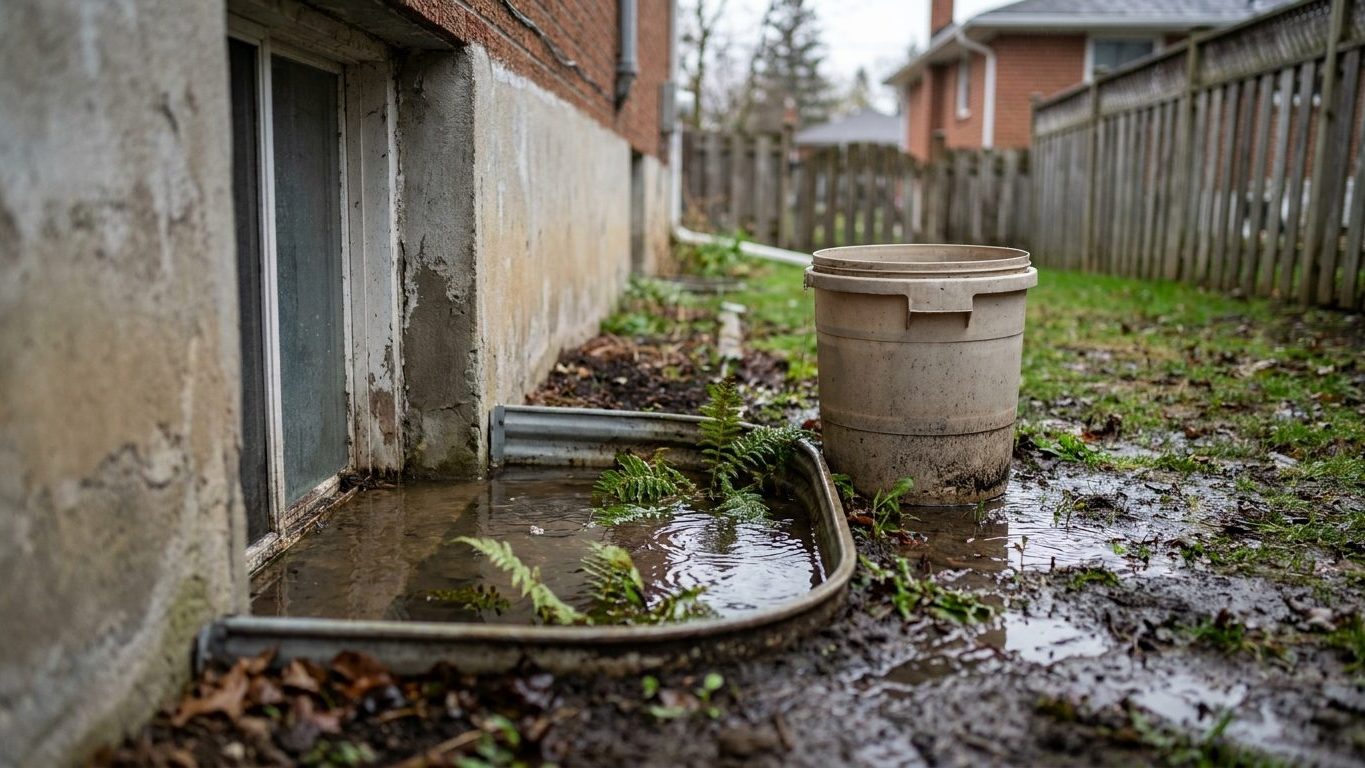

A crack that wasn’t there last fall, a musty smell that won’t air out, and a chalky white residue creeping across the basement wall usually trace back to the same cause: water finding a path through or around the foundation. Check the grading and gutters outside before touching anything indoors, and test for radon at the same time, regardless of what the cracks turn out to mean.
Slab, crawl space or basement

How a house meets the ground decides which of these problems are even possible for it to have. A slab-on-grade home has no basement or crawl space to flood, so water usually shows up as a damp patch on the floor itself or along the base of interior walls. A crawl space sits a short distance above the ground on low foundation walls, and it tends to fail by trapping humid air against the wood framing overhead rather than by flooding outright. A full basement has the most wall area in direct contact with soil of the three, and the most ways for water to get in, from the walls, the floor, or the joint where they meet. The differences between the three are big enough to deserve their own guide, Types of House Foundation, but the practical version is in the table below.
| Foundation type | How to recognize it | What it’s prone to | Pages that go further |
|---|---|---|---|
| Slab-on-grade | No visible foundation wall from outside, floor sits directly on the ground, entry steps are low or absent | Moisture moving up through the concrete, cracks that reflect movement underneath | Moisture Through a Concrete Slab, Cracks in a Concrete Floor |
| Crawl space | Short foundation wall a couple of feet tall, with a low, unfinished space underneath the main floor | Trapped humidity, condensation on framing, wood rot and mold | Moisture in a Crawl Space, Crawl Space Encapsulation |
| Basement | Full-height walls below grade, with a floor level below the main living space | Water entering through walls or the floor, efflorescence, damp air, wall cracks from soil pressure | Causes of a Wet Basement, Interior Basement Drainage, Before You Finish a Basement |
Why the type changes what you check
Foundation movement has a handful of recurring causes, whichever type of house sits on top of it. Clay soil expands when it gets wet and shrinks as it dries, and that seasonal swelling and shrinking pushes and pulls at a foundation year after year, a subject covered in Clay Soil and Foundations. Large trees planted close to a foundation pull moisture out of the soil unevenly around their root zone, which produces a similar effect from a different direction, covered in Trees Near House Foundations. In cold climates, the ground itself can lift a foundation as it freezes and expands, a process explained in Frost Heave and Foundations. Add settlement, where the soil under one part of a footing compresses more than the soil under another part, explained in Foundation Settlement Explained, and that accounts for most of what people notice as foundation movement, before water even enters the picture.
The type of foundation also decides which fixes matter later. A crawl space with damp soil under the framing has its own path forward, covered in Moisture in a Crawl Space and, for a more complete approach, Crawl Space Encapsulation. A slab that feels damp along its edges or grows a musty smell is usually letting moisture move up through the concrete itself, the subject of Moisture Through a Concrete Slab. A basement headed for finished walls and flooring has a checklist worth working through first, covered in Before You Finish a Basement, including whether the room needs a code-compliant escape route, covered in Escape Windows in a Basement.
Test for radon, whatever else you do
Radon is a colorless, odorless gas that rises up out of the ground itself, and it has nothing to do with whether a foundation has a crack in it, whether a basement smells musty, or how old the house is. The EPA and the U.S. Surgeon General recommend testing every home for radon, not just homes with visible symptoms, because the gas can move into a house with no foundation flaw at all. A neighbor’s clean result doesn’t tell you anything about your own house, since radon entry depends on the specific soil and the specific gaps under one building, not the one next door.
What the numbers mean
The EPA sets an action level of 4 pCi/L (picocuries per liter of air). At or above that level, the EPA recommends fixing the home to bring the number down. Between 2 and 4 pCi/L, the EPA says it’s worth considering action as well, because no level of radon is known to be fully safe, only progressively less risky as the number drops. Because radon rises from the soil, concentrations are usually highest in the lowest occupied level of a house, so a basement typically reads higher than the floor above it, and that’s where a test kit should be placed first.
Test kits come in short-term and long-term versions, and either one beats guessing, though a longer test better reflects how a level changes across a full year. None of this can be inferred from a geology report, from how old the house is, or from a neighbor’s number. Testing is inexpensive and it’s the only way to find out where a given house actually stands. A dedicated guide, Radon Testing in a Basement, covers where to place a kit and how to read the result.
Almost everything here is water
Cracks, a musty smell, damp air, mold spots, and white powder on a basement wall look like five separate problems, but almost all of them trace back to the same one: water, showing up in five different places, covered as a group in Causes of a Wet Basement. The chalky white powder is efflorescence, the mineral residue left behind once water carrying dissolved salts evaporates out of concrete or block, and it’s one of the clearest signs that water is moving through a wall even when the surface looks dry, explained further in White Powder on Basement Walls. A musty smell without any visible water usually points to humidity condensing somewhere out of sight rather than an active leak, a different problem with a different fix, covered in Why a Basement Smells Damp and Condensation or Seepage Explained.
The order that actually works
- Outside drainage first. Grading that slopes away from the house (Grading Around a House Foundation), gutters and downspouts that carry roof water well clear of the walls (Gutters and Foundation Water), and window wells that drain instead of filling with water (Window Wells Filling With Water) do more for a dry basement than anything done indoors. Where the soil itself needs help carrying water away from the footing, that’s the territory of Exterior Foundation Drainage.
- Then the building envelope: the wall and floor assembly itself, and whether it’s sealed and insulated correctly before a below-grade space gets finished, covered in Before You Finish a Basement.
- Interior management comes last: a system inside the basement to collect and remove whatever water still gets past the first two layers (Interior Basement Drainage), plus ongoing control of the humidity in the air that remains (Controlling Basement Humidity).
Doing this in reverse order is how money gets wasted in this subject. Sealing a basement wall from the inside can make it look dry and can help with humidity, described in Sealing a Basement From Inside, but it does not stop water that’s under pressure from the outside. That water simply finds the next path, often the floor-wall joint or a different stretch of wall, instead of stopping. An interior coating is a finish, not a fix, and it belongs at the end of this list, never as a stand-in for the drainage work outside.
Mold needs moisture and a food source, and a basement with elevated humidity for any length of time supplies both, covered in Mould in a Basement Explained. Wiping down a patch of surface mold without addressing the humidity behind it means it’s back within a season.
What this site will not assess
This site does not assess or repair structural cracks, and no page here will tell you that a specific crack in front of you is fine. What a page can do is describe what a certain type of crack usually means, and what would turn it from a cosmetic issue into a structural one.
When to call someone in
Vertical cracks (Vertical Cracks in Foundations) generally follow the path of least resistance as concrete cures and are the most common type in any wall, though their width and behavior over time still need a look. Horizontal cracks (Horizontal Cracks in Foundations) run across a wall instead of up and down, and they can point to lateral soil pressure pushing against the wall from outside. Stair-step cracks (Stair-Step Cracks in Block Walls) run diagonally along the mortar joints of a block wall, following the blocks rather than cutting through them. A wall that’s visibly bowing or bending inward (A Basement Wall Bending In) is a different order of concern than a crack sitting still in a flat wall. Cracks in a concrete floor (Cracks in a Concrete Floor) are usually just shrinkage from curing, but a floor crack lined up with a wall crack at the same spot is worth a second look. Not every crack carries the same weight, the subject of Which Foundation Cracks Matter, and watching one over time rather than guessing from a single glance is covered in Monitoring a Foundation Crack.
What turns any of these from something to watch into something to act on now is movement: a crack that keeps widening, a wall that keeps bowing, a door that increasingly won’t latch, or a crack that shows up suddenly rather than over years. Only a structural engineer can make that call, not a website and not a contractor who also sells the repair.
- A wall that is visibly bowed or bent inward
- A crack that is wider at one end than the other, or has visibly grown
- A horizontal crack of any size
- Floors or door frames noticeably out of level or square
- A crack that appeared quickly rather than gradually
A structural engineer is worth the call precisely because they aren’t selling a repair. Their job is to assess and report on what’s happening in the wall or the floor, which keeps the diagnosis separate from anyone with a financial interest in the outcome, unlike an estimate written up by a company that also does the fix. That distinction, and when it applies, is the subject of When to Call a Structural Engineer, and it’s the one call in this whole subject worth making before any repair work begins.