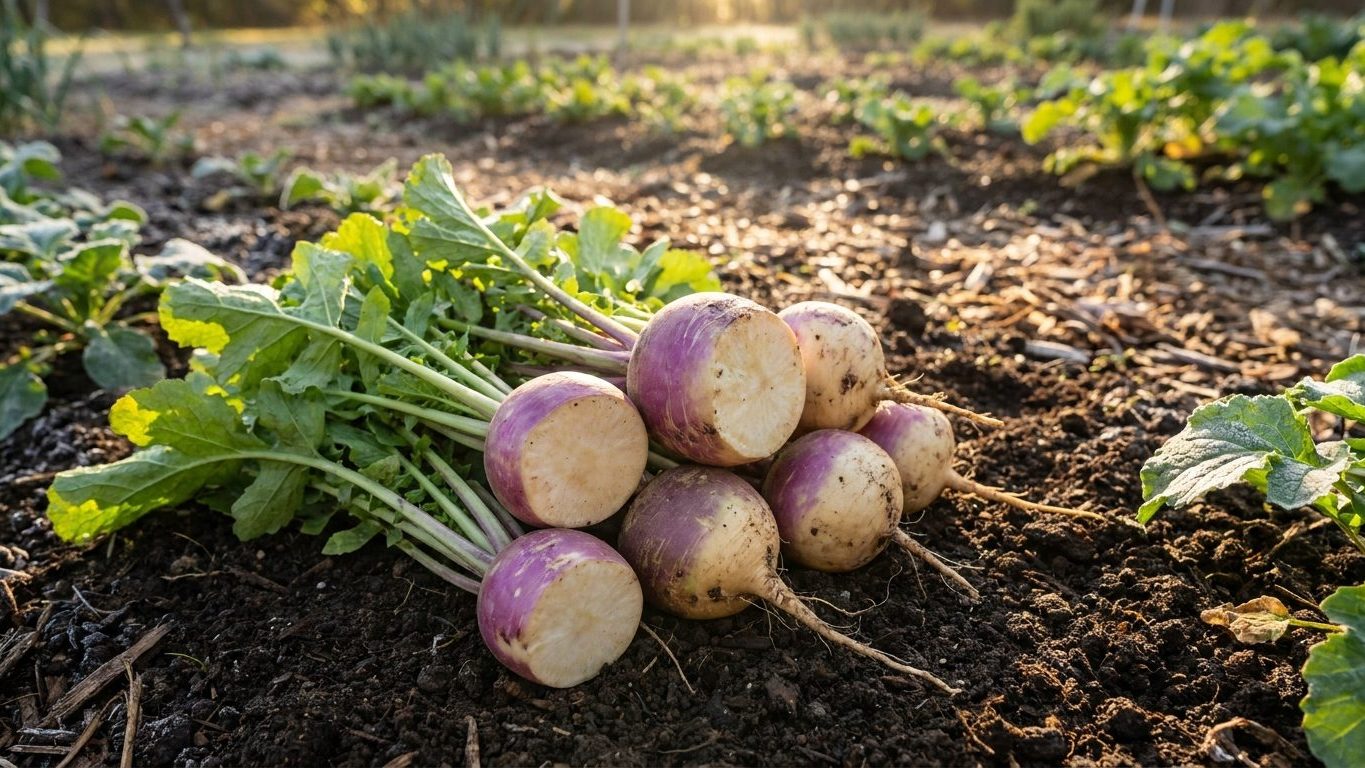

For autumn roots in Maine, sow in late summer and count backward from the first fall frost. Spring sowings go in only once the soil, not just the air, has warmed. At Portland, the last 32°F freeze falls somewhere between April 22 and May 1. Inland and northern Maine run later, so those dates move the whole calendar.
When the soil is warm enough in Maine
The frost date is a stand-in
NOAA’s 1991-2020 Climate Normals for Portland (NCEI station data) put the last spring freeze at 32°F in a 30-to-70-percent probability band from April 22 to May 1. That is a probability, not a promise, and a cold snap after the band closes would surprise no one who has gardened here.
Coastal Portland is the mild end of the state. USDA’s 2023 Plant Hardiness Zone Map spans 3b to 6a across Maine, and a gardener in the northern interior is working with a different calendar altogether. Treat the Portland dates as the earliest plausible anchor.
Frost is only a proxy for what turnips and rutabaga care about, which is soil. Air temperature swings by the day. Soil lags behind it, so it warms after the frost risk ends, not alongside it. A bed that was frost-free on April 30 can still be cold and wet underneath, and seed sown into it sits, slow to emerge and exposed to rot.
Reading the bed instead of the calendar
A soil thermometer a few inches down costs little and settles the argument. Check the germination range on the seed packet or with your extension office, then wait for the bed to hold it for several mornings in a row. The soil should also crumble rather than smear when you squeeze a handful.
What you plan to grow matters as much as the date. Quick, small-rooted turnip types suit a spring sowing, since they size up before summer heat. Rutabaga is a long-season root. It does best sown in early summer so that it bulks up in the cool of fall. Both are brassicas, in the same family as cabbage, kale and mustard, and they share those crops’ diseases and pests. Follow the crop rotation guide on this site and never plant them where any of those grew the year before.
Storage comes later, but it starts here. Roots that grew fast and steady store better than roots stressed by a stalled start. When you lift them, look over each one. A soft patch, a weeping spot or a moldy crown ends the question for that root, and a firm-looking neighbor does not prove it is safe. For the general picture across the country, see Growing Turnips and Rutabaga: An Autumn Crop, Sweetened by Frost.
How long the season lasts here
The same Portland normals give a first fall freeze between October 9 and October 21. Pair the two bands and the frost-free window comes out like this:
| Pairing of dates (Portland) | Frost-free days |
|---|---|
| Last spring freeze April 22, first fall freeze October 21 | 182 |
| Last spring freeze April 22, first fall freeze October 9 | 170 |
| Last spring freeze May 1, first fall freeze October 21 | 173 |
| Last spring freeze May 1, first fall freeze October 9 | 161 |
So at the coast, the window runs from 161 to 182 days, depending on how the dice fall. Inland, it shrinks, and the caution attached to the data says so plainly: inland and northern Maine run substantially later in spring and earlier in fall. I have no sourced dates for those places, so I won’t guess at a number.
What does a window that long allow? At the coast, it allows two sowings. A quick turnip type goes in as the soil warms. A second sowing in late summer, timed backward from the first fall freeze using the days-to-maturity printed on your seed packet, gives the roots that will sweeten in the cold. The succession sowing guide on this site walks through spacing those plantings so you are not harvesting everything in a single week.
A frost-free window overstates the real constraint, though. Turnips and rutabaga tolerate light frost, so the fall end of the season stretches past that first freeze. What shrinks is the spring end, where soil temperature, not frost, is the gate.
Farther inland, the shorter window usually turns the first sowing into the only one, and it raises the transplanting question. Brassica roots dislike disturbance. Starting rutabaga in cells to gain a few weeks can pay off in a short season, but only if you check the root at planting time. A taproot that has circled the cell or kinked at the bottom will fork, and a forked rutabaga is a poor crop however early it went in. If the roots look clean, transplant. If they don’t, direct sowing wins. For a comparison with another northern state’s window, see Growing Turnips and Rutabaga in South Dakota.
Heat and water in Maine
The verified data behind this page does not include a count of days above 90 F or a summer rainfall total for Maine, so I won’t supply either one. What I can say is that Maine’s summers are not where this crop is won or lost. Gardeners in the South fight the heat that turns roots woody and pungent; for that story, see Growing Turnips and Rutabaga in South Carolina. Here the summer risk runs the other way, to cool, damp stretches.
A cool wet summer brings slow ripening, foliar mildew, and rot in beds that drain poorly. The defenses are plain practices. Space plants so air moves between the leaves. Choose a well-drained bed. Water at the soil in the morning rather than overhead in the evening. Rotate away from every other brassica, because mildew and clubroot-type soil problems carry over from cabbage and kale beds.
The two cold figures that govern the crop
This is an autumn crop, and the two facts that matter most are both cold ones. The first is the coldest month’s mean daily minimum, which is 15.6°F at Portland (NOAA 1991-2020 Climate Normals). That is an average of nightly lows, not the record, so actual nights run colder, and inland Maine runs colder still. At those temperatures, the ground freezes. Leaving roots in the bed under a heavy straw mulch can extend the harvest into late fall, but it is not a plan for all winter. Plan on lifting everything before the soil locks up hard, because a frozen root cannot be dug and a thawed one is often mush.
The second is the timing of the first fall freeze. At Portland, that falls between October 9 and October 21. Light frosts push the plant to turn stored starch into sugar, which is why a turnip pulled after a few frosty nights tastes milder and sweeter than one pulled in September. How much of that sweetening you get depends on the gap between the first freeze and the day the ground freezes hard. That gap is generous on the coast and narrower inland.
Lifted roots need the same inspection described above, and again before you put them away. Check every one. A soft patch, a weeping spot or a moldy crown means that root goes to the compost, not the cellar.
Which turnips and rutabaga suit Maine
The honest answer here is to choose by type, and to decline to name a variety. This page has no sourced trial results for Maine, and a cultivar name offered without them is a guess that happens to look authoritative. Gardeners notice an invented variety immediately, and they are right to. The varieties trialled locally are the only recommendation worth acting on, and University of Maine Cooperative Extension is where to find them.
Maine’s facts point in a few clear directions:
- Short season, especially inland: favor the earliest-maturing types, and for rutabaga pick the shortest days-to-maturity listed by the seller.
- Cool, damp summers: put disease resistance first. Seed catalogs flag mildew tolerance, and where clubroot is a concern, a resistance note on the packet is worth more than any flavor claim.
- Warm spells in July and August: a little shade and airflow at the root helps, which mostly means proper spacing and mulch kept off the crown.
- Storage plans: sturdy, dense-fleshed types hold up better than tender early turnips, which are best eaten soon after lifting.
The days-to-maturity figure on a packet is the seller’s number, and it assumes decent conditions. Use it to count back from the first fall freeze, and add a margin if your summer has been cool. Because turnips and rutabaga are brassicas, resistance traits only go so far if you plant them where cabbage or kale grew last year. Rotation does more for disease than any seed choice.
Common questions
When should I sow turnips in Maine?
For spring, wait until the soil has warmed and drained, which follows the last freeze. At Portland that falls between April 22 and May 1 (a probability band, not a guarantee), and later inland. For fall roots, count back from the first fall freeze using the days-to-maturity on your packet.
Can I fit in a second sowing?
At the coast, the frost-free window of 161 to 182 days at Portland leaves room for one. Farther inland the window is shorter, and the first sowing may be the only one.
Can I leave rutabaga in the ground over winter?
The coldest month’s mean daily minimum at Portland is 15.6°F, and the ground freezes hard. A thick mulch can stretch the fall harvest, but plan to lift roots before the soil locks up rather than counting on a winter in place.
How do I know a stored root is still good?
Inspect each one, handling it for firmness and looking at the crown. A soft patch, a weeping spot or a moldy crown ends the question, and a root that looks sound is not proof of safety. Discard anything doubtful.