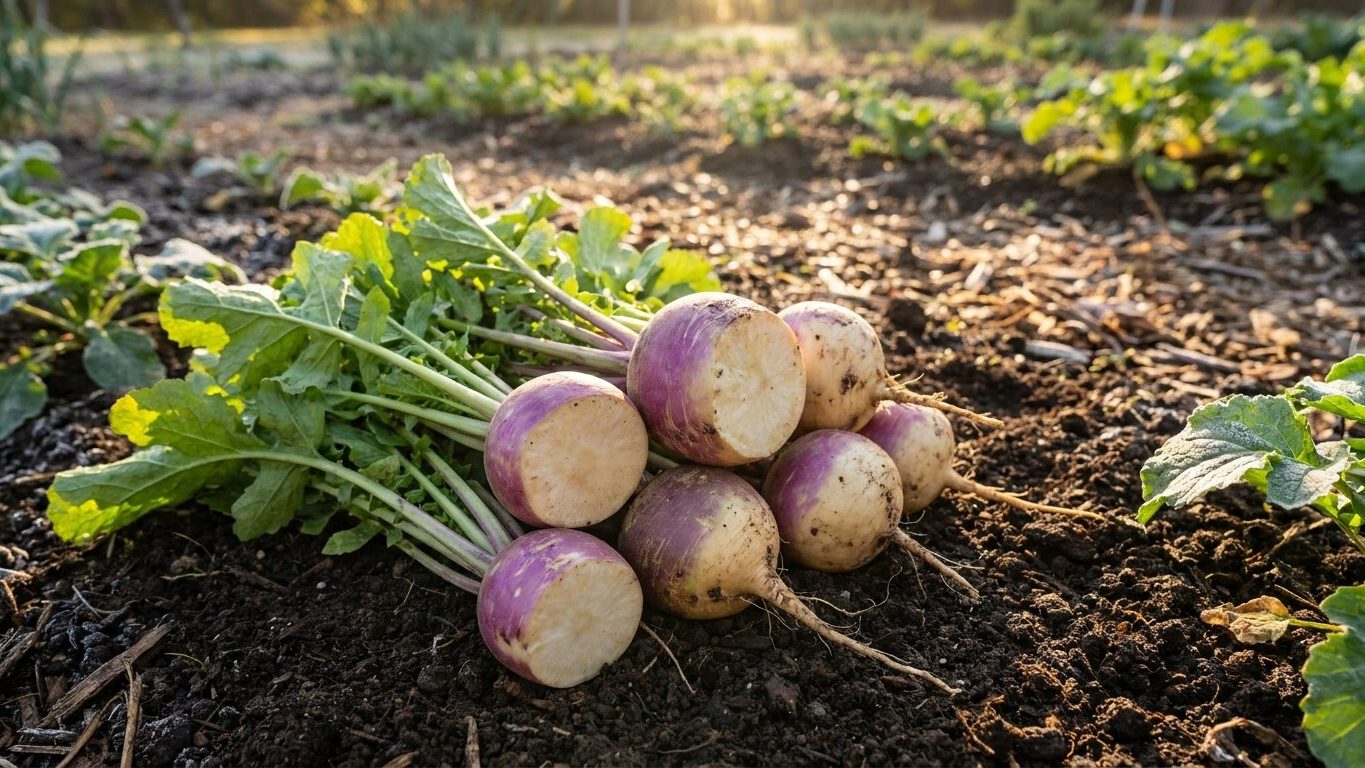

In Massachusetts, the frost-free date at Boston’s Logan Airport falls between April 1 and April 8, but that is not your sowing date. Turnips and rutabaga follow the soil, not the calendar, and the biggest payoff comes from the fall crop. Where you live matters: Logan is the mildest spot in the state.
When the soil is warm enough in Massachusetts
NOAA’s 1991-2020 Climate Normals put the last spring frost at Logan between April 1 and April 8, using the 30-70% band of 32°F freeze probabilities (NOAA NCEI station data). That is a probability, not a promise, and a late freeze can still land after the band closes. Say it once and plan around it.
Logan sits on the harbor, surrounded by water that moderates the air. Inland suburbs and the Berkshires frost noticeably later in spring, so a gardener in Worcester County or Pittsfield should push every date on this page later and not copy the Boston numbers.
Why the soil lags the calendar
A frost date measures air temperature at one moment. Seeds respond to the soil, and soil warms slowly after the last freeze, with cold, wet ground hanging on in shaded beds and heavy clay. Turnip and rutabaga seed sown into soil that is still cold and saturated sits and rots, or comes up patchy. A cheap soil thermometer pushed a couple of inches down in the morning tells you more than any normal does. The thresholds for each crop are worth getting from your extension office, because this page cannot source a number you could trust.
Spring sowing versus the fall crop
Both crops are brassicas, so they belong to the same family as cabbage, kale and mustard and share their pests and diseases. A bed that held any of those last year is the wrong bed this year, however it looks. The rotation page in this series explains why, and the rule matters more here than anywhere: moving turnips into a cabbage bed rotates nothing.
Spring sowing suits the quick, small-rooted turnip types, harvested before summer heat makes roots woody and strong-flavored. Rutabaga is a slower, larger root and generally earns its place as a fall crop, sown in summer so it matures in cooling weather. The Growing Turnips and Rutabaga: An Autumn Crop, Sweetened by Frost guide covers the reasoning behind that timing. For which varieties have actually been trialled in Massachusetts, ask UMass Extension.
How long the season lasts here
The same NOAA normals give the first fall frost at Logan between November 3 and November 14. Subtract the two sets of dates and the arithmetic is simple.
| Pairing | Last spring frost | First fall frost | Days between |
|---|---|---|---|
| Tightest window | April 8 | November 3 | 209 |
| Widest window | April 1 | November 14 | 227 |
That is 209 to 227 days at Logan, the generous end of the state. Inland suburbs lose days at both ends, and the Berkshires lose the most. Treat the figures as a ceiling, not a forecast for your yard.
The window is long enough to matter, because it allows two plantings rather than one. A spring sowing of quick turnips can come out well before midsummer, and the bed can then go back in for the fall crop, with fresh seed, rotated away from any brassica residue. Rutabaga, which wants the longest stretch of cool weather, can be sown in summer and still has room to finish before hard freeze. The main turnip and rutabaga guide sets out the broader approach, and the succession sowing guide on this site gives the spacing between sowings.
Where the season is shorter, the arithmetic changes. A gardener in the hills has one sowing, not two, and has to put it in at the right time. Transplanting also becomes harder to justify. Roots hate disturbance, and a transplant with a damaged taproot comes out forked or stunted. A longer window can forgive a failed first attempt and a short one cannot, so before you start seedlings indoors, check the roots as you pot them up and be honest about whether the saved days are worth it.
Heat and water in Massachusetts
This page carries no verified count of days above 90°F and no summer rainfall total for the state, so it quotes none. Estimating a number would be worse than leaving the gap. What can be said honestly is that Massachusetts is a northern state, and the two facts that govern an autumn crop are cold ones.
The winter low decides the storage question
At the Boston reference station, the mean daily minimum of the coldest month is 23.1°F. That is an average of nightly lows, not a record. Real nights run colder, and inland they run much colder. Along the coast, a thick mulch over the rows can plausibly keep roots workable into early winter. Inland, where the ground freezes harder and sooner, the safer plan is to lift the crop before the soil locks up.
The USDA Plant Hardiness Zone Map (2023) puts the state across zones 5a to 7b. That range is built on one variable, the average annual extreme minimum, and it covers everything from the Cape to the Berkshires. Look up your own location instead of leaning on the range. Compare the reputation of colder states: Michigan gardeners, covered in Growing Turnips and Rutabaga in Michigan, face harder ground freeze far earlier than Boston does, while Growing Turnips and Rutabaga in Texas shows the opposite problem.
Frost sweetening, and what a damp summer brings
Cold nights just under freezing push roots to convert starch into sugar, which is the whole point of a fall crop. Massachusetts gets enough of those nights before the ground freezes hard, especially inland, but the sweetening is gradual and a mild autumn delivers less of it.
Where summers run cool and damp rather than hot, trouble takes a different form. Mildew, slow ripening and fungal disease replace heat stress. Leaves that stay wet invite problems, and these crops share their diseases with every other brassica in the garden. Give plants airflow, avoid overhead watering late in the day, and keep them out of beds where cabbage-family crops grew recently.
Any root you plan to store needs a hard look first. Check for soft patches, weeping spots and a moldy crown. If you find any of these, the question is settled: do not keep that root and do not eat it. A firm, clean look is not a guarantee of safety, and this page will not promise how long any root keeps.
Which turnips and rutabaga suit Massachusetts
Choose by type. The first consideration is season length. At Logan the window runs 209 to 227 days, but inland it is shorter, and a short season favors the earliest, quickest-maturing types over the large, slow roots.
Disease comes next. Massachusetts weather swings between dry spells and damp stretches, and humid summers make disease resistance the first criterion for seed selection, ahead of size or shape. Look for descriptions that mention resistance to the foliar diseases common in your area. If you garden in a hot, sunny spot, types that give shade to their own shoulders and sit in well-aired rows will fare better than crowded ones.
This page names no cultivars, and that is deliberate. Variety recommendations only mean something when they come from local trials, and a variety that performs in Boston’s mild coastal conditions may fail in Berkshire clay. For what has actually been grown and tested in the state, contact UMass Extension. Its Massachusetts trials will beat any name pulled from a seed catalog.
Rotation is the other part of the choice. Turnip and rutabaga are brassicas and carry the same pests and diseases as cabbage, kale and mustard. Read the rotation page in this series before you decide where they go.
Common questions
When should I sow turnips in Massachusetts?
Wait for workable, warming soil, not just the last frost date. At Logan, NOAA normals put the last spring frost between April 1 and April 8, but inland sites run later. For a fall crop, sow in summer so roots mature in cooling weather.
Can I grow both turnips and rutabaga here?
Yes. Turnips suit a quick spring sowing as well as fall, while rutabaga is slower and usually earns its place as a fall crop. Both are brassicas, so rotate them away from cabbage, kale and mustard beds.
Do I need to lift roots before winter?
It depends where you garden. The coldest-month mean minimum at the Boston reference station is 23.1°F, which may allow mulched roots to stay in the ground near the coast for a time. Inland, where the ground freezes harder, lifting is the safer plan.
How do I know a stored root is safe?
Inspect each one. A soft patch, a weeping spot or a moldy crown ends the question, and the root goes. Looking sound is not proof of safety, and no keeping time should be treated as a promise.