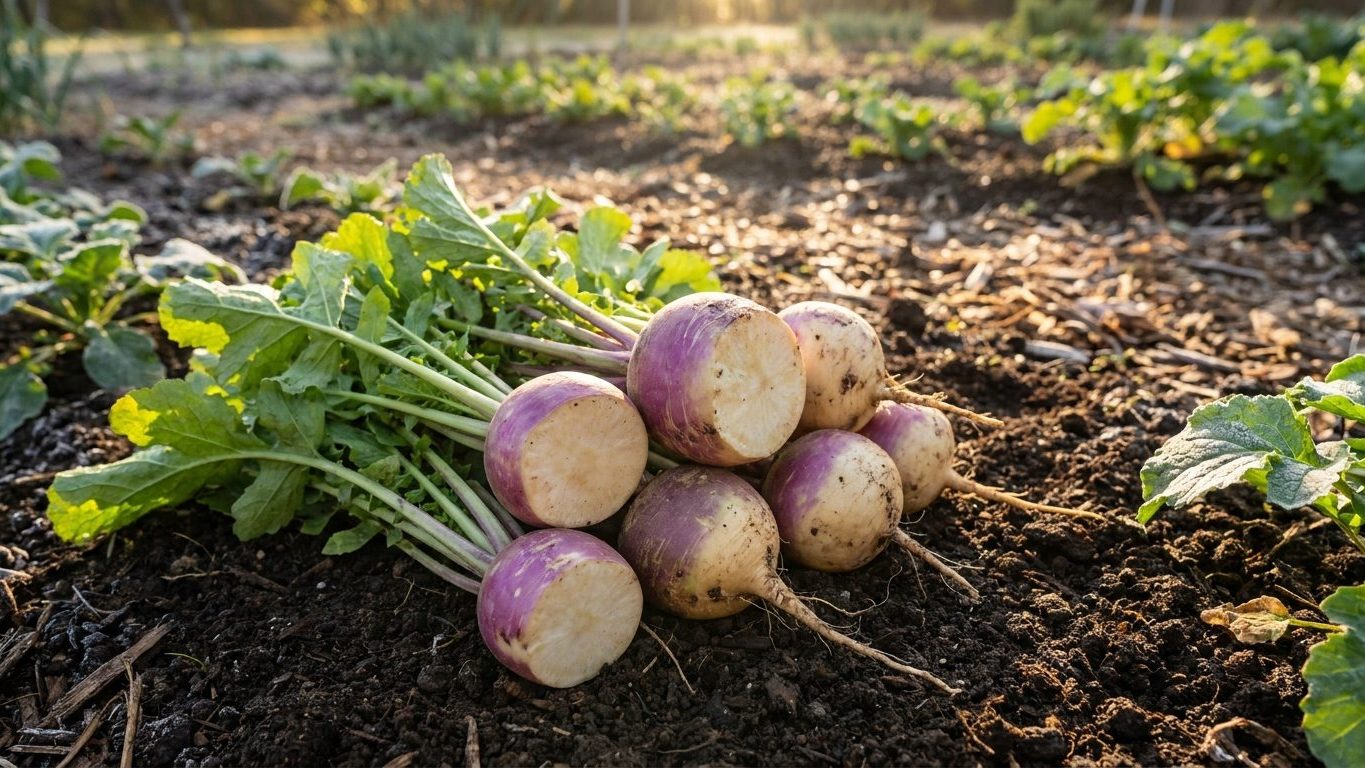

Turnips and rutabaga do well in Newfoundland and Labrador’s cool climate, but the calendar is tighter than the seed packet suggests. In the St. John’s area, the average last spring frost is May 30 and the average first fall frost is October 17, which leaves about 140 days between them. Sow into warm soil, plan to harvest after frost has sweetened the roots, and keep both crops out of any bed that has held cabbage.
When the soil is warm enough in Newfoundland and Labrador
The frost date, and what it can’t tell you
Most gardeners want one number: the day the seed can go in. Environment and Climate Change Canada puts the average last spring frost at May 30 (Canadian Climate Normals 1981-2010, station ST JOHN’S A, climate ID 8403506). Hold on to the word “average.” In one year out of two, the last frost falls later than that date, so it marks the middle of a window rather than a safe day. The figure also comes from a single airport station on the Avalon Peninsula. Northern and upland districts run weeks behind it, and Labrador runs behind again, so adjust for your own site rather than copying a St. John’s date.
Even a correct frost date is a stand-in for what the crop actually cares about. Turnips and rutabaga are cool-season roots that shrug off a light frost, but the seed still needs soil that has shed its early-spring chill and its waterlogging. Soil warms after the frost risk ends, not at the same moment. In a maritime climate with cold ocean water close by, that lag can be long. Cold, saturated ground leaves seed sitting in the dark, slow to sprout and open to rot.
Reading the ground instead of the calendar
A cheap soil thermometer settles the argument better than any date. Push it a couple of inches (about 5 cm) into the bed in the morning, check it over several days, and wait for a steady upward trend instead of one mild afternoon. Then do the hand test: a handful of soil that crumbles is ready, while one that smears into a ribbon or drips water is not. Raised beds and sloped, well-drained sites usually reach that point sooner than low, heavy ground.
Worth knowing: in Newfoundland speech, “turnip” usually means the big yellow-fleshed root that botanists call rutabaga, the one that goes into a Jiggs dinner. The two crops are close relatives and grow similarly, but the rutabaga is the slower, longer-season one, and that matters for the next section. For the sowing depth, spacing and soil temperature thresholds that suit the types sold locally, check with the provincial agriculture department (more on that at the end).
How long the season lasts here
Count from May 30 to October 17 and you get 140 days. Both dates are averages from the same station and the same period (1981-2010), so the subtraction describes a typical year at ST JOHN’S A, not a guarantee. Note also that Canadian normals cover 1981-2010, while the US pages on this site use 1991-2020, so comparisons across the border are rough.
| Measure | Value | Source |
|---|---|---|
| Average last spring frost | May 30 | ECCC Canadian Climate Normals 1981-2010, ST JOHN’S A |
| Average first fall frost | October 17 | ECCC Canadian Climate Normals 1981-2010, ST JOHN’S A |
| Days between the two | 140 | Calculated from the two dates above |
What 140 days allows
It is a modest window, and the real one is shorter. You will not sow on May 30 itself, since the soil needs to catch up, and a root crop needs its final weeks of growth before the cold shuts it down. Add the fact that half of all years bring a frost after the average date, and the practical conclusion is plain: the first sowing is the main event. For rutabaga, the slow one, it is effectively the only sowing. Count back from October 17 using the days-to-maturity printed on your seed packet, add a margin for a cool summer, and see whether a later sowing even fits.
Quick-maturing turnip types are the exception. A short-season type sown in midsummer can reach harvest size in the cooler days of fall, which is when turnips taste best anyway. How to space those later sowings and how many to attempt is covered in the succession sowing guide on this site. For the broader picture of why frost improves the crop, see Growing Turnips and Rutabaga: An Autumn Crop, Sweetened by Frost.
Transplanting: usually not worth the risk
With a short window, the argument for starting turnips indoors and transplanting weakens. Root crops form a single taproot, and a check at transplant time, from a bent root or a disturbed seedling, shows up later as forked, stunted or woody roots. A transplant that stalls for two weeks has spent a big share of a 140-day season for nothing. Direct sowing into prepared soil and thinning early wins in most cases. Starting seedlings makes sense only if a cold, wet spring has left the beds unworkable and you can handle the plants gently.
Heat and water in Newfoundland and Labrador
The two cold figures that run this crop
Most pages in this series start with heat stress. This one can’t, and shouldn’t. The facts behind this page include no count of days above 90°F and no summer rainfall total, so none appears here rather than a guess. What can be said is that Newfoundland and Labrador’s summers are cool and often damp, and heat is not what limits this crop. Two cold figures are. They decide what happens at the end of the season, and both come from the St. John’s reference station.
The first is the coldest month. The mean daily minimum there is -8.7°C (16.4°F), an average of the lowest temperature on each day, so individual nights are colder. Under a thick layer of straw or leaf mulch, roots can stay in the ground and be pulled as the ground allows. In colder districts, or where the soil freezes hard and stays frozen, the roots must come out and go into storage before that happens. Soil lags behind air temperature, so a cold night in October rarely freezes the bed, but a run of them does.
The second is how much frost sweetening the crop gets. Cold nights push the roots to turn starch into sugar, which is why a turnip pulled after frost tastes better than one pulled in August. With the average first fall frost on October 17, the sweetening period is the stretch between that date and the day the ground freezes hard. The page can’t give you that end date, so watch your own soil. For reference, the St. John’s reference city sits in Canadian hardiness zone 6a (Natural Resources Canada, 1991-2020 normals). That is the Canadian system, built on seven climate variables, and it does not convert to a USDA zone. It also describes perennials surviving winter, not an annual root crop.
What a cool, damp summer does instead
Where heat is scarce and moisture plentiful, the trouble changes character. Cool, damp summers slow ripening, so roots reach size later than the packet promises. Leaves stay wet longer, which favors downy mildew and other fungal problems. Soil-borne disease also moves in. Clubroot, a serious disease of the cabbage family, thrives in cool, wet, acidic soil and persists for years once it takes hold. Cabbage root maggots are another northern concern, and the usual answer is a physical one: floating row cover laid at sowing and sealed at the edges.
That brings up the family tie. Turnip and rutabaga are brassicas, and they share their pests and diseases with cabbage, kale, broccoli and mustard. Rotate them into a bed where any of those grew recently and you have rotated nothing. The rotation page on this site sets out the gap to leave between brassica crops. If you want to see how the same crop is handled under very different weather, compare Growing Turnips and Rutabaga in Washington with Growing Turnips and Rutabaga in Alabama.
Inspecting roots before storage
Storage is a food-safety question, so no keeping time is promised here and no root is safe just because it looks sound. Before storing, check each root: firm all over, no cuts, no gnawed tunnels, and a crown free of mold. A soft patch, a weeping spot or a moldy crown ends the question for that root. Check stored roots again every few weeks, and discard any that fail.
Which turnips and rutabaga suit Newfoundland and Labrador
No variety is named on this page, and that is deliberate. A cultivar is only a recommendation if someone has grown it in your conditions and recorded the result. This page rests on climate figures, not on local trial data, so any name it offered would be a guess dressed as advice. The varieties trialled and sold for local conditions are tracked by the provincial agriculture department, Newfoundland and Labrador’s Department of Fisheries, Forestry and Agriculture. Start there, then compare with what regional seed suppliers list.
What this page can do is tell you which types to look for, reasoning from the facts above.
- The earliest types first. A season of about 140 days between average frosts, with a late soil warm-up, favors quick-maturing turnips. For rutabaga, take the earliest-maturing type you can find and read its days-to-maturity carefully against your own sowing date.
- Disease resistance before anything else. A cool, damp climate makes resistance the first filter. Seed descriptions often note tolerance to clubroot or mildew; choose for that before flavor or root shape.
- Heat tolerance last. Bolting-resistance claims matter in hot regions. Here, they should not drive the decision.
Cultural choices matter as much as the seed. Space plants generously and thin early so air moves between leaves and the foliage dries after fog or rain. Keep beds weeded, since several common weeds are brassicas too. If a type will go into storage, pick one described as a keeper, then inspect it as above. Because all of these crops are brassicas, the bed you choose should not have carried cabbage, kale or mustard recently.
Common questions
When should I sow turnips near St. John’s?
The average last spring frost at the ST JOHN’S A station is May 30, and half of all years see frost after that. Sow once the soil is workable and warming steadily, which in a typical year means around the start of June, and later in northern or upland spots. Treat any date as a starting point and let the soil decide.
Is a Newfoundland turnip the same as a rutabaga?
In everyday Newfoundland speech, “turnip” usually means the large, yellow-fleshed root that is botanically a rutabaga. The true turnip is smaller, white-fleshed and quicker to mature. Check which one a seed packet means before you count days.
Can I leave the roots in the ground all winter?
Only in part. The mean daily minimum of the coldest month at the St. John’s reference station is -8.7°C (16.4°F), and colder nights are normal, so mulched roots can wait in the ground a while but should not be counted on all winter. Lift anything that risks hard freezing, and check every root for soft patches, weeping spots or a moldy crown before eating or storing it.
Can I plant them where cabbage grew last year?
No. Turnip and rutabaga are brassicas and share their diseases with cabbage, kale, broccoli and mustard, so the rotation page on this site applies to all of them as one family. Clubroot is the main reason: it survives in soil for years, and wild mustard and shepherd’s purse, both brassica weeds, can carry it between crops. Pulling those weeds counts as part of the rotation.