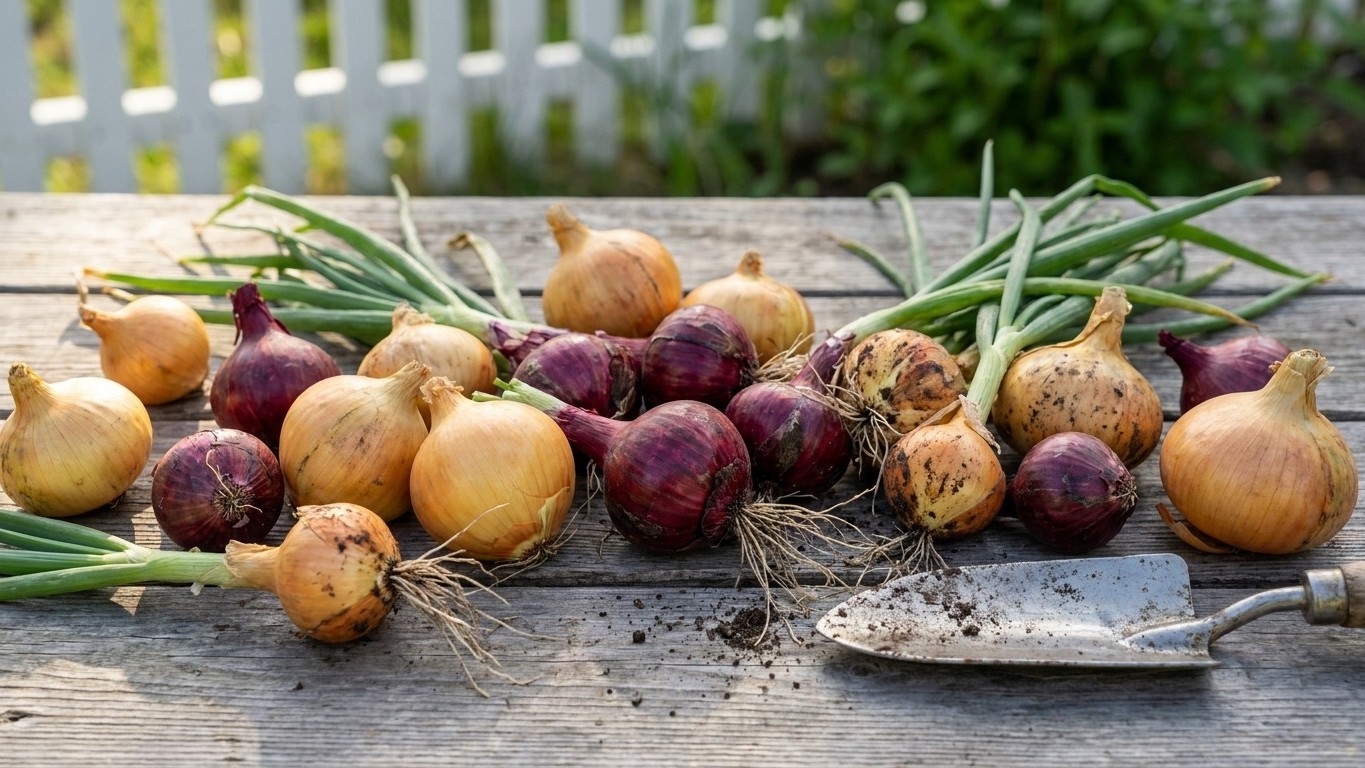

Lift onions in New Jersey once most of the tops have flopped over and the necks have gone soft. Pull them on a dry day, then cure them in a warm, dry, airy spot until the necks are tight and the skins papery. The harvest date comes from the plant, not the calendar. The rest of this page covers why that works here and what to do differently if you want onions that last.
The short answer for New Jersey
Newark sits at 40.68 degrees north, and on the longest day of the year it gets 14 h 55 of daylight. That number sets the whole schedule. An onion stops making leaves and starts swelling a bulb when day length crosses a threshold, regardless of how warm the soil is. Short-day types start at about 12 hours (a figure published by Clemson Cooperative Extension). Long-day types wait for 14 to 16 hours. At 14 h 55, New Jersey clears the long-day bar with room to spare, which is why the onions grown across New Jersey are mostly long-day and intermediate types.
Bulbing is the starting gun, but you do not lift at the starting gun. After the trigger, the plant spends weeks pushing sugars from the leaves into the bulb. Each leaf the plant has grown by then becomes a ring of the bulb, so a bigger plant makes a bigger onion. When that work is finished, the neck softens and the tops fall over on their own. In a typical New Jersey year that happens in the heat of summer, but the exact week moves with planting date and spring weather.
Tops down is your signal. Wait until most of the row has fallen, not just the early ones. Choose a dry spell, loosen the soil with a garden fork, and lift the bulbs rather than yanking by the tops, which bruises the neck. A bruised neck is an open door for rot in storage.
Curing is the step that turns a garden vegetable into a pantry vegetable. The outer skins dry to paper, the neck seals shut, and the bulb closes itself off from the air. Spread the bulbs in a single layer with the tops still on, somewhere airy that rain cannot reach and the afternoon sun cannot cook them. A covered porch, a garage with the door open, or a shaded deck with a fan nearby all work. This page does not carry a day count for curing, because the time depends on the weather. The test is the neck: when it is tight and dry, with no give when you squeeze it, the bulb is ready.
What will not work here
Planting late does not delay the harvest, it shrinks it. Whatever size the plant has reached when day length triggers bulbing is the size of the bulb. An onion transplanted into a New Jersey bed after a cold, wet spring has fewer leaves when the trigger arrives, so it forms fewer rings and ends up small. No amount of summer fertilizer rescues it, because the plant is already switching from leaves to bulb.
Storage has its own list of mistakes. Each of these is common in New Jersey gardens, and each ends the same way, with soft bulbs by midwinter:
- Short-day varieties grown for storage. They begin bulbing at about 12 hours of daylight, far earlier than Newark’s 14 h 55 peak, so in a northern bed they bulb on a small plant and stay small.
- Long-day varieties given a late start. They will bulb in New Jersey, but a plant set out late has few leaves when the trigger comes, and the bulb is small.
- Sweet onions meant to last the winter. They carry fewer of the sulfur compounds that protect a bulb, so they soften and sprout well before spring.
- Bulbs stored straight from the ground. Uncured necks are still open and moist, and that is where rot enters.
- A damp cellar shared with carrots. Root vegetables want humid air and onions want dry air, and one basement corner cannot satisfy both.
The last item deserves a second look. Clemson Extension states it plainly: “Ideal conditions are between 45 °F and 55 °F, and 50 to 60 percent humidity” (Clemson Cooperative Extension, Home & Garden Information Center). Many New Jersey basements run damper than that in summer, so a cheap hygrometer tells you more than guessing does. If the basement is too humid, a cool, dry closet or a ventilated spot in an unheated room will do better than the cellar.
Sorting matters too. Bulbs with a thick, green, stubborn neck, or with nicks and soft spots, will not keep. Eat those first. Damage from insects is a common cause of soft spots, and what eats onion in New Jersey, and when explains which pests leave which marks.
What changes across New Jersey
All the figures on this page come from Newark. New Jersey runs from High Point in the northwest down to Cape May at the southern tip, and day length shifts along the way. The farther north you garden, the longer the longest day, and the farther south, the shorter. A reader in Sussex County gets slightly more than 14 h 55, while a reader near Cape May gets slightly less. Exact figures for your town are not published here. Look up your own latitude and compare it with Newark’s.
| Where you garden | Latitude | Longest day | What it changes |
|---|---|---|---|
| Far northern New Jersey | North of 40.68 degrees | A little over 14 h 55 | Long-day types bulb with room to spare; the case for long-keeping onions is strongest |
| Newark (reference city) | 40.68 degrees north | 14 h 55 | Long-day and intermediate types bulb; this is the baseline for this page |
| Far southern New Jersey | South of 40.68 degrees | A little under 14 h 55 | Still above the 12-hour short-day trigger; bulbing comes a bit earlier and the gap to the long-day range narrows |
None of this moves a southern New Jersey garden out of the state’s group. It does mean your harvest may start earlier than a Sussex County neighbor’s, and that a variety rated for one end of the state may behave differently at the other. The best onion varieties for New Jersey are matched to day length for exactly this reason, so check the variety’s day-length class before you buy.
Sweet now, or onions that last
The trade is built into the onion. University of Missouri Extension puts it this way in its onion guide (G6355): “As a rule, ‘sweet’ onions do not store as well as the more pungent types.” The bite of an onion comes from volatile sulfur compounds. Those same compounds help protect the bulb while it sits in storage. A sweet onion has fewer of them, which is why it tastes gentle raw and why it will not last the winter. Calling a variety “mild” hides the mechanism, but the mechanism is what predicts your pantry.
Day length lines up with this. Short-day types run sweeter and long-day types keep longer. A garden in the warm south of the country gets onions to eat soon. A northern garden gets onions that feed you into March. New Jersey sits between those poles, and what you grow decides which side you land on. If you plant sweet types, treat them as a summer and early fall crop and eat them first. If you plant pungent types, you can stretch your harvest much further.
Picture the pantry in March. With pungent, well-cured bulbs held cool and dry, you still have firm onions with tight skins, some starting to sprout a green tip in the warmest corner. With sweet bulbs, the basket has been empty for weeks, or what remains is soft at the neck and ready for the compost. Never count on a sweet onion that stores, because no gardener has found a way to promise one. If you want both, plant a few of each and label the baskets, so the sweet ones get eaten while they are at their best.
Checking this against your own garden
Newark’s numbers are a reference, not a rule for every bed in the state. Spend a weekend confirming what applies to your yard. A state-wide figure is only an average, and your own latitude, microclimate and frost dates decide what actually happens in your rows. The Rutgers Cooperative Extension office in your county is the best place to get local answers, and its staff know what the season looked like in your part of New Jersey. Frost dates are not published on this page, so take them from the extension office.
- Find your latitude with any map app and compare it with 40.68 degrees north.
- Look up sunrise and sunset for the June solstice at your town and work out your longest day.
- Ask your county extension office for your average first and last frost dates.
- Read the day-length class on the label of every onion you grow.
- Put a hygrometer and thermometer in your intended storage spot and see how close it comes to 45 °F to 55 °F and 50 to 60 percent humidity.
- Write down the week your tops fell this year, so next year’s harvest has a baseline.
Common questions
Should I bend the tops over to speed things up?
Let them fall on their own. Bending green tops early stops the plant from sending its last sugars into the bulb, and you lose size. If the tops have fallen and yellowed naturally, the bulb has finished its work.
How do I know curing is finished?
Squeeze the neck. If it is tight, dry and papery, with no soft or moist feeling, the bulb is cured. The outer skins should rustle and the roots should be hard and brittle. Do not go by a date, since the time depends on the weather.
Can I store sweet onions through the winter?
Not reliably. Fewer sulfur compounds means less protection, so sweet types soften and sprout well before pungent ones. Eat them first and save the pungent bulbs for late winter.
What do I do with onions that have thick necks or bruises?
Use them right away. A thick, green neck stays open and moist, and a bruise gives rot a way in. One bad bulb can spoil its neighbors, so sort before you store and check the basket every couple of weeks.