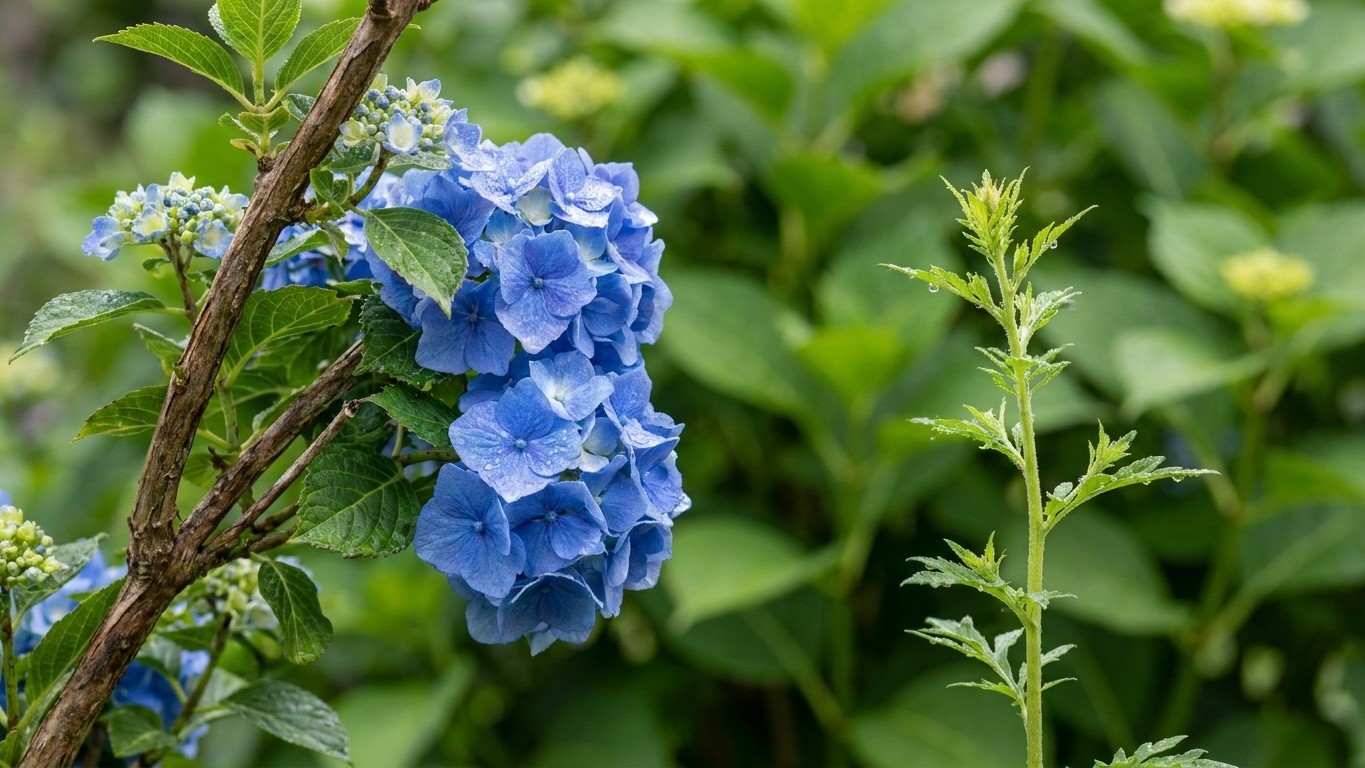

Most New Jersey gardeners set hydrangeas in the ground in April or early October, using nursery plants rather than seed. The Newark airport reference station puts the last spring freeze between March 29 and April 6, and most yards run a week or two later. Choose the species by what wood it blooms on, not by the flower photo. Panicle and smooth types bloom on new growth and shrug off a hard winter. Bigleaf types can lose their buds.
When to plant Hydrangeas in New Jersey
The reference figure comes from the NOAA NCEI U.S. Climate Normals for 1991-2020, measured at the airport weather station in Newark. It gives a last spring frost window of March 29 to April 6 (the 30-70% probability band for a 32F freeze). Treat that as the reference-city number, not a state-wide guarantee. Northern and higher-elevation parts of the state run later. Suburban and rural gardens typically see the last frost one to two weeks after the airport does, so a planning range of roughly April 5 to April 20 is safer for the average yard. Your county’s own pattern beats any single station.
Hydrangeas are shrubs, so the usual vegetable-garden rhythm of “start seed, harden off, plant out” only partly applies. The planting window is wider than for tomatoes, but tender new leaves on a plant that has already broken dormancy can still be burned by a late freeze. Plant after your local frost date, or keep a bedsheet or row cover handy for any night that dips close to freezing.
Seed, cuttings and nursery plants
Skip seed. Hydrangeas grown from seed rarely match the parent plant, and they take years to bloom. The practical starting points are a container shrub from a nursery or a cutting rooted from a plant you already own. A greenhouse-grown shrub arrives with soft, protected growth, and it needs hardening off before it goes into open ground. Give it seven to ten days. Start with a shady spot, move to two hours of morning sun, and add an hour or two each day. Bring it indoors if frost is forecast.
The count-back arithmetic is simple. Subtract ten days from your planting date. If you plant on April 6 (the late end of the airport window), start hardening off on March 27. If your yard runs two weeks later and you plant April 20, start on April 10. For more on the plant itself, see How to Grow Hydrangeas: The Complete Guide.
The fall window
Early fall is the better season for many shrubs. Soil is still warm, air is cooler, and the plant doesn’t face a July heat wave in its first month. The airport reference gives a first fall frost between November 4 and November 16. Count back four weeks of root-growing time and you land on October 7 to October 19. Colder inland gardens, where frost arrives one to two weeks earlier, should aim for late September to the first days of October. Reading this in mid-October, you are still inside the window near the coast and probably at its edge inland. Water the new plant until the ground freezes, then mulch.
Soil and site preparation
Light decides more than almost anything. Bigleaf and oakleaf hydrangeas do best with morning sun and shade from the hottest afternoon hours. Smooth hydrangeas like ‘Annabelle’ accept part shade. Panicle types tolerate full sun if the soil holds moisture. Plant a bigleaf on a hot, west-facing wall and you will spend summer watching it wilt at 3 p.m.
Texture and drainage come next. Hydrangeas want moisture-retentive soil that never sits waterlogged. Dig a hole about a foot deep, fill it with water, and let it drain. Fill it again the next day. If water is still standing after several hours the second time, raise the bed or choose another spot. Sandy ground, which is common in parts of South Jersey, drains fast and needs organic matter to hold water. Heavy clay, more typical in parts of the north, holds water and needs organic matter to open up. Both respond to the same fix: compost.
Timing matters more than most people expect. Work the amendments in four weeks before planting, or in fall for a spring planting. Spread two to three inches of compost over the bed and mix it into the top eight to ten inches. Do the same with any pH correction. Lime and sulfur both act slowly, which is the reason to test the soil in fall rather than the week the shrub arrives. A pH reading also tells you what bloom color to expect from a bigleaf (more on that below).
On planting day, dig the hole about twice as wide as the root ball and no deeper. Set the top of the root ball level with the soil surface, loosen circling roots, backfill with the native soil, and water in slowly. Spacing should follow mature size, not nursery pot size. Allow four to six feet for most bigleaf types and six to eight feet for large panicles. Crowding invites mildew and pruning headaches.
Varieties that suit New Jersey
The state’s real hydrangea problem is winter, not season length. A mild January followed by a hard April freeze can kill the flower buds that bigleaf types set the previous summer. Four traits do the work in this climate: which wood the plant blooms on, cold tolerance, sun tolerance, and how upright the stems stay in heavy rain.
| Type | Blooms on | Light | Good for |
|---|---|---|---|
| Smooth (Hydrangea arborescens), such as ‘Annabelle’ and ‘Incrediball’ | New wood | Part shade to sun | Reliable flowers after any winter; ‘Incrediball’ was bred for stronger stems |
| Panicle (H. paniculata), such as ‘Limelight’, ‘Little Lime’ and ‘Bobo’ | New wood | Sun to part shade | Hot, sunny sites; compact forms for small yards |
| Bigleaf (H. macrophylla), including reblooming lines such as Endless Summer | Old wood (reblooming lines also on new) | Morning sun, afternoon shade | Blue or pink flowers; best near the coast or in protected spots |
| Oakleaf (H. quercifolia), such as ‘Snow Queen’ | Old wood | Part shade | Fall leaf color, peeling bark, dry shade |
If you want the lowest-risk choice, plant a smooth or panicle type. Both flower from stems grown this season, so a bad winter changes the plant’s size rather than its bloom. Reblooming bigleaf lines set flowers on both old and new wood, which softens the damage after a freeze, though the first flush is usually the best. Colder states face the same trade-off: Growing Hydrangeas in New York: Types, Colour and Winter covers it for the upstate side, and Growing Hydrangeas in Alberta: Types, Colour and Winter shows how far the logic stretches in a much harsher climate.
Color is a soil decision
Only bigleaf hydrangeas shift between pink and blue. Blue flowers need acidic soil, roughly pH 5.5 or lower, where aluminum is available to the plant. Pink comes with soil near pH 6.5 or higher. In between you get purples and mixed heads. White varieties do not respond. The pink that develops on panicle flowers in late summer is aging, not soil chemistry. Test before you amend, because adding aluminum sulfate to the wrong soil can stress roots.
What to plant alongside
The pairings that genuinely help are about layering and shade. Hostas, ferns, astilbe and heuchera cover the bare soil under a hydrangea, which cuts evaporation and weed pressure. Hellebores and spring bulbs fill the gap before the shrub leafs out. Azaleas and rhododendrons share the same preference for acidic, moist, well-drained soil, so they fall into one watering and pH routine. Tall deep-rooted trees such as oaks cast the dappled afternoon shade that bigleaf types appreciate.
On pollinators, be specific. Panicle, smooth and lacecap flowers carry small fertile blossoms that bees visit. The big mophead heads are mostly sterile showy sepals with little to offer. If bees matter to you, plant lacecaps or panicles and add summer flowers nearby, such as bee balm or coneflower, to extend the season.
Competitors are easier to spot. Shallow-rooted trees, Norway maples above all, strip the top six inches of soil of water and nutrients. A hydrangea planted in that root zone will wilt even with regular watering. Turf grass right up to the stem competes too, so keep a mulched ring around the shrub. Roses planted close enough to crowd the airflow help powdery mildew along, though the mildew species are host-specific and do not jump between the two plants.
Some claims have no real evidence behind them. A ring of marigolds, garlic or chives is often said to protect shrubs from insects. Those stories rest on anecdote, and I know of no controlled tests showing a companion plant keeps pests off a hydrangea. Plant them if you like them. Do not count on them for protection.
Watering, feeding and support
The name says it: hydra is water. New plants need a deep soak two or three times a week for the first season, less often once rain picks up. Aim for about an inch of water a week for established shrubs in summer, delivered in one or two long soaks rather than daily sprinkles. Check by pushing a finger two inches into the soil. Afternoon wilt that perks up by evening is the plant managing heat. Wilt that persists the next morning means dry soil.
Mulch holds the moisture in. Lay two to three inches of shredded bark or leaf mold over the root zone, and pull it back from the stems so the crown stays dry. Refresh it each spring.
Feed lightly. One application of a slow-release, balanced fertilizer in spring, once new leaves open, is usually enough, and compost does part of the job for free. Heavy nitrogen produces big leaves and few flowers. Stop feeding by midsummer, because late growth is soft and vulnerable to the first cold snap.
Support is a stem-strength question. ‘Annabelle’ is the classic flopper, with huge heads on slender stems that bow after rain. A peony ring set early in spring lets the stems grow through it. Newer smooth selections and most panicles hold their heads without help, which is part of the reason they are popular.
Pruning follows the bloom wood. Smooth and panicle types flower on new growth, so cut them back in late winter or early spring before growth starts. Bigleaf and oakleaf types flower on old wood, so prune only right after bloom, and never later than August, or you remove next year’s flowers. Bigleaf and smooth hydrangeas also spread by suckers. Dig the extras in spring and pot them up, or leave them if you want a fuller shrub.
Common problems
Few blooms top the list. A bigleaf with healthy leaves and no flowers has usually lost its buds to winter or been pruned at the wrong time. Too much shade and too much nitrogen cause it too. Check which type you have before blaming the soil.
Leaf spots show up as brown patches with purplish edges, most often in humid, wet summers. They come from fungi and mostly look bad rather than kill the plant. Water at the base, thin crowded stems, and rake up fallen leaves in fall. Powdery mildew leaves a white coating on leaves in late summer, especially in shade with poor airflow. Better spacing is the practical fix.
Yellow leaves with green veins signal iron chlorosis, which usually means the soil pH is too high for the plant to take up iron. A soil test confirms it. Brown, crisp leaf edges after a hot spell are scorch, which means the plant lost water faster than it could replace it. Deeper watering and mulch help.
Wilted plants with moist soil deserve a closer look. Roots sitting in saturated ground cannot take up water, and the plant wilts for the opposite reason from drought. Improve drainage before adding more water. Last, if stems and buds disappear overnight, check for browsing animals. Where deer are present they chew new growth and flower buds, and a fence or repellent routine has to start before the buds form.
Pests that actually show up in New Jersey
The Rutgers NJAES fact sheet FS1123 lists the insects the extension highlights for home gardens, and it is written around vegetables. Only one entry on it is a serious concern for woody ornamentals: the spotted lanternfly (Lycorma delicatula). Pressure varies within the state, and your county office can identify what you find.
Spotted lanternfly
What you see first depends on the month. Nymphs hatch in mid-May, small and black with white spots, clustering on stems and leaves. Adults arrive from late July and stay until frost, with gray-and-red wings that flash when they jump. Heavy feeding leaves sticky honeydew on leaves and the ground, which turns into black sooty mold, and it draws wasps and ants. The one control that works at home is physical: squash or scrape them off by hand while they are still slow, and scrape egg masses off bark and nearby surfaces in winter. For small shrubs this is enough.
The vegetable-garden beetles
The rest of the list covers insects aimed at specific crops. Cucumber beetles emerge in early May above 60F, with a second generation in midsummer. Bean leaf beetles appear from mid-May to early June. Colorado potato beetle adults show up in early spring, with a second generation in late summer. The hornworms attack tomatoes, and the asparagus beetles and Mexican bean beetle go for their namesake plants. Hydrangeas are not their targets, and I would not spray a hydrangea for any of them. A stray beetle on a bloom is most likely a visitor from a nearby vegetable bed. The place to act is that bed, using the timing above.
Harvest and end of season
Cutting hydrangeas for a vase works best in the morning, with a clean cut at a leaf node and the stems plunged straight into water. Fresh blooms last longest when the flower head is fully open and the florets feel firm. For drying, wait until late summer or early fall, when the sepals turn papery and take on a slightly antiqued color, then cut and hang them upside down in a dry, shaded spot. Heads cut too early shrivel.
Leave some spent flowers on the plant. Dried heads add winter structure, and on bigleaf types they help protect the buds below. Hold off on fall pruning for old-wood bloomers.
The first fall frost at the airport reference falls between November 4 and November 16, with inland gardens often seeing it one to two weeks sooner. Before then, finish watering deeply, because dry roots go into winter stressed. After leaf drop, add a fresh layer of mulch. For bigleaf types in exposed spots, build a cage of chicken wire around the shrub and fill it with dry leaves. Northern New Jersey gardeners in colder pockets should lean harder on this step. More New Jersey guides cover the other seasonal chores.
Local help
County dates and soil results beat any state average. Rutgers NJAES Cooperative Extension runs county offices that offer soil testing, pest identification and local planting advice. Send a sample in fall, and you will have a pH reading and amendment advice before spring planting.
Common questions
What is the best month to plant hydrangeas in New Jersey?
April and early October both work. Spring planting follows your local last frost, which runs from about April 5 to April 20 in an average yard once you add the one-to-two-week delay to the airport window. Fall planting works best when it leaves about four weeks of root growth before the first freeze.
Why won’t my hydrangea bloom?
Most often it’s a bigleaf or oakleaf that lost its buds to winter, or was pruned after midsummer. Heavy shade and excess nitrogen are the other usual causes. Switching to a panicle or smooth type removes the winter-bud problem.
How do I turn pink hydrangeas blue?
You need a bigleaf hydrangea and acidic soil near pH 5.5 or lower, with aluminum available. Test the soil first, then adjust slowly. Changes take a full season or more, and white varieties will not change at all.
Should I cut hydrangeas back in fall?
Not as a rule. Smooth and panicle types can wait for late winter. Bigleaf and oakleaf types bloom on old wood, so fall cutting removes next summer’s flowers.
Is the airport frost window a guarantee?
No. The window covers the 30-70% probability band for a 32F freeze, so in some years frost still arrives after the later date, and in others the last freeze is already behind you before the earlier date. Watch the forecast through mid-April rather than treating a calendar date as safe.