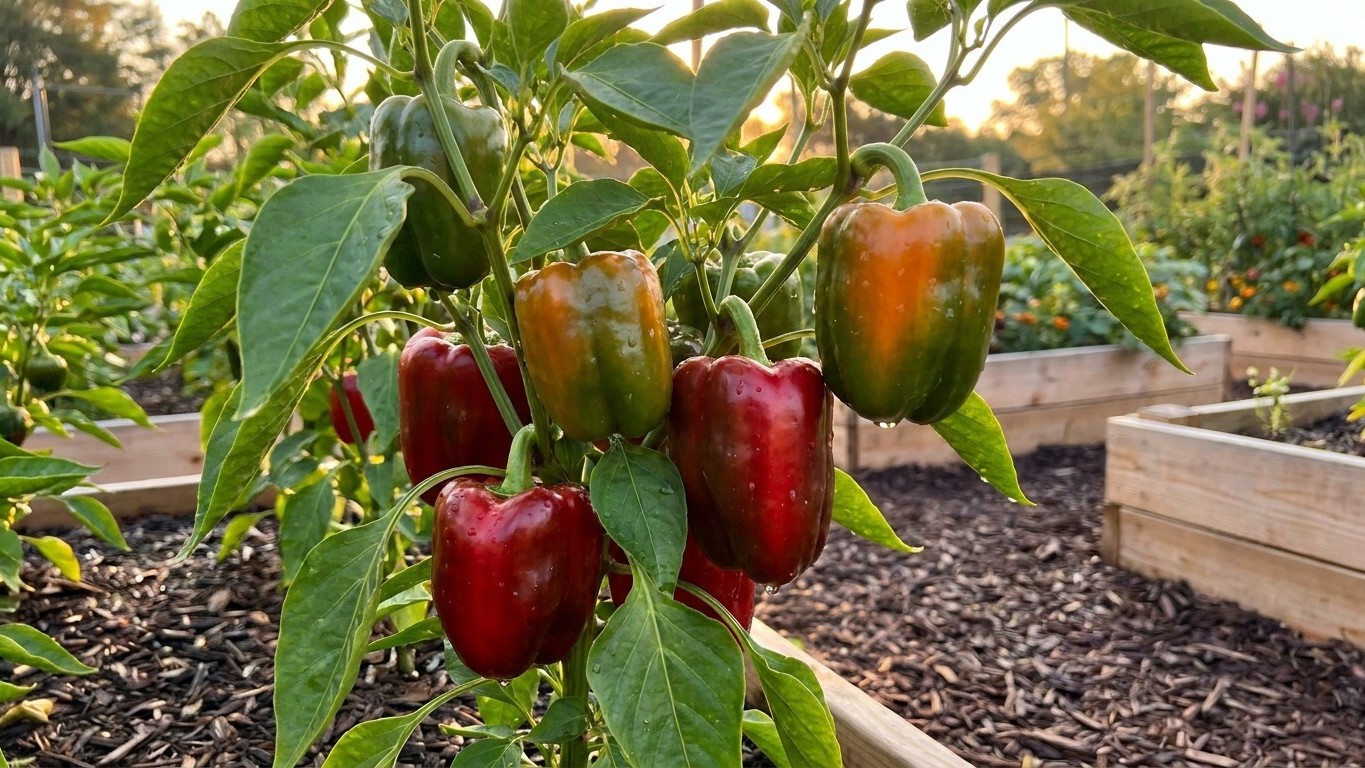

Pick peppers once the fruit has reached full size and feels firm, which Clemson Extension puts at about 70 to 85 days after transplanting. Then keep them out of the refrigerator. Clemson’s storage range is 45 to 50 °F, and a household fridge runs colder than that, so peppers left in it pit and go soft. In Louisiana the timing question is mostly a heat question: the New Orleans reference station averages 70.7 days a year at 90 F or more.
The short answer
That 70.7 comes from NOAA NCEI climate normals, and it is a mean count of days a year reaching 90 F or more at the reference station. It measures summer heat load, not average summer temperature. Utah State University Extension says pepper fruit set fails when days climb above 90 F. Set those two facts side by side and the picture is plain: a long stretch of the Louisiana year sits in the zone where blossoms may drop instead of turning into peppers. The count is an average over many years, so some summers run hotter and some milder, and it comes from one station, so the northern part of the state will read differently.
The failure runs the other way too. The same Utah State source says fruit set also fails when nights fall below 55 F. This site does not carry summer night minima, so there is no number here to tell you how often your nights dip under that line. Watch your own. A cheap min/max thermometer set at plant height, checked each morning during bloom, answers the question better than any regional guess would. Latitude and the coldest month of the year tell you nothing reliable about a July or September night, so don’t lean on either.
Picking and storing
Harvest timing starts with the calendar and ends with the fruit. Clemson Extension says peppers should be ready about 70 to 85 days after transplanting. That clock starts when the seedling goes into the ground, not when the seed went into the tray. Day counts only mean something once you know where they begin: a shorter count of 35 to 45 days, where you see one, runs from flowering. Use the dates as a window, then judge by the fruit itself. It should be full-sized for its type, firm, and glossy. Pick with pruners or a sharp snip, leaving a short stub of stem, because pulling can tear the branch.
Storage is where most people undo their own work. Clemson’s guidance for the best keeping is 45 to 50 °F and 80 to 90 percent relative humidity, for two to three weeks. Read that as a ceiling under ideal conditions, not a promise. A domestic refrigerator is colder than that range, and below about 45 °F peppers develop pitting and soften, a problem called chilling injury. The crisper drawer feels like the right place and is the wrong one. If you have no spot in the 45 to 50 °F range, eat the peppers soon, or freeze, dry, or pickle them rather than parking them in the cold for weeks.
When to start seed here
Louisiana does not run on a normal planting calendar. South Louisiana barely freezes. At the New Orleans station, the last spring frost falls between January 18 and February 8 (NOAA NCEI, 30 to 70 percent probability band), and a 32 F freeze shows up in only 86.8 percent of years. Roughly one year in seven has no freeze at all, and the freeze season straddles the New Year. North Louisiana freezes far more reliably, so its dates run later. Frost is not what limits you here. Summer heat is. The data is on the NOAA NCEI normals file for the reference station, but your own county is what counts, so do the arithmetic yourself:
- Find your county’s last spring frost date. In south Louisiana expect something near the late January to early February window above, and later as you move north.
- Wait for the soil. Utah State Extension says to transplant when the soil reaches 60 F, after frost. Push a soil thermometer a few inches down in the morning and take the reading, not the date on the calendar. In a year with no freeze, the soil is still the gate.
- Pick your transplant day, the first day both conditions hold. As an illustration only, suppose that day is March 1. That is a made-up date to show the method, not a Louisiana recommendation.
- Count back 8 to 10 weeks, the indoor time the same Utah State source calls for. Eight weeks before March 1 is about January 4, and ten weeks is about December 21. So seed goes in the tray between roughly December 21 and January 4.
- Count forward to check your harvest. Using Clemson’s 70 to 85 days after transplanting, a March 1 transplant gives roughly May 10 to May 25 for first picking.
- Hold that harvest window against the summer heat. If the picking window runs into weeks of days at 90 F or more, blossoms set during that stretch may drop, so earlier transplanting, where the soil allows it, buys more time before the heat arrives.
Redo steps one through five with your own numbers. If your soil reaches 60 F on April 1, everything slides a month later, and the heat window moves closer to the fruiting window. That is the trade-off in this state. The earlier plants get a head start on heat but need protection from a late chill, and the later plants dodge the cold but flower into the hottest stretch. The Growing Peppers in Louisiana guide covers site selection and varieties, and the Why Peppers Fail to Set Fruit in Louisiana page goes deeper on the bloom stage.
What goes wrong here
The climate causes a short list of repeat failures. Most are fixable once you can name them.
- Blossom drop in a hot spell or a cool night. Flowers fall off without making fruit when days top 90 F or nights sink below 55 F. With 70.7 days a year at 90 F or more at the reference station, the hot version is the one to expect. Remedy: keep moisture steady, use mulch to hold the root zone cooler, and consider 30 to 40 percent shade cloth over the plants during the worst heat. Don’t strip off the dropped blooms in a panic; new ones follow when conditions ease. For the cool end, check your own nights with a min/max thermometer and cover plants on nights that threaten to fall under 55 F. The site doesn’t carry those numbers for you.
- Sunscald on the fruit. Strong sun bleaches pale, papery patches on the shoulder of the pepper, and those patches sink and invite rot. It often follows a heavy pruning, a disease that strips leaves, or a stretch of gaps in the canopy. Remedy: let the foliage cover the fruit, skip any leaf stripping, and give afternoon shade with cloth if the plant has thin cover. Pick scalded fruit early and cut the damaged spot away before cooking.
- Blossom-end rot. A dark, leathery, sunken patch on the bottom of the pepper, opposite the stem, is a calcium delivery problem, and uneven watering is the usual trigger. A plant swinging between soaked and bone-dry cannot move calcium into the fruit well, even in soil that holds plenty. Remedy: water deeply and regularly, mulch to even out moisture, and avoid heavy nitrogen feeding that pushes leaf over fruit. Remove affected peppers so the plant puts energy into healthy ones; the next ones often come clean once watering steadies.
- Chilling injury after picking. This one happens after the garden is done. Peppers held below about 45 °F develop pits and soft spots, and the fridge is the usual cause. Remedy: store at 45 to 50 °F with 80 to 90 percent humidity if you can, expect two to three weeks at most, and move anything you can’t keep right into the freezer or a pickling jar.
Insects can ruin a crop that survived all of the above, and the timing is predictable. The What Eats Pepper in Louisiana, and When page lays out who shows up and in which weeks.
Common questions
How many days after transplanting are peppers ready?
Clemson Extension says about 70 to 85 days after transplanting. That is a window, not a deadline, and the real signal is fruit that has reached full size for its type and feels firm. Count from the day the seedling goes in the ground, not the day you sowed seed.
Can I put picked peppers in the refrigerator?
It is the mistake almost everyone makes. Ideal storage is 45 to 50 °F with 80 to 90 percent relative humidity, which is warmer than a domestic refrigerator. Below about 45 °F peppers pit and soften from chilling injury. If the fridge is your only option, keep the stay short, and freeze or pickle whatever you can’t use quickly.
How long will peppers keep in the right conditions?
Clemson gives two to three weeks at 45 to 50 °F and 80 to 90 percent humidity. Treat that as the maximum under optimal conditions. Fruit that was already stressed, scalded, or picked late will keep for less, and a warmer spot such as the kitchen counter shortens the clock further.
How do I know if my nights are too cool for fruit set?
Measure them. Utah State Extension names nights below 55 F as one end where fruit set fails, but this site doesn’t carry summer night minima, so there is no figure here to apply to your yard. A min/max thermometer near the plants, read each morning through the bloom period, tells you whether cool nights are a problem in your garden. Don’t guess from latitude or from how cold the winter gets.