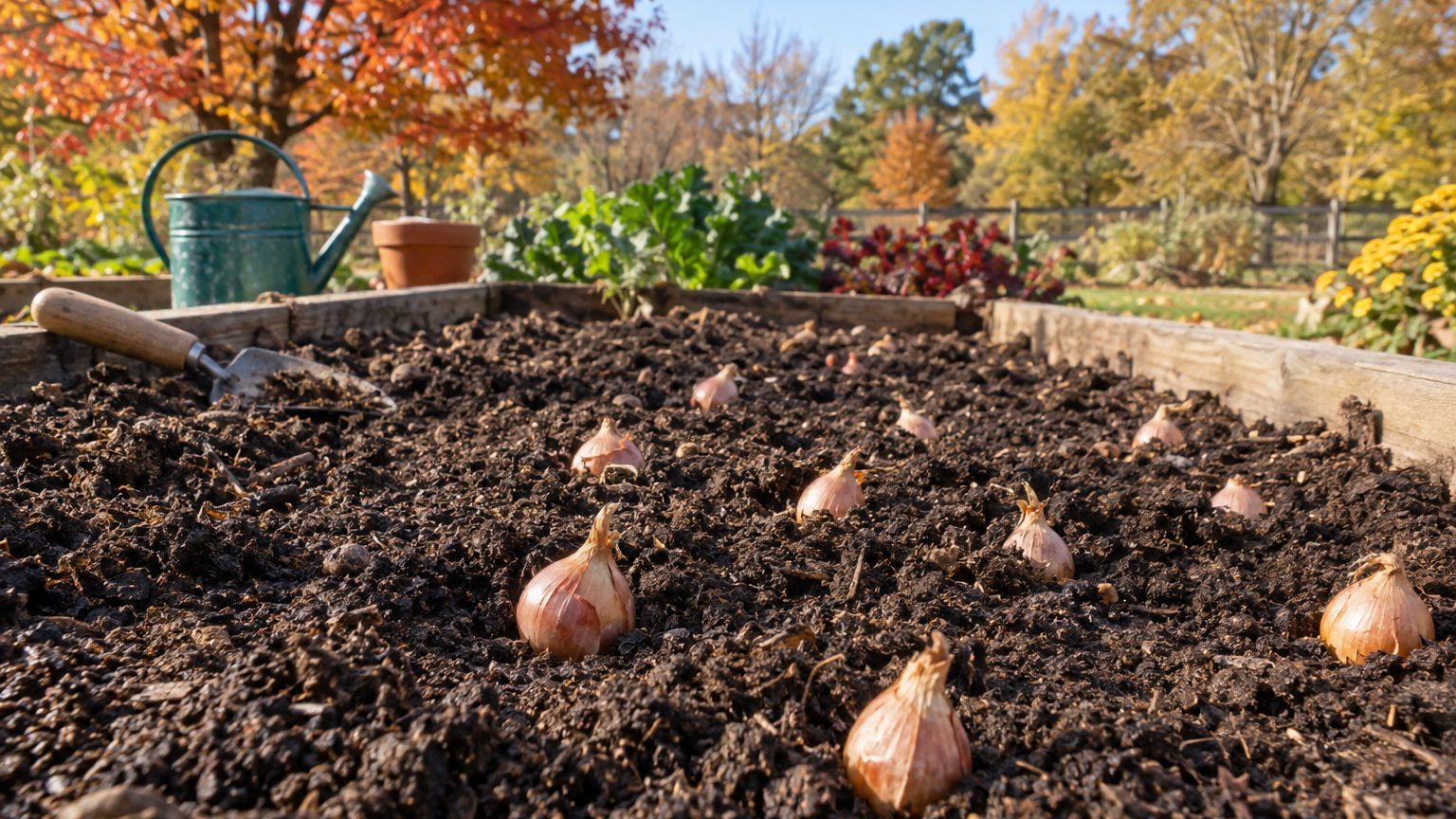

In the Houston area, plant shallots in autumn, with sets in the ground before the first fall frost window opens on December 1. A late-winter planting, finished by the end of the spring frost window on March 1, is the fallback. Those dates belong to Houston, not to Texas as a whole. The state spans USDA zones 6a to 10a, and the Panhandle runs on a different calendar.
The short answer for Texas
The Gulf end of Texas has the longest shallot season in the state, and it opens in autumn. Sets planted before December 1 get weeks of mild weather to root and put up green tops before winter slows them. A planting after the last freeze is the second-best choice.
The frost dates need a careful reading. NOAA’s 1991-2020 Climate Normals for Houston Intercontinental (station IAH) give a last spring frost of February 4 to March 1 and a first fall frost of December 1 to December 19. Each is a probability band, not a promise. The figures come from the 30 to 70 percent probability range for a freeze at 32°F. In the spring, February 4 is when the odds of one more freeze drop to roughly three in ten. By March 1 they are about three in ten the other way around, meaning a freeze is still plausible earlier in the band and unlikely after it. A fall planting date is only as firm as that range, which is why December 1 is the line to beat, not the line to aim for.
Winter cold is not the problem for shallots here. The mean daily minimum of Houston’s coldest month is 43.7°F, a few degrees warmer than the inside of a refrigerator. Shallots tolerate light frost, and in this climate they spend the winter growing instead of sitting dormant. The deadline works from the other direction: the bulbs need cool weeks to build tops, and spring warmth arrives fast on the Gulf coast.
If you are still choosing what to plant, the variety decision matters as much as the date, and it is covered in The Best Shallots to Grow in Texas. For the broader picture of how shallots fit into a Texas garden, start with Growing Shallots in Texas.
What will not work here
A spring planting by northern rules fails first. Advice written for Minnesota says to set shallots out as soon as the soil can be worked, then harvest in late summer. In Houston, a set planted in March has maybe a few cool weeks before heat arrives. The plant gets little foliage, and the foliage is what sizes the bulb. The usual result is a small, thin-skinned bulb that never fattens.
Waiting on the calendar is the second trap. Because the coldest-month minimum averages 43.7°F, it is tempting to think winter is too mild to worry about and plant whenever. But the first fall frost band begins December 1, and a set tucked in during mid-December has barely rooted when the first real cold shows up. Late fall plantings do survive, but they trail the early ones all season.
Humidity is the third problem. The Gulf coast is wet through much of the cool season, and shallots clustered tightly in heavy clay stay damp around the base. That invites rot and fungal disease. Spacing that works in a dry climate is too tight here, and a raised bed or a well-drained row matters more than the date. If your yard holds water after a rain, fix that before worrying about timing.
Using the Houston window anywhere else is the fourth mistake, and probably the most common one. The facts behind this page are explicit: these figures describe the mild Gulf end of Texas. The Panhandle freezes months earlier in fall and months later in spring, so a gardener in Amarillo who follows a December 1 deadline will be planting into frozen ground. Even inside Houston, Hobby airport runs about two weeks milder than IAH, so a gardener near the south side may sit on the early edge of both bands.
What changes across Texas
Texas has no single shallot calendar, and the hardiness numbers show why. The USDA Plant Hardiness Zone Map 2023 (built on the 1991-2020 normals) places the state in zones 6a through 10a. That system rests on one variable, the average annual extreme minimum temperature, and it spans a gap of roughly 40°F between the coldest and warmest ends. This page’s frost data covers only the Houston reference station, so it cannot speak for the rest.
Gardeners at the cold end, mainly the Panhandle and the high plains, should shift everything toward a tighter season. Fall planting still works for hardy types, but it has to happen early enough for roots to establish before the ground freezes, and a heavy mulch matters. Many northern growers in colder zones plant in early spring instead, as soon as the soil is workable, and treat shallots as a spring crop with a summer harvest. That is the reverse of the Gulf pattern.
Hill Country and North Texas fall between the two. They get real winter freezes, so the fall deadline sits earlier than Houston’s December 1, though this page does not have a measured frost window for those regions and will not borrow one. Altitude also pulls the dates around. A garden on a hilltop can freeze a couple of weeks before one in a nearby valley.
To find your own zone, use the USDA Plant Hardiness Zone Map and enter your ZIP code instead of guessing from the state’s reputation. The map gives a zone for your location, and that zone tells you how far to move the Houston dates.
Where to check this for your own county
Your best source for local timing is Texas A&M AgriLife Extension, the state’s land-grant extension service. It has offices across the state, and the county agent or horticulture staff there know which crops perform in your soil and which dates have worked recently.
Look for two things. The first is a local planting calendar for bulb onions and shallots, written for your area and not for the state as a whole. The second is a list of varieties trialled in your county, because a shallot that performs in coastal humidity may not do well on the dry plains. Shallot day-length response and heat tolerance both vary, and county trial data tells you what actually produced.
A county recommendation beats a state one, and this page is the state one. The frost figures here come from a single Houston weather station, and they are a probability band, not a guarantee. If the extension office gives you a date that disagrees with this page, trust the extension office. The same goes for any online calendar, including this one, that was written for a different climate.
If you can’t reach the office, check for a planting guide on the AgriLife site for your region. Don’t assume a bulletin from another state applies. Calendars are written species by species and place by place.
Checking this against your own garden
Your own observations outrank every date on this page, because they show what your yard actually does. Three things are worth watching.
- Soil warmth by feel. In autumn, press your hand flat on the bed in the morning. If the soil still feels warm and dry, summer has not let go and sets can wait a little. If it feels cool and slightly damp, roots will establish. A bed that stays warm long after your neighbors’ is a sign of a sunny, sheltered microclimate.
- The first true leaves. After planting, note how many days it takes for green shoots to appear. Fast growth means your site is mild and well drained. Slow, uneven growth points to cold or wet soil, and next year you should plant earlier or raise the bed.
- Your own last frost. Frost on the lawn, car windshield or a tomato plant tells you more than any station thousands of yards away. Write down the date of the last frost you saw. After two or three years you have a personal frost window, and it may sit a week or two off from the published one.
Keep a few notes on when you planted, when tops came up and when they fell over at harvest. They are worth more than any state calendar.
Common questions
Can I plant shallots in spring in Texas?
In the Houston area, spring planting is a fallback, and it needs to be done after the Feb 4 to March 1 last spring frost window passes. The crop is usually smaller than a fall planting because heat arrives before the plants have grown much. Colder parts of the state, where spring is the normal planting season, are a different case.
Is December too late to plant shallots?
In Houston, December 1 is the start of the first fall frost window, which runs to December 19. Sets planted after that can still grow, but they get less time to root. Earlier is better. Elsewhere in Texas, December can be too late by a wide margin.
Do these dates apply to the Panhandle or North Texas?
No. The figures come from the Houston reference station and describe the mild Gulf end of the state. This page does not have a measured frost window for the Panhandle or North Texas, so check your local extension office.
Which Texas hardiness zone am I in?
That depends on your location, and the state covers zones 6a to 10a under the USDA Plant Hardiness Zone Map 2023. Look up your ZIP code on the USDA map and don’t rely on a guess.