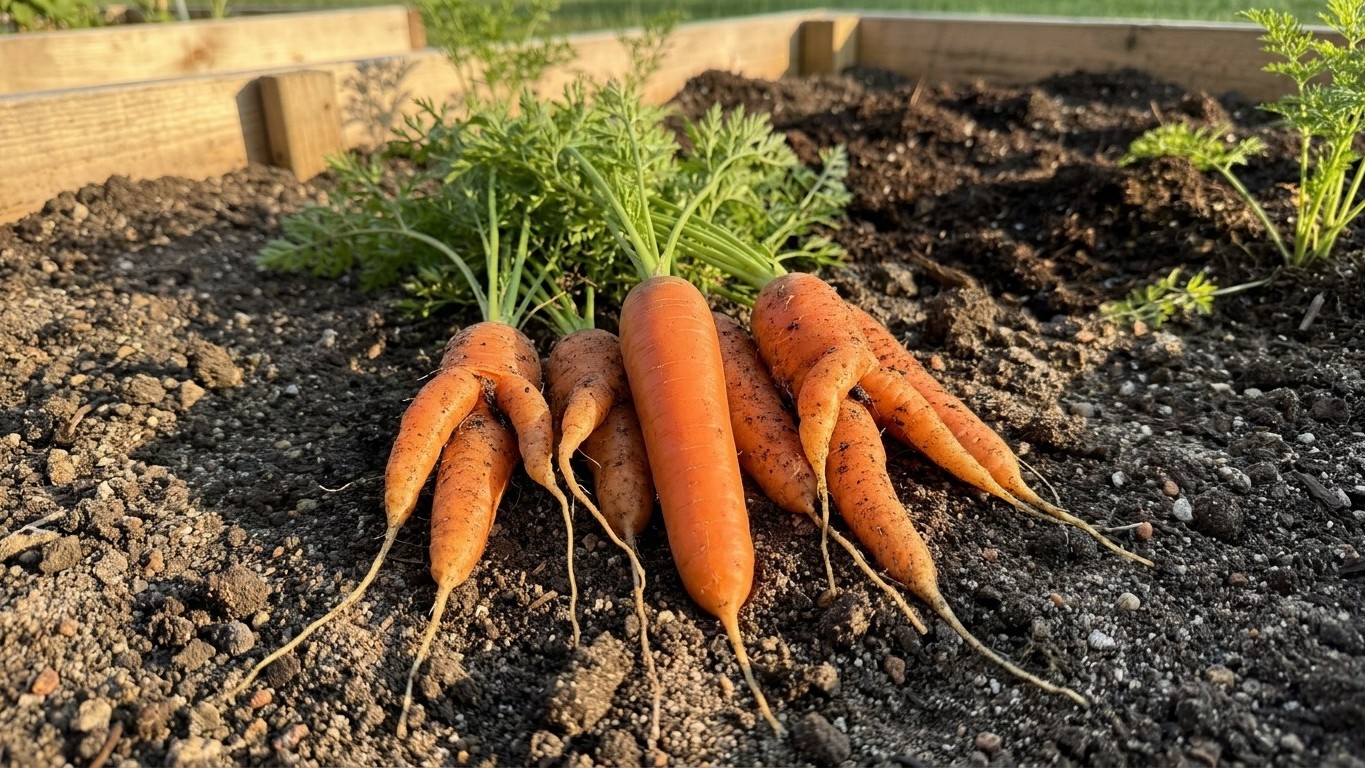

Count 70 to 100 days from the day the seed went into the ground. Carrots are sown in place, so there is no transplant date to start from. Pull one to check its size, then cut the tops off the moment the roots are out. Store them at 33 °F in high humidity. With the tops left on, they last about 10 to 14 days. Trimmed, they keep for months. British Columbia’s ground mostly cooperates, but not everywhere.
The short answer
Start with the dirt. The most common soil among the mapped farmland surfaces of British Columbia is a Brunisol, a young soil whose horizons are only beginning to separate, typical of recent or coarse parent material. It covers 33 percent of the mapped surface, with Podzolic soils next. The median surface layer is 52 percent sand, 10 percent clay and 38 percent silt, which puts it in the loam to silt range. Organic matter is about 5.0 percent, the median surface pH is about 5.8 (slightly acid), and the drainage class is well drained. These figures come from Agriculture and Agri-Food Canada’s Canadian Soil Information Service, drawn from 2,593 mapped soil components.
One caution comes before anything else. Canada has no official provincial soil the way each American state has a state soil, so this is the dominant profile of the province, not a single named series. British Columbia spans hundreds of soils, and the survey covers the agricultural regions, not the far north. River bottoms, muskeg and any lot a builder has scraped or filled can look nothing like this median. It is a starting point, not a diagnosis, and the pH above is the province’s, not yours.
Will a carrot fork in it?
Utah State University Extension says carrots want deep, sandy, well-drained soil rich in organic matter, and that heavy or rocky ground makes the root fork. Set that against the numbers. Ten percent clay is low, drainage is good, and organic matter is decent. On the median British Columbia profile, a carrot has no reason to fork from clay. The remaining risks are stones and compaction. Where your own ground is heavier, Extension’s answer is plenty of compost and double digging. Where drainage is poor, build a raised bed. A different variety does not fix a soil problem. For the longer version of this question, see Will Carrots Fork in British Columbia Soil?
Pulling and keeping
Clemson Cooperative Extension puts harvest at about 65 to 75 days after planting. Since carrots are never transplanted, read that as days from seeding. Seed packets often run longer, up to 100 days, so use the packet’s number as your own cue and pull one test root before you pull the row. This article does not publish a frost date for British Columbia. The coast and the interior differ too much for one date to mean anything, so check a local source before you plan a fall harvest.
For storage, Clemson says to hold carrots at 33 °F with high humidity to prevent wilting, and that bunched carrots (tops on) keep about 10 to 14 days. That 33 °F is just above freezing, which is much colder than a typical root cellar. Store carrots at 50 °F and they sprout and go soft in a fraction of the time. The tops are the catch. The leaves keep drawing moisture out of the root, which is why bunched carrots last days and trimmed ones last months. Cut the tops off first, then chill the roots.
The broader picture of the crop in the province sits in Growing Carrots in British Columbia.
The test that settles it in your own garden
The province’s median is a statistic, and your bed is a place. One afternoon with a spade tells you more about your carrots than any survey does. Do the steps below in the spot where the row will go.
- Dig a test hole. Go down as far as a full-length carrot would need, well past the loose top layer. Set the soil on a tarp so you can see how it layers.
- Look at the walls and the pile. Note how deep the dark, crumbly topsoil goes before it changes. Check for a hard layer, a color shift, or a wall of packed material where a builder may have compacted it. Count the stones. A root that meets a rock turns aside or splits, and a bed full of stones will produce a lot of crooked carrots.
- Feel the texture. Take a handful of moist soil and rub it between your fingers. Gritty means sand. Smooth and floury means silt. Sticky and slick means clay. Squeeze it into a ball and push it out with your thumb. If it holds a long, shiny ribbon, clay is in charge. If it crumbles at once, it is sandy. A ball that holds but breaks when poked is the loam you want.
- Watch it drain. Fill the hole with water and let it soak away, then fill it again. If the water drains away steadily, you have the well-drained ground carrots like. If the hole is still holding water when you come back later in the day, plan a raised bed, because heavy ground that stays wet is what produces forked roots.
- Send a sample for a real pH number. Your fingers cannot read acidity. A soil test will give you your own pH and organic matter, which this page does not know.
- Act on what you found. Loose and deep, sow. Heavy but draining, work in plenty of compost and double dig. Wet or stony, build up a raised bed with good soil and sieve out the rocks.
What goes wrong here
Even good ground has a bad season in it. These are the failures that British Columbia’s soil and weather cause most often, with the fix for each.
- Forked or twisted roots in heavy ground. Clay, compaction and stones push a root off its straight path. The remedy is plenty of compost and double digging, or a raised bed where the ground drains poorly. Pull stones out as you dig, since carrots are sown in place and cannot be moved once they start.
- Patchy germination in a hot spell. Carrot seed sits in the top of the soil, and a hot dry stretch can bake that layer before the seedlings break through. Keep the seedbed evenly moist, and lay a board or sheet of burlap over the row until you see sprouts, lifting it daily to check. Silty surfaces can crust over, so a light cover of fine compost helps shoots push through.
- Splitting from uneven water. A long dry stretch followed by a soaking rain makes roots swell faster than their skins can stretch, and they crack. Water on a steady schedule and mulch the row to even out the swings. The well-drained median soil of the province sheds water fast, so mulch matters even more here.
- Damage from pests mistaken for a soil problem. Tunnels, scarring and stunted roots are often something feeding on the crop, not a texture issue. What Eats Carrot in British Columbia, and When covers what to look for and the timing.
- Wilted, rubbery carrots in storage. The usual cause is tops left on. The leaves pull moisture out of the roots, so cut them off first. Then store at 33 °F in high humidity, the figures Clemson Cooperative Extension gives. A warmer spot invites sprouting and softening. A bunched carrot lasts about 10 to 14 days, and a trimmed one lasts months. The Clemson factsheet is at hgic.clemson.edu.
Common questions
How many days until I can pull carrots in British Columbia?
Count 70 to 100 days from seeding. Clemson Cooperative Extension gives about 65 to 75 days after planting, and since carrots are never transplanted, that count also starts at sowing. Your seed packet gives the number for your own seed. Pull one root to check before you lift the row.
Can I leave carrots in the ground, or should I pull them all at once?
The sources used here do not give a time limit for leaving them in the ground, and no frost date is published on this page. The safest approach is to pull the roots you plan to store before the ground locks up. Check a local source for dates in your part of the province.
What temperature should I store carrots at?
33 °F, with high humidity to prevent wilting, per Clemson Cooperative Extension. That is just above freezing, much colder than a typical cellar, and a warmer spot at around 50 °F leads to sprouting and softening much sooner.
Why do I have to cut the tops off before storing?
The leaves keep drawing moisture out of the root. That is why bunched carrots (tops on) keep only about 10 to 14 days, while trimmed carrots keep for months. Cut the tops off right after you pull the roots, then chill them.