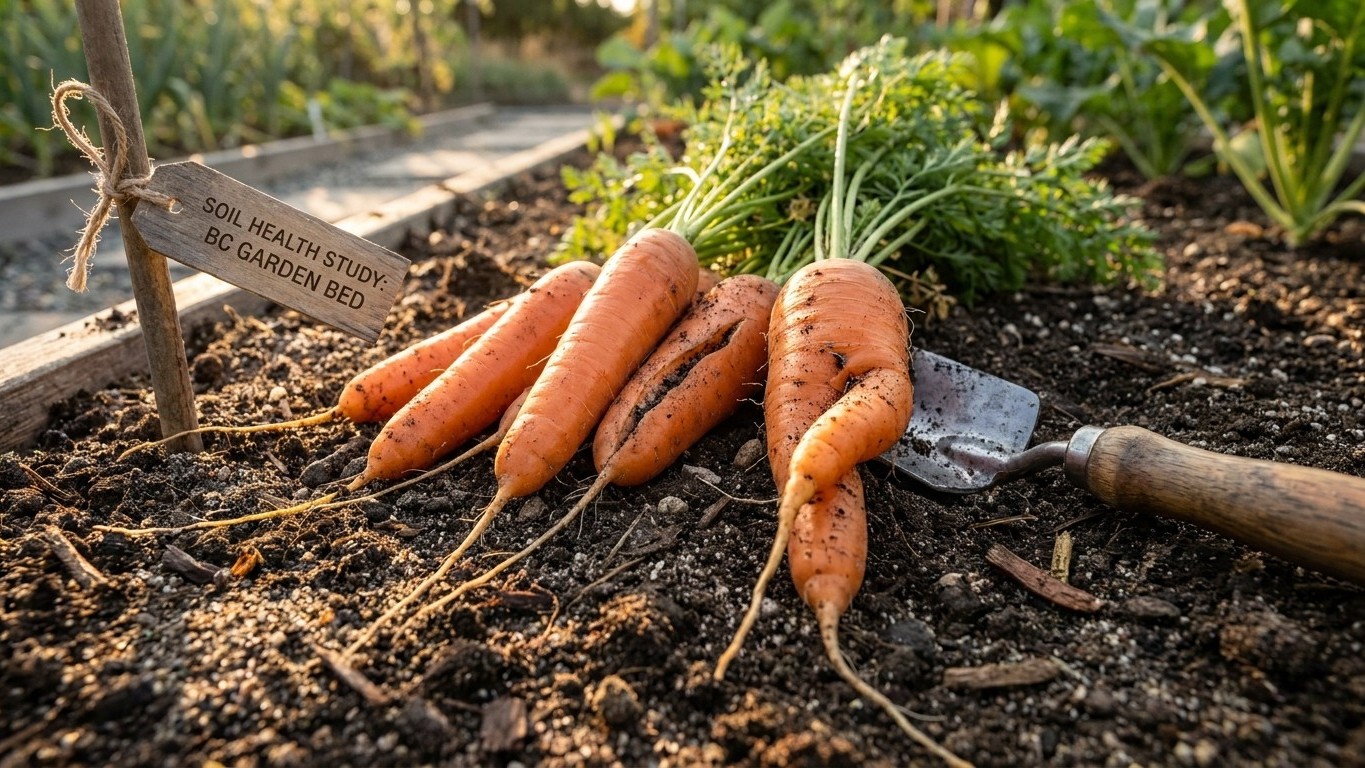

Most of British Columbia’s mapped agricultural soil leans loam to silt, with sand making up over half the mix and clay sitting under 15 percent. That’s a texture carrots generally tolerate without twisting into forked, split roots. But that’s a provincial average, not your backyard, and pockets of heavy or compacted ground still cause trouble no matter what the regional number says.
The short answer
British Columbia’s agricultural land is dominated by Brunisols, a young soil order where the horizons are still barely separating from each other, covering about 33 percent of the mapped surface (Podzolic soils come in second). The median surface reading across nearly 2,600 mapped soil components puts the texture at 52 percent sand, 10 percent clay and 38 percent silt, essentially a loam-to-silt blend. Organic matter runs around 5.0 percent, and drainage is classed as good across the province’s farmland, according to the Canadian Soil Information Service’s Soil Name and Soil Layer tables. Median pH sits at about 5.8, slightly on the acid side.
For a carrot, that combination is close to ideal on paper. Carrots want deep, sandy, well-drained soil rich in organic matter, and forking shows up when the ground is heavy or full of rock, according to Utah State University Extension. A root pushing through compacted clay or a stone splits and grows sideways looking for the path of least resistance. With sand as the majority texture and clay barely a tenth of the mix, most of the province’s farmed ground doesn’t hand a carrot that kind of obstacle course.
That said, “well drained” and “10 percent clay” describe a median, not your raised bed or your side yard. British Columbia spans a huge range of ground, from river-bottom silt in the Fraser Valley to thin, rocky soil on interior benches to fill dirt trucked in around a newer subdivision. The Canadian Soil Information Service data also only covers the province’s mapped agricultural regions, so the far north and remote backcountry aren’t represented in that median at all. A soil order name and a province-wide pH tell you what the region tends toward, not what’s under your own shovel.
If your garden runs heavier than that median, the fix isn’t a different carrot variety. Utah State University Extension is clear that heavy soil calls for plenty of compost worked in and double digging to break up the layers a taproot has to push through. Where the ground stays wet or compacted no matter how much you dig, building a raised bed with loose, amended soil sidesteps the problem outright, since you control the texture from the surface down instead of fighting whatever the yard gave you.
The test that settles it in your own garden
A province-wide soil order tells you the tendency. It doesn’t tell you what a carrot seed will hit six inches down in your specific bed. That takes a look at your own ground, and it takes about fifteen minutes with a shovel.
- Dig a hole at least a foot deep where you plan to sow. Carrots need that much clear depth to grow straight, so this is the first checkpoint, not an afterthought.
- Check for stones and hardpan as you go. A shovel that stops abruptly, or a layer of gravel and rock partway down, is exactly the obstruction that forks a root.
- Grab a handful of soil from the bottom of the hole and squeeze it. If it forms a slick, sticky ribbon between your fingers, you’re dealing with heavy clay. If it falls apart and feels gritty, you’re closer to the sandy loam the province’s median describes.
- Fill the hole with water and time how long it takes to drain. Water sitting for hours points to poor drainage and a soil that will stay soggy after rain, which sets up rot and splitting as much as it sets up forking.
- Repeat the dig in two or three spots around the bed. Soil can change texture within a few feet, especially near a foundation, a slope, or wherever fill dirt was brought in during construction.
None of this needs a lab. It needs your own eyes, your own hands and a willingness to dig a little deeper than you’d planned before you drop seed.
What goes wrong here
- Forking in pockets of heavier ground. Even where the provincial median runs sandy loam, individual gardens with more clay underfoot will still fork roots on any rock or compacted layer. The remedy is the same one Utah State University Extension gives for heavy soil anywhere: work in compost, double dig to loosen the profile, or build up a raised bed so the carrot never meets the native ground at all.
- Poor germination during a hot, dry stretch. Carrot seed is slow to sprout under the best conditions, and a crusted, dried-out surface layer stalls it further. Keeping the top inch of soil consistently damp until seedlings show, rather than watering heavily and then letting it dry hard, gets a more even stand up.
- Splitting from uneven watering. A root that grows through a dry spell and then gets soaked, or the reverse, expands unevenly and cracks along its length. A steady watering routine, rather than a feast-or-famine schedule tied to whenever you remember, keeps roots growing at one pace instead of stalling and lurching.
- Slow, weak taproots in compacted beds that were never loosened before sowing. Carrots are sown directly in place, with no transplanting step to fall back on if the seedbed turns out wrong. Loosening the soil to a full foot of depth before seed goes in, rather than after germination when it’s too late to fix, is the difference between a straight root and a stubby one.
Common questions
Does British Columbia’s soil pH matter for carrots?
The province’s median surface pH runs about 5.8, slightly acid, based on the Canadian Soil Information Service’s mapped soil data. That figure is a provincial median, not a reading from your bed, so it shouldn’t be treated as your garden’s actual pH. A home or lab soil test is the only way to know what your own ground is running.
Do I need a different carrot variety for heavy soil?
No. Utah State University Extension frames forking as a soil problem, not a variety problem, and points to compost and double digging, or a raised bed, as the fix. Changing what you plant doesn’t address what’s under it.
How long do carrots take to mature from seed in British Columbia?
Carrots generally run 70 to 100 days from seeding, since they’re sown directly where they’ll grow with no transplanting step involved. That window comes from Utah State University Extension and applies wherever carrots are grown, not as a British Columbia-specific figure.
Is British Columbia’s soil generally good for root vegetables?
The province’s dominant profile, a Brunisol running loam to silt with good drainage, leans favorable for root crops in general. But Brunisols make up only about a third of the mapped surface, with Podzolic soils and plenty of other types filling in the rest, so that tendency doesn’t guarantee anything about a specific yard without digging in and checking.