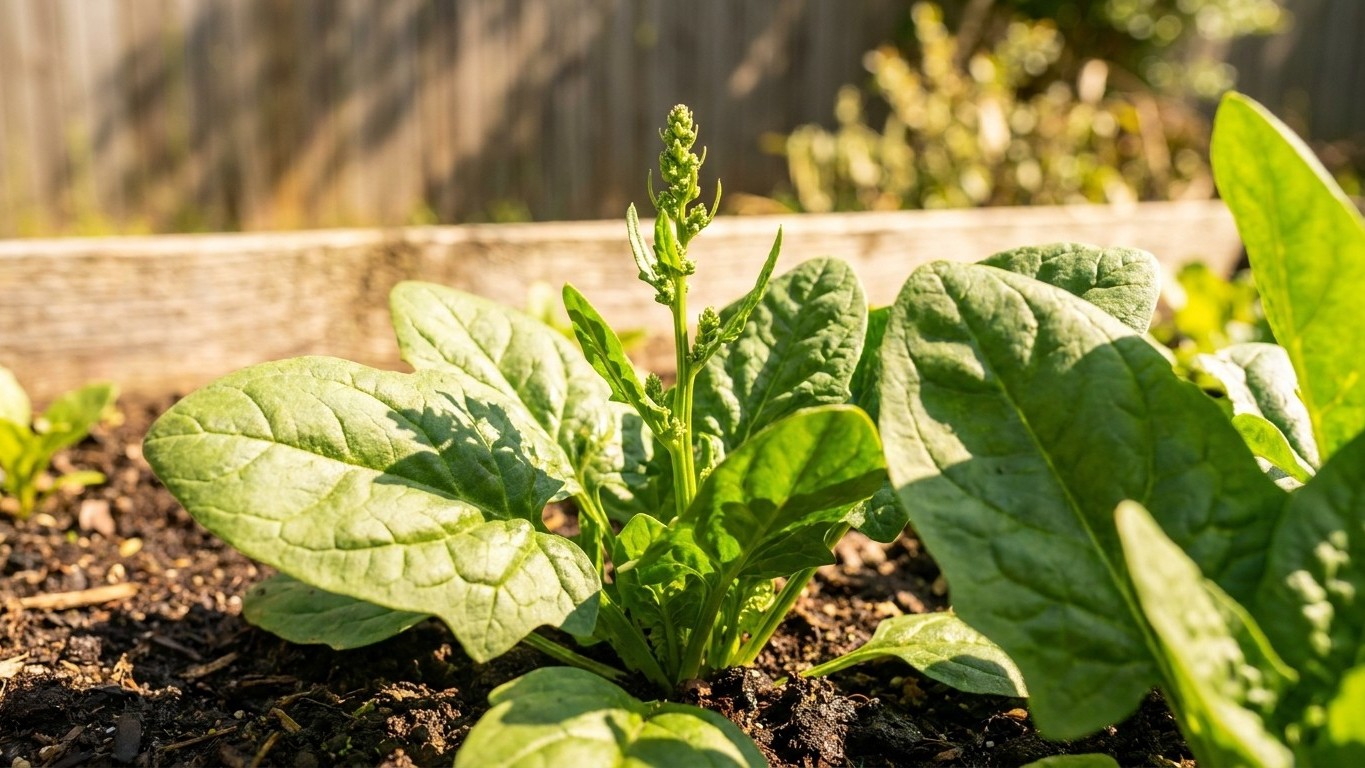

Cut spinach while the leaves are full-sized and the center of the plant is still a flat rosette. In British Columbia that means a spring harvest from a late-winter sowing and an autumn harvest from a late-summer one. Midsummer is off the calendar. Once cut, the leaves keep 10 to 14 days at best, and only in a fridge held near 32°F. The reasons come down to day length, heat, and a short list of dates.
The short answer
On the longest day of the year, Vancouver gets 16 h 01 of daylight. That figure is calculated for the airport station, Vancouver Int’l A, and leaves out the seven or so minutes that atmospheric refraction adds. For spinach it matters more than any thermometer reading. The plant flowers in response to long days as well as warm temperatures, and long days alone are enough to start the process. A cool summer therefore does not buy extra weeks.
Coastal British Columbia is cool, no question. That same station records 0.29 days a year at or above 30 °C, and 0.07 days at or above 32 °C. A bed that almost never feels real heat can still send up a flower stalk, because the trigger is the length of the day and not the air temperature. So on the coast the limit is mostly day length. Heat adds its own pressure only where summers run hotter than the reference station, and a province is not one climate. Spinach grows best where temperatures stay at or below 75 F (about 24 °C), and that same number is where the leaves turn bitter.
What decides the day you cut
The calendar gives you a window, but the plant gives you the signal. Cut outer leaves once they are big enough to eat, or take the whole rosette at the base. Do it before the center begins to rise into a stalk. After that, quality drops fast. Our guide to whether spinach will bolt early in British Columbia covers the warning signs, and the parent guide, Growing Spinach in British Columbia, covers the full season. Leaves already chewed before you reach them are a different problem, handled in What Eats Spinach in British Columbia, and When.
How long it keeps once it is cut
UC Davis Postharvest gives the best case: 32°F (0°C) and 95 to 98 percent relative humidity. Even then, it says spinach “will not maintain good quality for more than 2 weeks.” Wilting, yellowing and decay become more likely after 10 to 14 days. At common distribution temperatures of 41 to 50°F (5 to 10°C), the decline comes faster.
A fridge door sits squarely in that warmer range. The coldest spot is the back of the bottom shelf, so put the spinach there, loosely wrapped with a damp paper towel in a container. Treat two weeks as a ceiling, not a plan. Eat the freshest cutting first, and check at day five.
How long the spring window really is
The mean last spring frost at Vancouver Int’l A is March 18, according to Environment and Climate Change Canada. It is a midpoint, and in one year out of two the last frost lands later. Those normals also cover an older 30-year span than the US figures used elsewhere on this site. Northern and upland districts run weeks behind the airport. Here is how the spring window works out:
- Sow 2 to 3 weeks before the last frost. Counting back from March 18 puts the earliest sowing between roughly February 25 and March 4. Treat that as the middle of a range and not a safe date. A cold, wet stretch can push it later.
- Measure the time to the solstice. From those sowing dates to the longest day, in the third week of June, is about 15 to 17 weeks. That is the outer boundary, and the usable part is shorter.
- Watch the heat, which rarely ends the window on the coast. Growth stops being good above 75 F (about 24 °C), but with only 0.29 days a year at 30 °C or more, the airport station almost never gets there. Inland and upland gardens may hit it sooner.
- Watch the daylight, which does end it. Days keep stretching toward that 16 h 01 peak, and long days alone can push spinach to flower. The source behind this page publishes no day-length cutoff, and it publishes no days to maturity either, so I will not put a date on the end of spring.
- Cut early and often. Because the window closes on daylight and not on a thermometer, harvest as soon as the leaves are usable rather than waiting for bigger plants. A plant left too long is a plant that has bolted.
The result is a spring crop that begins in early March and has to be finished well before the solstice. Sowing a second round in May, just to fill the gap, will mostly give you stalks.
The autumn crop, and when the soil lets you sow
Autumn is the better season here, and it has two obstacles. Neither one is cold.
Warm soil blocks germination
Seed germination drops once soil temperature climbs above 80 F (about 27 °C), according to Utah State University Extension. In late summer the soil is the last thing to cool, long after the air feels pleasant. Vancouver’s cool summers help, and sowing in late August is usually workable on the coast. But I have no soil-temperature data for the province to give you a date, so use a soil thermometer. Sowing into a bed that is still too warm gives patchy rows and wasted seed. Shade the bed or water the soil before sowing to cool it down.
Days are shortening by then, which takes away the flowering trigger that dominates spring. That is why an autumn crop is far less likely to bolt than a spring one. Seed catalogs offer Bloomsdale, Melody, Teton and Olympia, and the source names them. It gives no data on any of them, such as days to maturity or bolting resistance, so choosing among them is up to you.
The frost that ends the season
The mean first fall frost at Vancouver Int’l A is November 10. Like the spring date, it is a midpoint, so half of years bring frost later and half bring it sooner. The source advises planting 50 to 75 days before the date you want to harvest. If you want spinach in the basket by about November 10, count back:
- 75 days before November 10 is August 27.
- 50 days before November 10 is September 21.
That gives a sowing window from late August to about the third week of September, with the earlier end safer in cooler, upland gardens and the later end workable on the mild coast. The window is already closing as I write this in early October. A sowing today would reach 50 days only after November 20, past the average frost date. It could still yield small leaves under a cover, but it is a gamble, not a plan. The 50 to 75 day range is a planting guideline from the source and not a measured time to maturity for any variety, so treat it as a rough guide.
Common questions
Can I cut spinach more than once?
Yes, if you take outer leaves and leave the center growing. The plant keeps producing until it bolts or the frost ends the season. In spring the second cutting often comes just as the days get long, so expect fewer rounds than in autumn. The source I used does not publish a number of cuttings, so go by the plant.
Does a cool coastal summer let me grow spinach through July?
No. Day length is the problem. With 16 h 01 of daylight on the longest day, the plant gets its flowering signal whether or not the air is cool. A cool summer means the leaves will not turn bitter from heat, but they will still bolt.
Is March 18 safe to count on as the last frost?
No. It is a mean date, so frost arrives after it in about half of years. Treat it as the middle of a window. Gardens inland or at elevation often run weeks behind the airport station, so check your own local record or a thermometer in the bed.
How long does cut spinach really keep?
At 32°F with high humidity, the best case is under two weeks. Quality starts to slip after 10 to 14 days. In a fridge door at 41 to 50°F it declines faster, with yellowing in days. Keep it at the back of the bottom shelf and use it quickly.