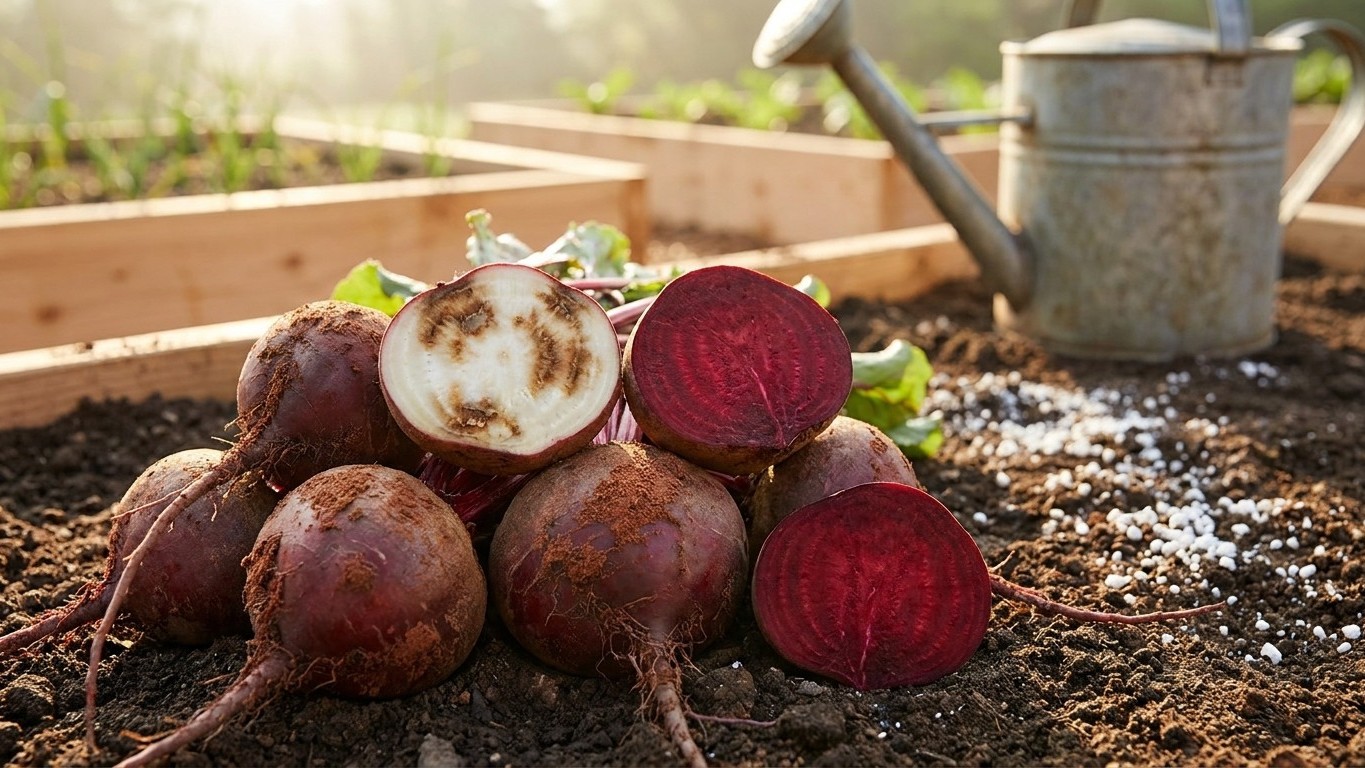

Count 60 to 80 days from the day the seed goes in, not from a transplant, because beets are sown where they will grow. For a sowing near the average last frost, that puts the pull in late spring, ahead of the summer heat that toughens roots. Storage is where gardeners trip. Colder is not better: topped roots keep best at 33 to 36 F, and the 32 to 34 F range of a very cold fridge produces more black spot and rot.
The short answer
The commonest soil among British Columbia’s surveyed surface horizons is a Brunisol, a young soil whose horizons are only beginning to separate, typical of recent or coarse parent material. It covers 33 percent of the mapped surface, with Podzolic soils next. The median surface is a loam to silt: 52 percent sand, 10 percent clay and 38 percent silt, a pH of about 5.8 (slightly acid), organic matter around 5.0 percent, and well drained. Those figures come from Agriculture and Agri-Food Canada’s Canadian Soil Information Service, across 2,593 mapped soil components.
Treat that profile as a starting point. The province spans hundreds of soils, and river bottoms, muskeg and any lot a builder has scraped or filled will behave nothing like the median. The survey also covers the agricultural regions only, so the far north is not represented, and 5.8 is the province’s median, not your pH. A soil test gives your own number, and Beet Soil in British Columbia: What the Root Will Meet goes deeper on what the root finds below the surface.
Utah State University Extension asks beets for deep, sandy, well-drained soil rich in organic matter, amended with no more than 1 inch of composted organic matter per 100 sq ft. On paper the median profile clears most of that. Drainage is good, organic matter is generous, and with only 10 percent clay the ground is not the heavy kind that fights a taproot. The catch is the sand. Over half the surface is sand, so water leaves quickly, and a dry week reaches the roots sooner than it would in a clay bed.
That speed matters because beets can fail in two separate ways, each with its own trigger. Water stress during the first six weeks causes premature flowering, which is bolting. Heat above 85 F combined with water stress, later in the crop, makes the root woody. One is a seedling-stage problem and the other is a summer problem, so “keep it watered” does not cover both.
How many days a year the reference city passes 90 F is not published in the data behind this page, so no number appears here. The 85 F threshold is the one to watch. The practical move is to time the sowing so the 60 to 80 days finish before your district’s hottest weeks, then pull on schedule. Roots left to sit through a heat spell are the ones that turn on you.
The six weeks that decide it here
Sowing 2 to 3 weeks before the last spring frost is the usual advice, and it fixes the first six weeks in a known stretch of the calendar. The only frost date carried here is the average last spring frost of March 18, from Environment and Climate Change Canada’s climate normals for the Vancouver International Airport station (climate ID 1108447). Work back 2 to 3 weeks and the window opens around February 25 to March 4 for that station.
That date is a mean, not a safe date. In one year out of two, the last frost falls later than March 18, so treat it as the midpoint of a window. It also describes one coastal station. A province is not one climate, and northern and upland districts run weeks behind it. Canadian normals also cover a different 30-year span than the US figures used elsewhere on this site, so don’t line the two up as if they were the same measurement.
Take a sowing at the start of March and the arithmetic runs like this: 60 days lands near the end of April, 80 days near May 20. That is an early crop, finished well before the hottest part of summer. Sow in April or May and the same count lands you in July or August, much closer to the heat-plus-thirst combination that makes roots woody.
So where does the bolting risk sit? The coast generally has a wet spring, and the dry, drying-wind interior is a different story. Take that as a general tendency, since this page carries no rainfall figure. On the coast, the early weeks often take care of themselves, and the danger is a dry spell in an otherwise wet season. In the interior, where springs run drier and swing more between warm days and cold nights, the seedbed needs watering as a matter of routine. In both, the sandy-leaning loam is the multiplier. It drains the surplus fast, which is a gift in a wet March and a liability in a dry April.
The first six weeks are the whole window for the bolting failure, so that is when to check the seedbed daily. Press a finger into the soil. If the top inch or so is dry, water. Rain on the forecast is a hope, not a delivery. After week six, the job changes from preventing thirst at the seedling stage to avoiding thirst on top of heat. For the broader picture of sowing and varieties, see Growing Beets in British Columbia.
What goes wrong here
- Bolting from early thirst. Water stress in the first six weeks sends the plant into flowering before it has built a root. In this fast-draining ground, water the seedbed on a schedule rather than waiting for rain, and mulch lightly once seedlings are up to slow evaporation.
- Woody roots from later heat. Heat above 85 F with water stress toughens the root, and it is a different failure from bolting. Sow so the crop finishes before your hottest weeks, keep water even once the weather warms, and pull on time rather than letting roots idle in a heat spell.
- Overdone compost. More organic matter does not mean better beets. The Utah State University Extension guidance caps it at 1 inch of composted organic matter per 100 sq ft, and the median surface already holds about 5.0 percent. Test first, then add less than you think you need.
- Storage that is too cold. At 32 to 34 F, the USDA’s Agricultural Handbook 66 reports more black spot and rot than at slightly warmer settings. Aim topped roots at 33 to 36 F and 98 percent humidity, and keep a cellar or clamp between 31 F and 41 F. Every other root crop on this site wants the cold end, but beets don’t.
- Leaves left on. Bunched beets, tops attached, keep only about 10 to 14 days at 32 F and above 98 percent humidity. If you plan to store them for longer, top them first.
- Storing the small ones. Large roots keep much better than small ones because they lose water and shrivel more slowly. Eat the small roots first and save the big ones for the cellar. Most gardeners do the opposite, saving the tidy little ones.
- Ground that is not the median. Fill, scraped lots, river bottoms and muskeg can be anything from compacted to waterlogged, and a soil test tells you which. Pests are a separate problem with their own calendar, covered in What Eats Beet in British Columbia, and When.
Common questions
How do I know when to start counting for harvest?
Count from seeding day, not from emergence or a transplant, because beets are sown in place. Sixty to eighty days is the span, so mark the sowing date on a calendar. That gives you the window in which to start checking roots, and pulling one beet to look is a fair test.
Should I put the coldest setting on my fridge for beets?
No. The commercial storage handbook puts topped roots at 33 to 36 F and 98 percent humidity, and it notes more black spot and rot at 32 to 34 F. A home fridge won’t match those numbers exactly, but the point holds: don’t chase the lowest temperature, and keep the roots humid.
Which beets should I store and which should I eat?
Eat the small ones first and store the large ones. Large roots lose water and shrivel more slowly, so they hold up far better in storage. Top them before storing, since bunched beets with leaves last only 10 to 14 days.
Does the March 18 frost date apply to my garden?
Only if you garden near the Vancouver International Airport station. March 18 is an average, so frost arrives later in one year out of two, and northern and upland districts run weeks behind. Use it as the midpoint of a window and watch your own last frost.