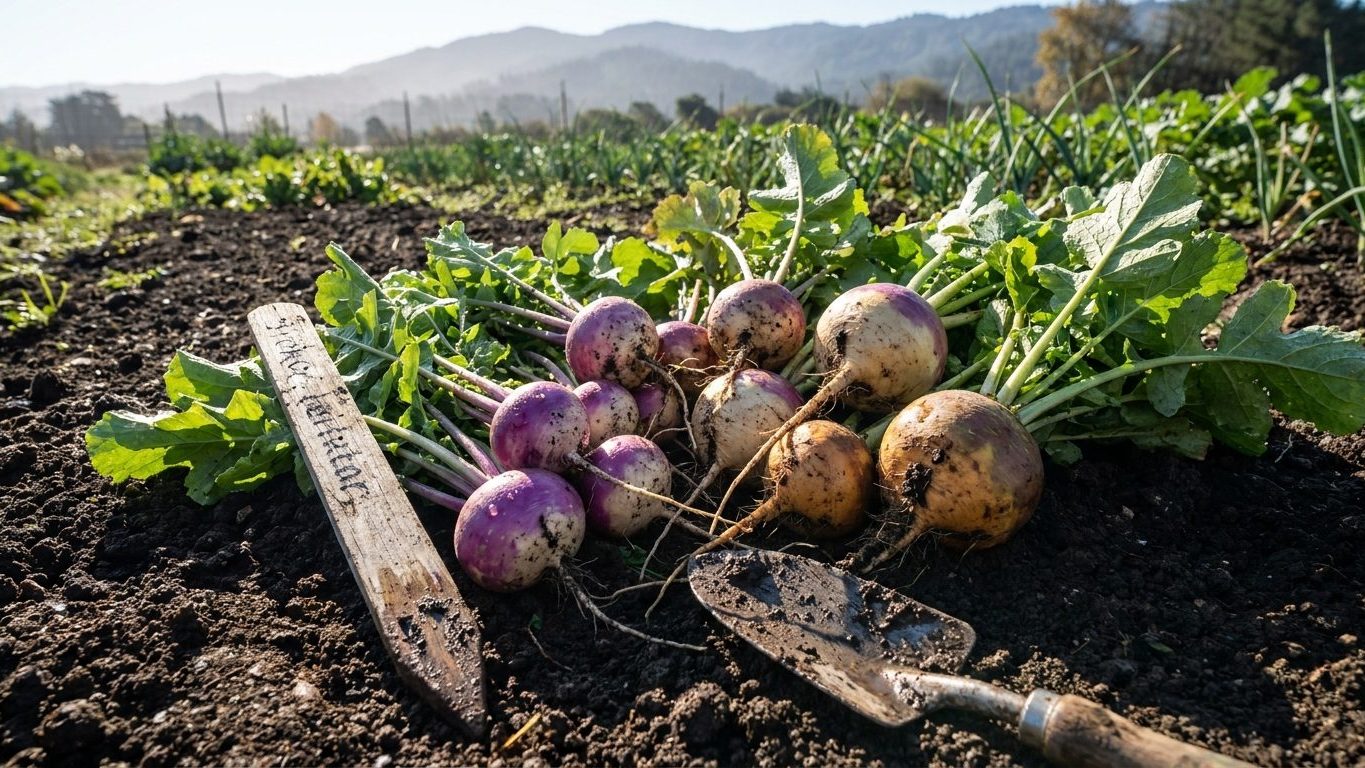

Fall-sown turnips are the safest bet in Alabama, whether you want roots, leafy greens or both. Rutabaga works too, but only as a late-summer sowing that finishes in cool weather, and it is the pickier of the two. Spring sowings of either crop are a gamble here. Season matters more than the exact variety, so this page matches type to timing and says where the evidence stops.
The short answer for Alabama
Choose by type. For cooking greens, grow a leafy turnip such as Seven Top. For roots, grow a globe turnip such as Purple Top White Globe. For speed and tenderness, a small white salad turnip such as Hakurei is the easy win. For rutabaga, a standard purple-top type earns its space only if you can give it a long, cool finish. These are long-established, widely sold names. This page has no Alabama trial results ranking them, so treat them as examples of each type, not as a verdict.
The reasoning starts with the frost numbers. At the airport reference station in the NOAA NCEI 1991-2020 Climate Normals, the last spring freeze (32°F) lands between March 19 and April 3. That is a probability band, not a date: it spans the point where the chance of another 32°F freeze drops from 70% to 30%. The first fall freeze falls between November 2 and November 16, the band where the odds of a first 32°F night climb from 30% to 70%. Between the two sits a frost-free stretch of roughly seven months, which is long on paper but mostly hot.
Cold is not the limiting factor. The mean daily minimum of the coldest month at the Huntsville reference station is 33.1°F. A typical winter night hovers right around freezing, which these crops shrug off. Heat on both ends of the season is the real constraint. Turnips and rutabaga are cool-season roots, so the best varieties here are the ones sown as the heat breaks and harvested before it returns.
These are reference-city figures, not a statewide guarantee. Suburban and rural gardens usually see the last spring frost one to two weeks later and the first fall frost one to two weeks earlier than an airport station. The gap widens at elevation.
| Type | Best use | Season fit in Alabama | Main risk |
|---|---|---|---|
| Leafy greens turnip | Cooked greens | Fall sowing, with cutting through the cool months | Bolting when warmth returns |
| Globe root turnip | Roots and tops | Fall sowing, with a smaller early spring window | Woody roots if the weather turns hot |
| Small salad turnip | Quick, tender roots | Fall or early spring | Splitting and going pithy if left in too long |
| Rutabaga | Large winter roots | Late-summer sowing for a cool finish | Too slow for spring sowing |
Exact sowing dates belong on a separate page. The one on When to Sow Turnips in Alabama works through the calendar, and this page stays with the choice of type.
What will not work here
Spring rutabaga and late spring turnips
Rutabaga is the slowest crop in this family, and Alabama spring does not wait for it. Even if you sow right after the March 19 to April 3 freeze band, the roots are still sizing up when summer heat arrives. Heat-stressed roots turn tough and strong-flavored. A spring rutabaga here usually produces plenty of leaf and a disappointing root.
Turnips sown late in spring fail faster. They bolt, which means they send up flower stalks, and the roots go woody and hot-tasting. The fix is to treat spring as a short, early window for fast types only, with a bolt-resistant variety if the seed catalog lists one, and to put your serious effort into fall.
Fall sowing that starts at the wrong end
Waiting for frost before you sow fails for a simple reason. The first fall freeze band is November 2 to November 16 at the reference station, and rural gardens can see it one to two weeks earlier. Turnips sown at that point have only a few weeks of growth left before real cold slows them. You will get greens, maybe, and little else. Roots need weeks of steady growth after sowing, so for rutabaga especially the sowing date has to sit well back from the first frost.
Starting too early fails as well. Seed sown into the lingering heat of late summer tends to sprout unevenly, and the seedlings sulk or wilt in the afternoon. Aim for the point where the soil has stopped feeling warm, not the point where the calendar says fall.
Close spacing is the other trap. Alabama’s summers are humid, and crowded turnip leaves stay wet, which invites leaf disease and rot at the crown. This page has no rainfall or humidity figures, so it cannot say how much room each county needs. It can say that the tight spacing printed on some seed packets, which suits a drier climate, is worth loosening here. Thin early and keep air moving between plants.
One more expectation to drop: a deep, sweetening freeze every winter. With the coldest month averaging a 33.1°F daily minimum, many winters bring only light frosts. Roots still sweeten with cold, but the gain is modest in a mild year. Plants that sit through a warm late winter will also bolt early, so harvest on a schedule.
What changes across Alabama
Alabama is not one garden. On the USDA Plant Hardiness Zone Map (2023, built on 1991-2020 normals), the state runs from 7a to 9a. That covers five half-zone steps, 7a, 7b, 8a, 8b and 9a, so there is no single answer for the whole state. The map is built on one variable, the average annual extreme minimum temperature. It tells you how cold the worst nights get, and it says little about when heat ends in September.
That distinction matters for turnips. Because all of Alabama is mild enough to carry these crops through winter, the zone spread shifts your timing less than it shifts your risk. In the northern parts of the state and at higher elevation, fall frost arrives sooner, so sowing has to move earlier, and rutabaga in particular needs a head start. The northern tier also has the cooler stretches that rutabaga prefers, which makes it the better place to try it.
Gardeners toward the southern end of the range face the opposite problem. Heat lingers longer, so the right moment to sow is later, and the winter growing season is longer. Turnips there can be harvested through the cold months, but a warm late winter will cause bolting sooner. A coastal or southern gardener who copies a northern sowing date risks seedlings that wilt in warm soil.
Do not take a zone from this page, and do not guess it from a neighbor’s tomato advice. Look up your own location on the USDA Plant Hardiness Zone Map, which lets you search by ZIP code, and treat the result as a clue about winter cold, not as a sowing date. For the full growing routine once you have chosen a type, Growing Turnips and Rutabaga in Alabama covers the season from seed to harvest.
Where to check this for your own county
The Alabama Cooperative Extension System is the best next stop. It is the state’s land-grant extension service, with a presence in every county, and its horticulture staff know your soil and your frost pattern in a way no statewide page can.
Look for two things. First, the local planting calendar for fall vegetables, which will give sowing windows for your county instead of a state-level estimate. Second, any variety recommendations or trial results for your area. Trials tell you which turnip and rutabaga varieties have been grown in local soil and weather, which is the one piece of evidence this page does not have.
If your county office has a staff member who answers gardening questions, ask three things. Which varieties have held up locally? What is the typical first fall frost where you live, not at the nearest airport? And when do local gardeners stop sowing turnips for roots and switch to greens only? If the extension office says something different from this page, follow the extension office.
Checking this against your own garden
Your own observations outrank every date on this page. Three are worth watching, and none needs an instrument.
- Soil warmth by feel. In the morning, push your fingers a few inches into the bed. If it still feels warm like a sunny windowsill, wait. A bed that warms early in fall will be slower to cool than a shaded one, which tells you where to sow first and where to hold back.
- First true leaves. After the seed leaves, the first true leaves are the ones with the crinkled edges of a turnip. If seedlings reach that stage and then wilt or lean in afternoon sun, the spot is hotter than you thought. Healthy, sturdy plants mean the timing and the location both worked.
- Where frost shows first. On the first cold mornings, walk the yard and note where frost whitens the grass and where it does not. A low corner that frosts early is your cold pocket. A bed against a south wall that stays green is your warm one.
Common questions
Can I grow rutabaga in Alabama?
Yes, as a fall crop. Sow it in late summer so it grows into cooler weather, and skip spring sowings, which run into heat before the roots size up. Gardeners in the north and at elevation have the easier time.
Which turnip is best for greens?
A leafy greens type such as Seven Top is bred for tops, not roots, and it is a classic choice for cooked greens. Root types give edible tops as well, so a globe turnip can serve both purposes.
Are the frost dates here my frost dates?
No. The March 19 to April 3 and November 2 to November 16 bands are NOAA 1991-2020 figures from an airport reference station, based on 32°F freeze probabilities. Your own garden will likely see frost later in spring and earlier in fall.
Do I need a hard freeze for good turnips?
Not a hard one. Cold sweetens the roots, and the coldest month averages a 33.1°F daily minimum, so light frosts will do some of that work. This page has no data on how often hard freezes occur in each county, so ask your county extension office.