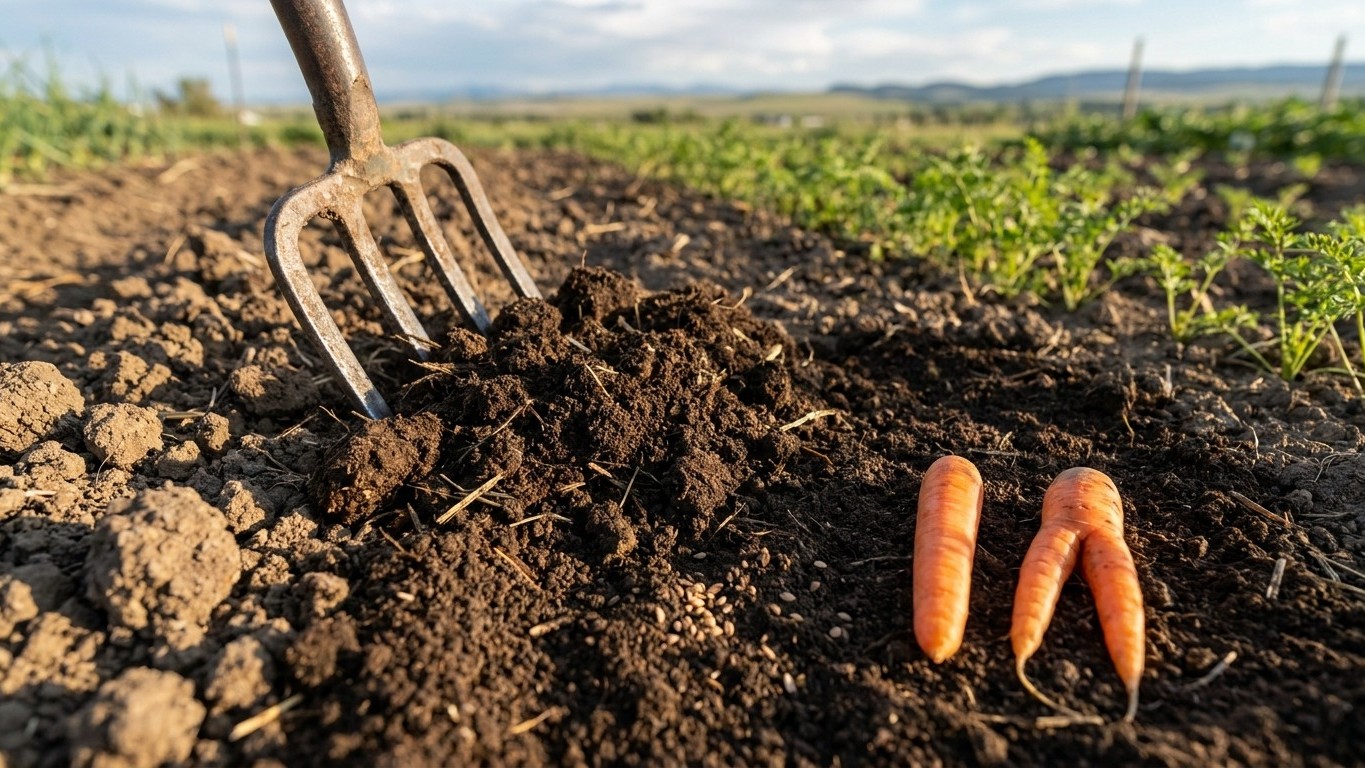

Pull carrots about 70 to 100 days after seeding, once the shoulders have filled out to the width the seed packet promises. To keep them, cut the tops off first, then hold the roots at 33 °F with high humidity. Leave the leaves on and the roots wilt within a couple of weeks. In Ontario the soil decides the shape of the root, and the calendar decides its size.
The short answer
Ontario’s dominant ground
The most common soil in Ontario’s mapped farmland is a Luvisol. It is a forest soil in which rain has carried clay down out of the surface layer, leaving the topsoil lighter and the subsoil underneath denser. Luvisols cover 39 percent of the mapped surface, and Gleysolic soils come next. Gleysols are the ones that tend to stay wet.
The median surface horizon is loam to silt: 43 percent sand, 17 percent clay and 41 percent silt. Organic matter sits around 4.3 percent, the median pH is about 6.5 (slightly acid), and the drainage class is well drained. These numbers come from Agriculture and Agri-Food Canada’s Canadian Soil Information Service, which covers the surface layers of 846 mapped soil components. Canada has no official provincial soil the way each American state does, so there is no single named series to point to. This is the dominant profile of the province, and the survey covers agricultural regions, not the far north.
Will a carrot fork in it?
Utah State University Extension says carrots want deep, sandy, well-drained soil rich in organic matter, and that heavy or rocky soil makes the root fork. Hold Ontario’s median against that list. Drainage is good, organic matter is healthy, and 17 percent clay is not heavy. The typical topsoil is not a forking soil.
The Luvisol’s denser subsoil is the catch. A carrot root pushes straight down until it meets a firm layer, and then it stalls, splits or twists. Where that layer sits close to the surface, the fix is compost worked in and the bed double dug, so the loosened zone runs deeper than the root will. Where water lingers (Gleysolic ground, low spots, scraped building lots), a raised bed is the better answer. A different variety will not solve either problem.
A starting point, not a diagnosis
Ontario spans hundreds of soils, and this profile is where to begin, not what to conclude. River bottoms, muskeg and any ground a builder has scraped or filled can look nothing like the median. Your pH is not 6.5 just because the province’s median is. The next section shows how to find out what you have.
One counting note: carrots are sown in place, so there is no transplant date. The 70 to 100 days run from the day the seed goes in. Clemson Cooperative Extension puts harvest at about 65 to 75 days after planting, which for carrots means after seeding. The packet for the variety you bought sets the exact number. For the full season, see Growing Carrots in Ontario.
The test that settles it in your own garden
The province’s median tells you what Ontario ground tends to do. It cannot tell you what is under your hose. An hour with a spade does, and it is best done in the exact spot where the row will go, not in the easiest corner of the yard.
- Dig a hole. Take it down a full spade blade, about as deep as the roots will grow, and keep the soil in separate piles by depth so you can see how it changes.
- Read the wall of the hole. Look for a change in color or a layer that resists the spade. That is your dense subsoil. Count the stones you pull out and note how deep the loose soil runs. A root needs loose, stone-free ground all the way down, or it will fork around whatever blocks it.
- Feel the texture. Squeeze a damp handful from the bottom of the hole, not just the surface. Gritty soil that falls apart is sandy. Smooth soil that holds together is silty. Sticky soil that stays in a firm ribbon is clay-heavy.
- Watch the water. Fill the hole, let it drain, then fill it again. A well-drained spot takes the second fill noticeably faster than the first. If water is still standing long after you expected it to vanish, drainage is poor, and a raised bed is the safer plan.
- Test pH and organic matter. The hole shows structure and drainage but cannot show chemistry. A lab test gives your own numbers, which are the only ones that count here.
Reading the results is simple. Loose, deep, stone-free soil that drains briskly can be sown with little more than compost. A firm layer partway down calls for double digging. Standing water calls for a raised bed. If you want the longer version of the forking question, Will Carrots Fork in Ontario Soil? goes through it in more detail.
Do the dig when the ground is moist but workable, not bone dry. A dry hole flatters the soil, and a spring hole after rain shows the worst case.
What goes wrong here
Most carrot failures in Ontario trace to three things: a dense layer below the topsoil, a hot spell at the wrong moment, and swings in moisture. Storage adds a fourth. Each has a remedy that costs little.
- Forked or stubby roots. Rocks, a firm subsoil layer or compacted ground turn a straight root into a split one. Work in plenty of compost, double dig so the loose zone goes deeper than the root, and pull out stones as you find them. In wet spots build a raised bed. Forked carrots are fine to eat, so do not throw them out.
- Patchy germination in a hot spell. Carrot seed sits in the ground a while before it sprouts, and a silty surface that dries and crusts in the sun can stop the seedling cold. Keep the seedbed evenly damp until the row shows green. A board or light cover over the row between watering holds moisture in, and it must come off once sprouts appear. If a heat wave is forecast, hold off sowing and wait for a cooler window.
- Splitting from uneven water. A dry stretch followed by a heavy rain or a deep soaking makes the root swell faster than its skin can stretch, and it cracks. Water on a steady schedule instead of in bursts, mulch to even out moisture, and do not leave mature roots in the ground long past their days. Eat split ones first, since they will not store well.
- Limp or sprouting roots in storage. Cut the tops off before storing, because the leaves keep drawing moisture out of the root. That is why bunched carrots with tops on keep only about 10 to 14 days, while trimmed ones keep for months. Clemson Cooperative Extension recommends 33 °F and high humidity, which is just above freezing and colder than most cellars. At 50 °F, carrots sprout and soften in a fraction of the time.
Pests are the other half of the story, and they follow their own calendar. What Eats Carrot in Ontario, and When covers what to watch for and when.
Common questions
How many days after seeding should I pull carrots in Ontario?
Plan on about 70 to 100 days from seeding, since carrots are sown in place and the count starts the day the seed goes in. Clemson Cooperative Extension gives about 65 to 75 days after planting, and the packet for your variety gives the specific figure. This page does not publish an Ontario frost date, so check a local source for that.
Do I really need to cut the tops before storing?
Yes. The leaves keep pulling moisture out of the root, and the root wilts as a result. Bunched carrots with tops on keep about 10 to 14 days, while trimmed carrots keep for months. Cut the tops off first, then store the roots at 33 °F in high humidity.
Is a root cellar cold enough to keep carrots?
Often not. 33 °F is just above freezing, and a cellar that feels cold to you can sit far above that. At 50 °F, carrots sprout and soften much sooner. Put a thermometer in your storage spot before you trust it with the crop.
Does Ontario’s median soil mean I can skip the raised bed?
Maybe, but the median is a starting point, not a diagnosis. Ontario’s typical surface soil is loam to silt, well drained, with 17 percent clay, which suits carrots reasonably well. Your garden may have a dense layer below the topsoil, standing water or builder’s fill. Do the dig and drainage test before deciding. Compost and double digging handle a firm subsoil, and a raised bed handles wet ground.