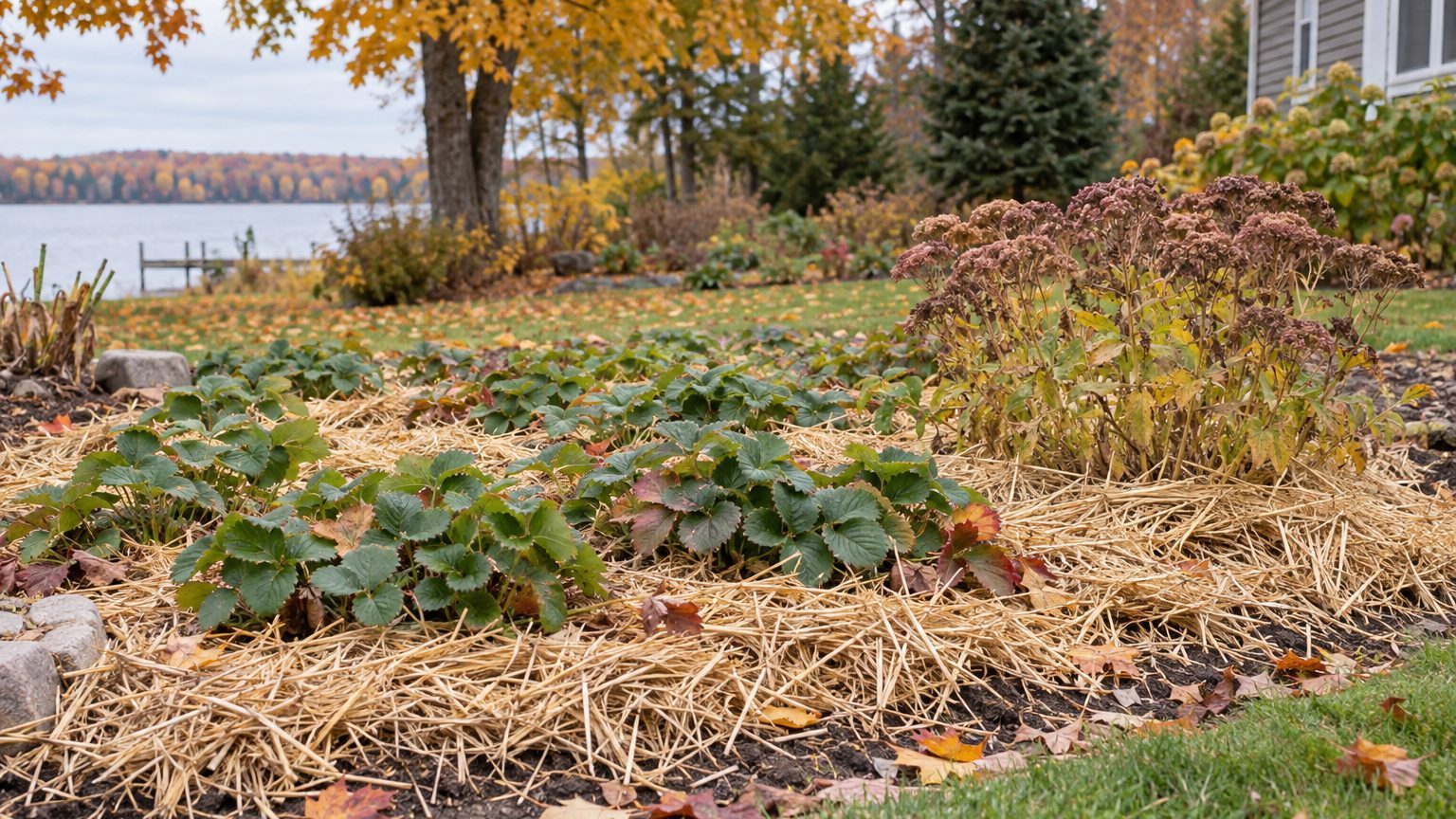

Strawberries and borderline perennials get their winter mulch after the ground begins to freeze, not when the first frost arrives. At Toronto Pearson, the first fall frost averages October 16, so the mulch belongs later in the fall: after a run of hard frosts, before deep snow settles in. Put it down early and you invite rot and rodents. Wait for the soil to stiffen, then cover.
When to put winter mulch down in Ontario
Most gardeners assume mulch is a blanket that keeps plants warm. In winter it does the opposite job. A layer of straw or leaves on frozen soil keeps that soil frozen, so it stays put through the January thaws that melt the surface and refreeze it overnight. Those freeze-thaw swings are what push shallow crowns and roots up out of the ground. Mulch applied while the soil is still warm traps that warmth, keeps the crowns damp, and gives mice and voles a cozy place to set up for the season.
Put winter mulch down after the ground starts to freeze, which in the Toronto area means well after the October 16 average first frost.
Reading the calendar
Environment and Climate Change Canada’s 1981-2010 normals for Toronto Pearson put the average first fall frost at October 16. That is a midpoint, not a safe date. In one year out of two the first frost comes later, and in the other half it comes earlier. So the mulching window opens some time after that midpoint and closes when the ground is frozen hard or deep snow arrives. In practice that is the back half of fall, often the stretch when most gardeners have already put the tools away.
The cold side of that calendar is real. Those same normals give a mean daily minimum of -10.2 °C for the coldest month at Pearson. That is an average, so individual nights run colder, and the soil there does freeze. Natural Resources Canada’s plant hardiness map (1991-2020 normals) places Toronto in Canadian zone 7a. That is the Canadian system, built on seven climate variables, and it does not convert to a USDA zone.
Pearson is one station in a large province. Northern and upland districts have an earlier first fall frost and colder winters, so the mulch goes down earlier there, and the same rule applies: the ground should be stiffening first. For your own frost window, see First and Last Frost Dates in Ontario. More regional timing lives in the Ontario guides.
How to tell the ground is ready
Skip the date and test the soil. Push a trowel into an open bed. If the top layer has gone crusty and the trowel meets resistance, or the soil is frozen in the morning and softens by afternoon, the time has come. Several nights in a row below freezing, with daytime temperatures that barely recover, is the pattern to watch. Plants will have stopped growing by then and gone fully dormant, which is the point. Mulch laid over active growth smothers it; mulch laid over dormant, frozen ground simply holds the status quo.
Strawberries
A strawberry plant carries its whole future in the crown, the compact stem at soil level where next spring’s leaves and flower trusses are already forming. Bare cold damages that tissue. Heaving makes it worse, because repeated freezing and thawing lifts the crown and snaps the fine roots that anchor it. A plant that comes out of winter sitting proud of the soil with exposed roots will struggle to produce much fruit, if it survives at all.
Clean straw is the standard cover, and “clean” matters. Straw from wheat or similar grain is a stalk, mostly hollow and light, and it stays airy when it gets wet. Hay is a different thing: it holds seed heads, and a mulched bed turns into a hayfield come May. Whole leaves from maples and oaks tend to mat into a soggy sheet over the crowns. If leaves are what you have, shred them first.
Depth is where gardeners overdo it. The sources behind this article are general-purpose, so here is what they say. NC State Extension writes: “A 2-inch to 3-inch layer of mulch suppresses most annual weed seeds and makes it easy to hand-pull any that do germinate.” Its handbook also advises: “Provide a 3-inch layer of mulch to reduce water loss and maintain uniform soil moisture and temperature around roots.” (NC State Extension Gardener Handbook, chapter 11, Woody Ornamentals.) Neither line is about strawberries specifically, but both give the same order of depth. Loose straw settles over the winter, so spread it fluffy over the crowns and between the plants rather than packing it down. More is not better. A heavy, compacted layer holds water against the crowns and sets up the rot you were trying to avoid.
For the full picture of the crop, from planting to renovation, see Growing Strawberries.
Pulling it back in spring
Uncovering is half the job. Straw left on the crowns after growth restarts blanches the new leaves and keeps the plants cold and wet. Rake the straw off the crowns once new leaves show pale yellow at the center of the plants, which comes after the hardest of the spring cold has passed. You are looking for that first flush of yellow-green growth peeking up through the straw, usually in mid spring.
Don’t throw the straw away. Pull it into the alleys between rows, where it keeps developing berries clean and off the soil, and keep a little in reserve. If a frost night is forecast after the plants have started to bloom, drawing a light layer back over them protects the open flowers, which are far more tender than the dormant crowns were in January. The last spring frost date for your area is on the Ontario frost dates page, and it is the date to keep one eye on until flowering is done.
Perennials and borderline plants
Toronto’s Canadian zone 7a sits at the milder end of Ontario’s gardening range, and many established perennials there are tough enough to come through winter with no help. Mulch earns its place with a smaller group: plants in their first winter, shallow-rooted species, and anything that sits close to the edge of its hardiness. Newly planted perennials have not yet knit their roots into the surrounding soil, so they are the easiest for heaving to lift out. Coral bells, garden mums, and foamflower are common offenders, with shallow crowns that ride up out of the ground in a winter of repeated thaws.
Borderline plants are a judgment call, and zone 7a is not a guarantee. It is Natural Resources Canada’s zone for the reference city, not for every garden in the province. A tag that says a plant is hardy to a given zone assumes average conditions, and exposed beds, wet clay, and wind can all push a plant past its limits. If a perennial rated for a mild zone is growing in a colder pocket, treat it as borderline and mulch it.
Depth follows the same range as before. NC State Extension’s advice is a layer of 2 inches to 3 inches, and for trees it recommends “a 3-inch layer of mulch to reduce water loss and maintain uniform soil moisture and temperature around roots.” That is the ceiling. Chopped or shredded leaves, shredded bark, and evergreen boughs all work. Boughs have a particular advantage: they hold snow in place, and snow is the best insulation there is.
Shape matters as much as depth. Make a ring around the plant, not a pile on top of it. Leave a gap of bare soil right around the crown or stems so moisture can escape and the base can breathe. A mound heaped against the crown is the same volcano mistake gardeners make with trees, and it rots the plant it is meant to protect. For more on getting the shape and material right, see Mulching Without Killing the Plant.
Perennial herbs such as lavender, thyme, and sage fall into the borderline group in many gardens, since they dislike wet feet more than cold. They get their own treatment in Getting Perennial Herbs Through the Winter. The timing, though, is the same as for everything else here: apply the ring only after the ground has started to freeze, well after the first fall frost.
What goes wrong
Four mistakes account for most failed winter mulching, and each one is easy to spot and easy to prevent.
Mulching too early
The mulch goes on in early fall while the soil is still warm, because the garden is being tidied anyway. The soil stays warm and wet beneath it, crowns soften, and the first sign of trouble is a plant that looks sodden and brown at the base. Rodents are the other cost: a warm, dry layer sitting over unfrozen ground is a good place to nest. The fix is patience. Hold back until the ground stiffens, even if it means working in coats and gloves. The Toronto Pearson average first frost of October 16 is a reminder of how much of fall is still ahead at that point.
Mulch that mats and rots
Whole leaves, wet grass clippings, and thick wood chips compress into a dense layer that sheds air and holds water. Under it, crowns go slimy and turn black. Prevention is in the choice of material and the thickness: use airy straw or shredded leaves, and stay inside the 2-inch to 3-inch range NC State Extension gives.
Voles and mice
Mulch heaped against trunks and crowns gives voles cover to chew bark and roots through winter, often under snow where you never see it. Keep the layer thin, keep it back from stems and trunks, and apply it late. Frozen ground and a loose layer are far less attractive than warm soil and a thick pile.
Forgetting to uncover
Mulch is a winter tool. Leave it on through spring and it holds the soil cold, delays growth, and smothers new shoots. Pull it back from strawberry crowns and perennial centers as soon as new growth starts, and keep it close at hand for any frost night that follows. A quick walk through the beds on the first warm weekend is all it takes.
Common questions
Should I mulch right after the first frost?
No. A first frost kills tender annuals, but the soil underneath is still warm and the freeze-thaw cycle has not begun. At Toronto Pearson the average first fall frost is October 16 (Environment and Climate Change Canada, 1981-2010 normals), and the mulch comes after the ground starts to freeze, which is a later stage of fall. Mulching on the frost date means covering plants that are still unsettled and soil that is still active.
Does the Toronto date apply across Ontario?
Only roughly. The figures come from one station, and northern and upland areas of the province run colder, with an earlier first fall frost. The mulching window there opens earlier too, so watch the soil rather than a date. The test is the same: mulch once the ground is starting to freeze.
Is Canadian zone 7a the same as a USDA zone?
No. Natural Resources Canada’s 7a is based on seven climate variables, while the USDA system uses a single one, and the two do not convert. Use it to compare plants within Canada, and treat any plant tag that lists a USDA zone as a rough guide only.
Can I use shredded leaves instead of straw?
Yes, for most perennials, and they are free. Shred them first so they do not mat, and keep the layer within the 2-inch to 3-inch range that NC State Extension gives. For strawberry crowns clean straw is still the better choice, since it stays loose and does not pack down as it gets wet.