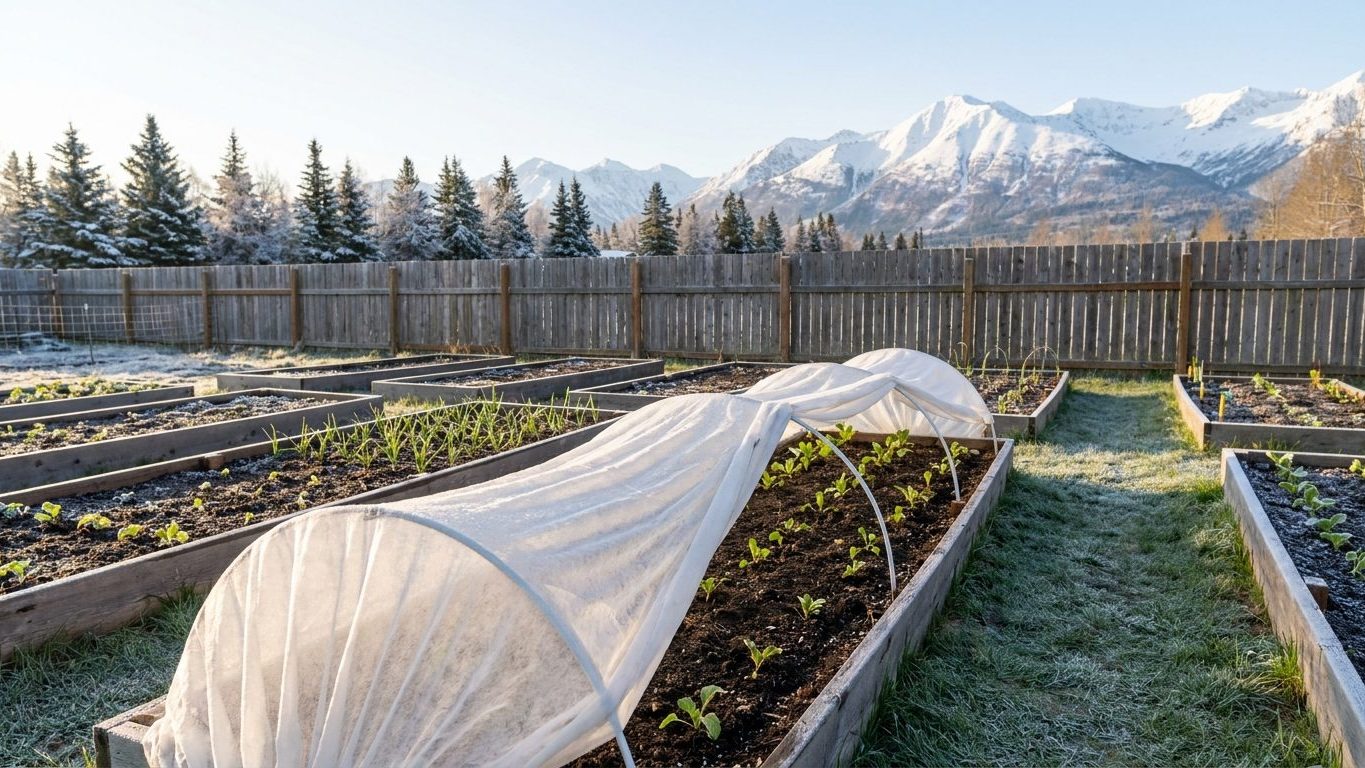

In lowland Hawaii, cover a garden when rain, wind, strong sun, or insects threaten the crop, not on a frost date. There is no frost date to use. NOAA’s 1991-2020 normals for Honolulu show zero days per year at or below 32°F. Frost shows up only on the summits of Mauna Kea, Mauna Loa, and Haleakala. Above the lowlands, the trigger shifts to cool nights.
The short answer for Hawaii
A frost date is a probability: the day after which the odds of a 32°F freeze fall below a chosen threshold. For the Honolulu station (USW00022521), NOAA could not compute any freeze percentile, at either 32°F or 36°F, because no freeze occurs in inhabited areas. The calendar that mainland gardeners count backward from simply does not exist here. The coldest month’s mean daily minimum is 66.8°F, which tells you cold is not what limits a lowland garden.
What replaces the frost date is a short list of stresses, and each has its own timing. You cover ahead of the stress, not on a fixed week of the year.
| Stress | Where it shows up | What a cover does |
|---|---|---|
| Heavy rain | Windward lowlands and slopes | Open-sided hoops with rain cover keep soil from splashing onto leaves and fruit |
| Strong sun and drying wind | Leeward lowlands | Shade cloth cuts leaf scorch and water loss |
| Insect pressure | Anywhere, all year (no freeze knocks populations back) | Fine netting keeps pests off the crop |
| Cool nights | Higher elevations | Row cover or a low tunnel adds a little warmth to slow growers |
In practice, that means putting insect netting on at planting, since pests do not take a winter break. Rain covers go up before a wet spell arrives, not after the first leaf spot. Shade cloth goes on seedlings and transplants during their first weeks, when a sunny leeward bed is hardest on them. The Extending the Growing Season in Hawaii page covers the broader logic of why “extension” means something different here than on the mainland.
What will not work here
Start with the frost-date calculator. Any tool that hands you a “last frost” date for a Hawaii address is filling a blank with a guess, because NOAA’s own record has nothing to fill it with. Planting schedules built on that date, such as starting tomatoes six weeks before it, have no anchor in the islands.
Frost cloth and sealed plastic tunnels fail for the opposite reason from the one you might expect. With a coldest-month mean minimum of 66.8°F in Honolulu, a closed tunnel has no cold to hold off. It mostly traps midday heat on a bed that already gets plenty. Seedlings that would shrug off a cool night can cook under a sealed cover on a bright afternoon. If you use plastic at all, use it as an open-sided rain roof so air moves through.
Light fabric and loose edges fail in the trade winds. A cover that works in a calm backyard becomes a sail on an exposed lot. Hoops need to be anchored deeply, edges pinned or weighted, and the fabric kept tight. Many windward and gap-exposed sites need a windbreak before they need any cover at all.
Tight spacing under cover fails on the wet side of an island. Humidity that lingers under a canopy invites fungal disease, so crowding plants “to use the protected space” works against you. On the leeward side, the failure runs the other way. A weekly soak is not enough for a dry, sunny, windy bed. Shade cloth reduces water loss but does not replace irrigation, and a covered bed can still dry out if you stop checking it.
Finally, the slow, season-lengthening approach (cold frames, heavy tunnels, heated beds) answers a question lowland Hawaii is not asking. The growing season is already year-round, so there is no short season to stretch. The Which Season Extenders Work in Hawaii page sorts the tools that earn their place from the ones that do not.
What changes across Hawaii
The USDA Plant Hardiness Zone Map (2023 edition, built on 1991-2020 normals) places Hawaii in zones 9a through 13a. That is four full zones apart, a spread few mainland states come close to. The system rests on a single variable, the average annual extreme minimum temperature, so it describes how cold the coldest nights get, not how wet, windy, or sunny a place is. There is no single answer for “Hawaii.” The 9a end belongs to the cold, high ground, and the 13a end to the warm coast.
Which end of that spread you live near changes what you do. A gardener at elevation, upcountry or on a volcanic slope, should shift toward cool-night tactics: row cover or low tunnels for heat-hungry crops, patience with slow growers, and a closer eye on wind. A lowland gardener should shift the other way, toward shade cloth, netting, and rain protection. Frost still stays on the summits, and no one gardens there. Between those poles, windward versus leeward exposure often matters more than elevation alone, since two lots on the same island can have very different rainfall.
Latitude adds a smaller wrinkle. The 21.32 degrees north figure belongs to Honolulu, not to the whole state. Kauai sits farther north and the Big Island farther south, so if you garden near either end, check your own latitude. It matters because day length, not warmth, tells an onion to stop making leaves and start making a bulb. At these latitudes day length swings far less across the year than on the mainland, so varieties bred for short days are the ones to look for.
To find your own zone, use the USDA map and search by ZIP code. This page will not guess it for you, and neither should anyone who has not seen your address.
Where to check this for your own county
The best next stop is CTAHR Cooperative Extension at the University of Hawaii, the state’s land-grant extension service. Two things are worth looking for there. First, a local planting calendar for your island or county, which will reflect your rainfall and elevation in a way a state page cannot. Second, the list of varieties trialled in your county, meaning crops that were actually grown and scored under local conditions rather than recommended from a catalog.
Look also for pest and disease notes that match your side of the island. A windward garden fighting leaf disease and a leeward garden fighting mites need different covers, and extension publications tend to say which pest is active where.
A county recommendation beats a state one, every time. This page is the state one. It rests on the NOAA normals for a single Honolulu station and a territory-wide hardiness range, which is a sound starting frame but a blunt tool for a particular valley. The page also has no county-level planting calendar, so where a local publication disagrees with anything here, trust the local one. Where extension staff can answer questions by phone or email, use them. They know which microclimates in your county behave like outliers.
Checking this against your own garden
No date on this page outranks what your own beds are telling you. Three observations cost nothing, and each reveals something about your microclimate.
- Soil warmth by feel. Push your hand a few inches into the bed in the early morning. Soil that feels cool compared with the air hints at elevation, shade, or a wet, windward site, and it will slow germination. Warm soil at dawn suggests a sheltered, sunny spot.
- The first flush of male flowers. On squash and cucumbers, male blooms open before female ones. Note the date they appear. A late first flush points to cooler or lower-light conditions than the neighbors report.
- The first true leaves. After the seed leaves come the first true leaves. Count the days from sowing to that point, and compare a covered bed with an open one. A big gap shows what your cover is actually doing.
Write the dates down for a season or two. Three entries a year will tell you more about your plot than any statewide chart.
Common questions
Do I need frost cloth in Honolulu?
No. NOAA’s 1991-2020 normals for the Honolulu station show zero days per year at or below 32°F, and the coldest month’s mean daily minimum is 66.8°F. Cloth is for shade, insects, or wind, not cold.
Does frost ever reach a Hawaii garden?
Not where people garden. Frost occurs only on the high volcanic summits of Mauna Kea, Mauna Loa, and Haleakala. Gardeners at elevation can still meet cool nights, so ask your county extension office what that means for your site.
Is there a best month to start covering crops?
There is no single month. Cover at the start of whichever stress applies: insect netting at planting, rain cover ahead of a wet spell, shade cloth for seedlings on sunny leeward beds, and row cover on cool upland nights.
Can I trust one set of numbers for the whole state?
No. The climate figures here come from one Honolulu station, and the USDA hardiness zones run from 9a to 13a across the state. Treat the numbers as a starting frame and let your own island, elevation, and exposure adjust them.