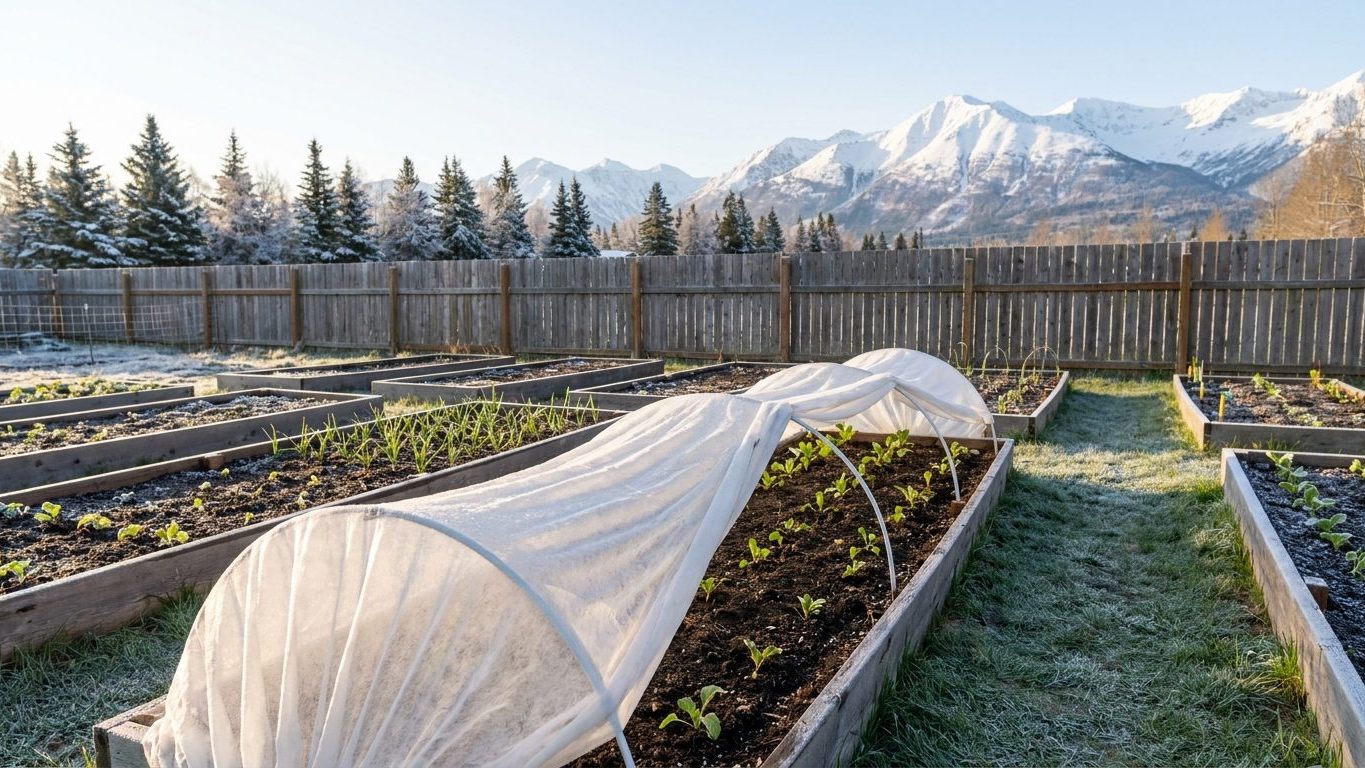

In south Louisiana, you cover the garden when the forecast shows a freeze, not when the calendar says so. Some winters never deliver one. Season extension here is a matter of short, reactive nights, not months under fabric. The dates below come from New Orleans climate data and describe odds, not appointments. North Louisiana plays by tighter rules, and your own parish may differ from both.
The short answer for Louisiana
Cover on the evening a 32°F freeze is forecast, and expect that to happen mostly between December 17 and February 8 at the New Orleans reference station. Those are probabilities, not fixed dates: the first fall freeze falls between December 17 and January 8, and the last spring freeze between January 18 and February 8. Each range is the 30 to 70 percent band of the NOAA NCEI 1991-2020 Climate Normals for a 32°F freeze.
Read the bands as odds. By December 17, there is roughly a 30 percent chance the season’s first freeze has already come and gone. By January 8, that chance is about 70 percent. The spring band runs the other way, with the odds of a freeze still ahead of you dropping from 70 percent on January 18 to 30 percent on February 8. The fall window straddles New Year’s Day, which is not how a normal planting calendar works. The two bands also nearly touch, leaving only about ten days between them. In practice, the stretch from mid-December through early February is when a cover might be needed at all.
Even then, the freeze is not guaranteed. At this station a 32°F freeze occurs in only 86.8 percent of years, so roughly one year in seven has no freeze at all. The mean daily minimum of the coldest month is 46.1°F, which means a typical winter night in New Orleans sits well above freezing. A freeze here is an event, and events are handled with a forecast and a bedsheet-sized decision, not a season-long schedule.
What counts as a cover night
The nights worth covering for follow a pattern. A cold front pushes through, the wind drops, the sky clears, and the temperature slides toward 32°F before dawn. Clear, calm nights lose heat fastest. Cloudy or breezy nights hold it. A few signals decide it:
- A forecast low at or near 32°F, especially under a clear sky
- A front arriving behind a warm, humid stretch, when tender plants are soft and actively growing
- Tender crops (tomato and pepper transplants, basil, young squash) that cannot take a hard freeze
Hardy greens, brassicas and most root crops shrug off light freezes and often taste better for them. The USDA hardiness zone for the state, 8a to 10a, is built on the average annual extreme minimum, so it tells you how cold the worst night gets, not how often cover nights come. Louisiana’s other “cover” season is summer, when shade cloth does the work frost cloth does in winter. The page on Which Season Extenders Work in Louisiana covers both.
What will not work here
Leaving covers on from December through February fails. With a coldest-month minimum averaging 46.1°F, most winter days and many winter nights are mild, and fabric left in place through them traps moisture against leaves. Louisiana humidity does the rest. Damp foliage under a closed cover invites fungal disease, and wet fabric touching leaves conducts cold instead of blocking it. A cover is a tool for one night or a few, then it comes off.
Sealed plastic tunnels fail too, and faster than most newcomers expect. A clear plastic hoop house on a sunny January afternoon after a front can climb far above the outside air. Closed up, it cooks seedlings that the night before needed protection. Anything plastic needs venting or removal by mid-morning, which is a hard routine to keep for a weeks-long cold snap and an impossible one for someone at work all day. Breathable row cover forgives more.
Treating the frost dates as planting signals fails as well. The spring band ends on February 8, but even then the odds of a freeze still ahead sit near 30 percent, roughly three years in ten. Planting tender transplants on that date and walking away is a gamble, and cheap row cover is what turns it into a reasonable one. The opposite mistake is waiting for the first freeze to start protecting a fall garden. In a year with no freeze (about one in seven), the date never arrives, so a plan built around it never starts.
The biggest failure is aiming season extension at the wrong end of the year. In south Louisiana, frost is rarely what limits the garden. Summer heat is. Pushing warm-season crops earlier into January with elaborate covers buys a few weeks, but it does not change the heat that arrives later and ends the harvest. The better payoff comes from planting cool-season crops early enough to be well established before the cold snaps, and from shading them through the late-summer start. A cover strategy that ignores heat and humidity is one borrowed from a northern state and pasted onto this one.
What changes across Louisiana
There is no single answer, because Louisiana is not one garden. The USDA Plant Hardiness Zone Map 2023 (built on 1991-2020 normals) puts the state at 8a to 10a, a spread of five half-zone steps. Every date on this page belongs to a New Orleans-area station at 29.99 degrees north, not to the whole state. A reader in Shreveport or Monroe is in a different climate from one in Houma or Grand Isle, and the map is how you see the difference.
North Louisiana freezes far more reliably than the south. A northern gardener should expect more cover nights, a first cover night earlier than the New Orleans band suggests, and a spring in which covers stay on the shelf later. The “one year in seven with no freeze” figure belongs to the south coast. In the north, that kind of freeze-free winter should not be assumed. Cold-hardy crops get a longer season in the south, while tender crops in the north need the cover habit more often.
Latitude matters for more than temperature. Day length, not warmth, tells an onion when to stop making leaves and start making a bulb, so a bulbing variety suited to the New Orleans latitude behaves differently farther north. Someone near the northern or southern edge of the state should check their own latitude before leaning on a figure drawn at 29.99 degrees. For a broader look at the strategies themselves, see Extending the Growing Season in Louisiana.
To find your own zone, use the USDA Plant Hardiness Zone Map and look up your ZIP code. Do not guess from a neighbor’s advice or a nursery tag. The zone is one input, and your own parish’s freeze history is the other.
Where to check this for your own county
The LSU AgCenter is the state’s land-grant extension service, and it is the right next stop. Look for the local planting guide for your parish, which sets sowing and transplant windows against local conditions instead of a single reference station. Look also for the varieties trialled in your region. A tomato that sets fruit in one part of the state may stall in another, and the trial results tell you which is which.
A parish recommendation beats a state one, and this page is the state one. It draws on one station’s freeze probabilities, one city’s latitude and one range of hardiness zones. It does not carry a parish-by-parish planting calendar, and it cannot replace one. When the extension guide and this page disagree, trust the extension guide, since it reflects local freeze records and local field trials.
The local agent matters too. Parish extension offices field exactly these questions, and they know which cold snaps surprised gardeners last winter. Ask them what the cover threshold looks like for your area and which crops they would protect first.
Checking this against your own garden
Your own observations outrank every date here. Three are worth watching, and none needs a gadget.
First, soil warmth by feel. Push a hand or trowel into the bed on a mild afternoon. Soil that feels cool and heavy is still winter soil, whatever the air says, and warm-season seeds will sit in it. Compare a sunny bed against a shaded one and you will see how different two corners of one yard can be.
Second, the first flush of male flowers on squash or cucumber vines. Male blooms appear ahead of the female ones, so their arrival says the plants are growing and the season is moving. If they show early on one side of the yard and late on the other, you have found a warmer wall and a colder low spot.
Third, the first true leaves on seedlings. The rounded seed leaves come first, and the true leaves that follow mark real growth. When true leaves stall in January, that bed is colder than you thought. A low spot where cold air pools may need a cover on nights when the rest of the yard does not.
Common questions
Should I cover plants every night in winter?
No. Cover on nights when a freeze is forecast, on clear, calm nights especially. In south Louisiana the coldest month’s average minimum is 46.1°F, so most winter nights do not call for it.
Do the frost dates on this page apply to my garden?
They apply to the New Orleans reference station. The first fall freeze falls between December 17 and January 8, and the last spring freeze between January 18 and February 8. North Louisiana freezes more reliably, so check your parish with the LSU AgCenter.
What if no freeze comes at all?
It happens. A 32°F freeze occurs in only 86.8 percent of years at this station, so roughly one year in seven has none. Keep covers ready anyway, since they cost little.
Do covers help in summer?
Shade cloth does, because heat, not frost, is the main limit in south Louisiana. Frost cloth and clear plastic do not belong over plants in warm weather, so store them once the cold season ends.