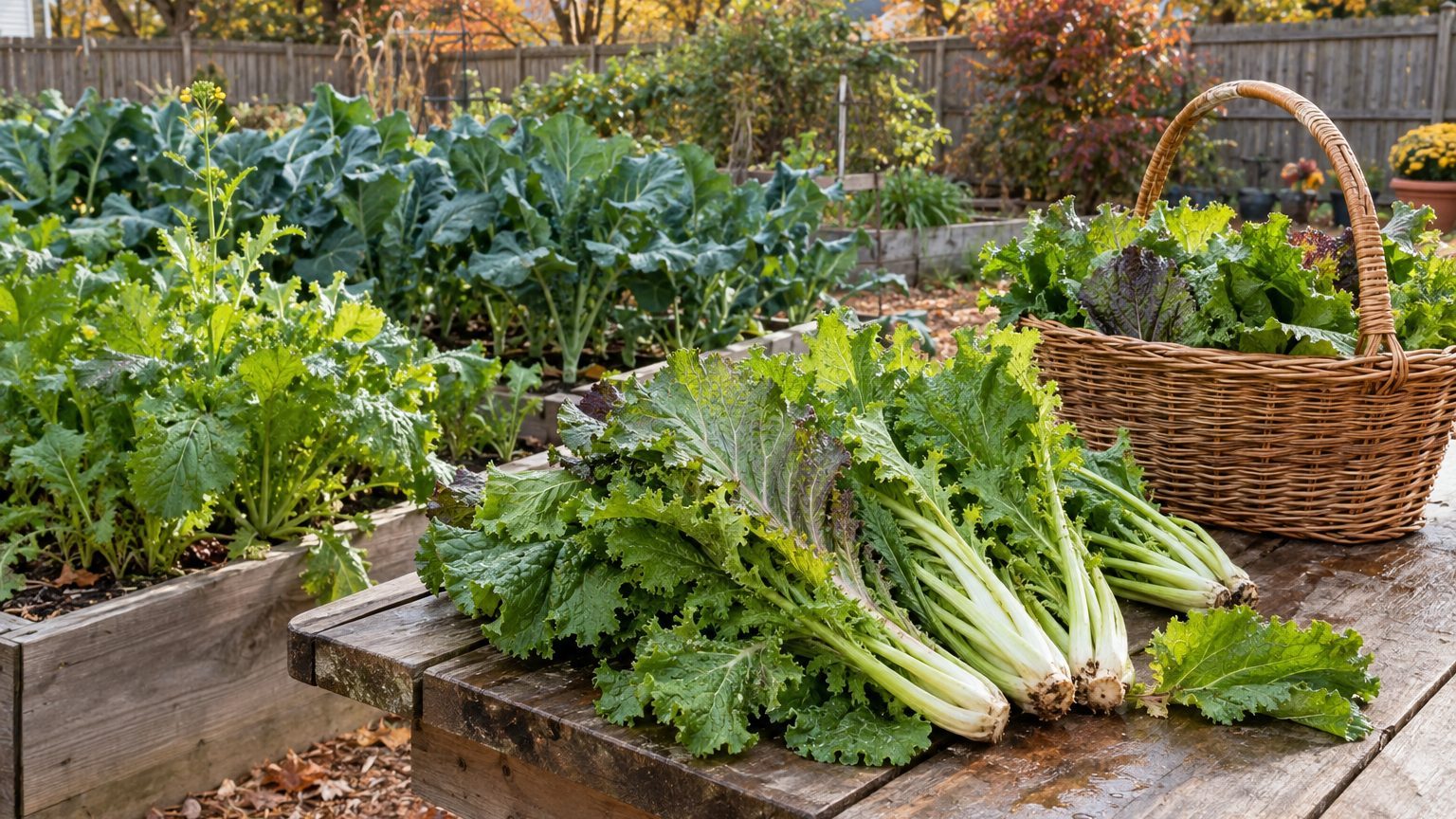

Mustard greens are the sprinter of the Southern greens pot. Sown from seed, they can be ready for a first picking in roughly 30 to 45 days, while collards usually need 60 to 75 days before a full harvest. The trade-off comes in three parts: a peppery bite that grows sharper in warm weather, a tendency to bolt the moment spring heat arrives, and a shelf life of a few days in the refrigerator. If you already grow Growing Collards: One Planting, Months of Harvest, mustard is the quick companion crop that fills gaps in the calendar. It won’t replace collards, though.
Two species, two clocks
Collards (Brassica oleracea) are close kin to kale, cabbage and broccoli. Mustard greens (Brassica juncea) belong to a different species entirely, one that also gave us brown mustard seed and the leafy Asian types sold as gai choy. That split explains most of the behavior differences in the garden.
Speed comes first. Mustard seed germinates in about three to seven days in cool soil, and baby leaves can be cut at 3 to 4 inches within a month. Full-size leaves for cooking take another two weeks or so. Collards are slower starters and slower finishers, but they keep producing for months once they get going, picking from the bottom as the stem rises.
Mustard is a one-and-done sort of plant. After a few weeks of leaf production, a mustard plant starts pushing a flower stalk, especially once days lengthen and temperatures climb past the mid-80s. When that happens, the leaves turn coarse and hot, and the plant is finished as far as the kitchen is concerned. Collards shrug off summer far better. In much of the South, a spring collard planting will still be producing in July, a bit tough and bug-chewed but usable.
Cold works the other way around. Collards hold up through hard freezes, and gardeners in Georgia, the Carolinas and Tennessee routinely pick them in January after nights in the teens. Mustard leaves are generally hardy into the low to mid 20s, but they tend to burn and turn mushy when temperatures fall below that. A frost sweetens both crops a little, since the plants convert starch to sugar to protect their cells, but mustard rarely gets to enjoy a true deep-winter run in zones 6 and colder without protection.
The practical result is a planting window that is narrower and more forgiving at the same time. You can sow mustard about four weeks before your average last frost in spring and again six to eight weeks before the first fall frost. Miss it by a couple of weeks and the plants bolt or freeze, but a failed row costs you a packet of seed and a few square feet, not a whole season. For regional timing on the longer-season crop, see Sowing Collards for an Autumn and Winter Harvest.
Where the sharpness comes from
Mustard’s heat is chemistry, not attitude. Like all brassicas, the leaves contain glucosinolates, sulfur compounds that break down into isothiocyanates when the cell walls are damaged by chewing or chopping. Mustard greens carry a lot of them, and the same family of compounds creates the sting in horseradish and wasabi. Collards have them too, just in gentler proportions, which is why they taste earthy and slightly bitter rather than peppery.
Growing conditions change the dial. Leaves from plants stressed by heat or drought taste noticeably hotter than those grown in cool, evenly moist soil. Age matters as well. A 4-inch leaf picked in October is mild enough for a salad. A 14-inch leaf left too long in a dry July is something closer to a dare.
Cooking tames it. Heat inactivates the enzyme that produces isothiocyanates, so a pot of simmered mustard greens loses most of its bite within 15 to 25 minutes. That is also much shorter than the 45 minutes to an hour or more that Southern cooks give collards, whose thick midribs and leathery blades need the time. Mustard greens will go to mush well before the collards in the same pot, which brings up the most common mistake in mixed pots.
Cooking them together
Put the collards in first, simmer them until they are about halfway done, then add the chopped mustard greens for the final 20 minutes or so. Everything finishes together, and the mustard keeps a little structure and a little pepper. The liquid left behind, pot likker, tastes best when the mustard goes in late, because it picks up that sharpness without turning bitter from overcooking.
A splash of vinegar or hot pepper sauce at the table is traditional with both. Smoked meat (ham hock, turkey wing, bacon) pairs well with either green because fat and salt blunt the bite. For a vegetarian pot, smoked paprika and a spoonful of oil do similar work.
Growing mustard next to collards
The two crops share a lot of needs: full sun (though mustard accepts afternoon shade in warm weather), steady moisture, and soil with a pH of about 6.0 to 7.0. Both are heavy nitrogen feeders. A side-dressing of compost or a balanced fertilizer three weeks after sowing keeps the leaves tender, and mustard in particular grows tough when growth stalls.
Spacing is where they differ. Collards need 18 to 24 inches between plants. Mustard can be sown in rows 12 inches apart and thinned to 4 to 6 inches for full-size plants, or broadcast thickly in a band and cut at 3 to 4 inches for baby greens. Seeds go in about a quarter to a half inch deep. Sow short rows every two weeks and you will have a steady supply instead of 40 feet of greens maturing on the same weekend.
Pests treat both crops the same way, which is to say enthusiastically. Flea beetles pepper young leaves with tiny holes, cabbage loopers and imported cabbageworms chew from underneath, aphids cluster in the folds of curled varieties, and harlequin bugs (the orange and black shield bugs common across the South) can wilt entire plants. Floating row cover, installed at planting and sealed along the edges, is the most reliable defense for both, though it has to come off for any crop that needs pollination. Neither of these does.
Some gardeners use mustard as a sacrificial trap crop, planting it at the edge of a bed so that harlequin bugs and flea beetles gather there first. Extension sources describe this as a partial help, not a cure: the pests still need to be hand-picked or removed from the trap plants, or they just breed there and spread. Treat it as a way to concentrate the problem, not eliminate it.
Disease is the larger worry, and it is shared. Clubroot, a soilborne pathogen that swells brassica roots into distorted knobs, attacks mustard as readily as collards, and it can persist in soil for many years. If you have seen it or suspect it (wilting in the afternoon, stunted plants, club-shaped roots when you pull one up), read Clubroot in a Collard Bed before sowing anything in that spot. Quick mustard crops do not exempt you from rotation either. A bed that grew mustard in spring should not host collards, kale or cabbage right behind it. Aim for at least a three-year gap between brassicas in the same ground, longer if disease has shown up.
Harvest, storage and the fragility problem
Harvest mustard the way you would harvest leaf lettuce, with a few differences. Pick the outer leaves when they are 4 to 6 inches long for a mild flavor, or let them reach 8 to 10 inches for cooking. Leave the growing center intact and the plant will keep producing for several weeks. For baby greens, cut the whole row about an inch above the soil and let it regrow once, maybe twice, before the quality drops.
Mornings are better than afternoons. Leaves are crisp and full of water, and they hold up longer after cutting. Wet leaves are fine as long as you dry them before storage.
This is where fragility shows up. Mustard leaves are thinner and more tender than collards, and they wilt, yellow and turn slimy faster. Unwashed leaves wrapped in a barely damp paper towel and sealed in a perforated bag will usually last three to five days in the refrigerator crisper. Collards routinely hold a week or longer. Washing before storage speeds spoilage unless the leaves are thoroughly dried, so rinse just before cooking if you can.
For longer storage, blanch mustard for about two minutes, cool it in ice water, squeeze out the water, and freeze it in portions in freezer bags. Frozen mustard keeps for roughly 10 to 12 months and goes straight into soups or stews. Texture suffers a little, but flavor holds up well. Raw freezing without blanching is not recommended, since enzymes continue to degrade color and flavor in the freezer.
Variety choice affects all of this. Curled types such as Southern Giant Curled are the classic Southern pot green and stand heat a little better than smooth-leaf kinds. Red-leaved varieties add color and extra bite, and they look good in salads at baby size. Slower-bolting selections are worth seeking out if your springs jump quickly from cool to hot, which is increasingly common across the Midwest and Mid-Atlantic.
One last nuance: when a mustard plant bolts, you do not have to rip it out right away. The flower buds and tender stalk tips can be eaten like a rough broccoli raab, with a strong peppery flavor that suits garlic and olive oil. And if you let a few plants flower and set seed, you are growing the same plant that supplies the seed for brown mustard condiment, though homemade mustard from garden seed takes some soaking and grinding to lose its harshness.