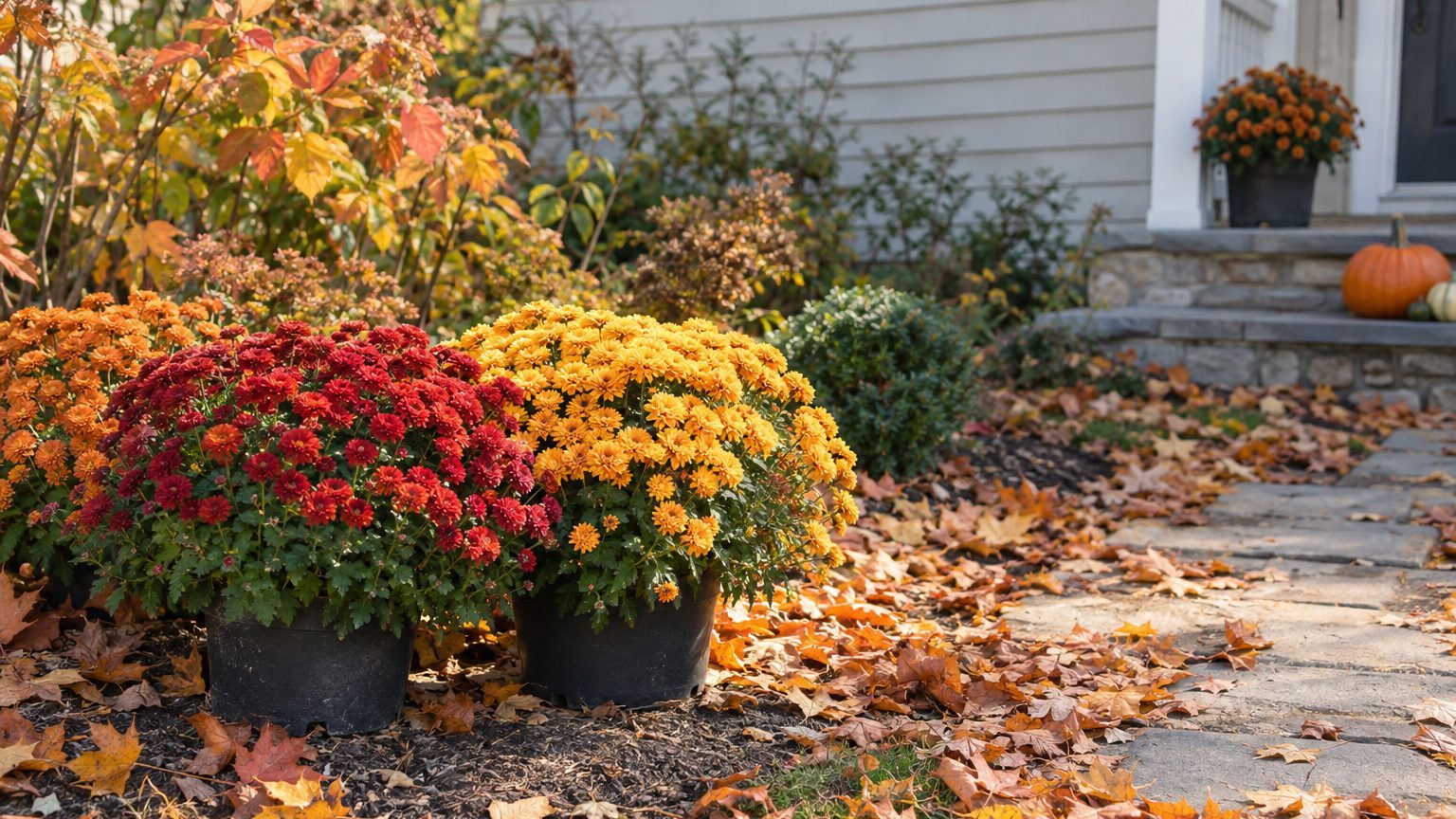

Florist mums are not the hardy perennials that the usual fall advice assumes. The pot of mums from a grocery store or florist and the garden mum from a nursery bench look alike in bloom, and only one of them is built to come back. Find the plant tag before you do anything else, because it tells you which set of rules applies to your plant.
Garden mums can stay out, florist mums usually cannot

Which mum you have decides everything. Iowa State University Extension and Outreach says garden mums are more cold-hardy than florist mums, and that the varieties sold as flowering potted plants at the florist are not winter hardy in Iowa and cannot be successfully planted outdoors. The rules below for stems and mulch are for garden mums, the hardy kind that count as perennials.
Telling the two apart
Start with the tag or the receipt. A plant labeled as a hardy garden mum is the one worth planning a winter for. A plant in a foil sleeve with no hardiness information, sold in full bloom as a seasonal decoration, is almost certainly the other kind. Iowa State describes these potted plants as intended for indoor decor or use as annuals in outdoor containers and garden beds. That is the job they were bred for.
If the tag is gone, ask the nursery where you bought it. If nobody can say, assume the plant is the tender type and treat anything it does as a bonus.
The planting-time problem
Even a true garden mum can fail if it goes in late. Iowa State warns that while many mums are available at garden centers in early fall, those planted in late summer or early fall often do not survive the winter. The plant is simply sold at its showiest, long before it has had time to settle into the soil.
That does not mean you should refuse a fall mum. It means you should buy it knowing the odds are not in its favor, and give it everything the following sections describe. Nothing here guarantees a plant will return, and a mum that does not is not evidence that you did something wrong.
Your local season sets the clock. Look up the first and last frost dates by state and watch your own first frost rather than the calendar. Gardeners in Canada should check guidance from a Canadian source, since hardiness and winter conditions can differ from the US advice quoted here.
Leave the old stems standing
Do not cut the plant down in fall. Iowa State reports that research has found garden mums survive better if the old growth is left standing through the winter. This runs against the tidy instinct that sends most people out with shears after the flowers fade, and it is the easiest part of the whole job because it asks you to do nothing.
What to do this week
Put the pruners away and leave the browned plant exactly as it is. Faded blooms, dry foliage and all of it can stay. The old growth is not dead weight in this case. The research Iowa State cites favors the plant that was left alone.
Mark the spot if you are the sort to forget. A mum with standing stems is easy to find, but once it is later cleared or buried under leaves, a short stake beside it keeps you from digging it up by accident when you plant bulbs nearby. For the broader question of which plants want cutting and which want leaving, see our page on when to cut back perennials in fall.
What to skip
Skip the fall cleanup for this one plant even if the rest of the bed is going tidy. Neighbors may think the brown clump looks neglected. That is fine.
This advice is for garden mums in the ground. Iowa State gives no standing-stems rule for florist mums, so do not read it as a trick that rescues one.
Mulch once the ground has frozen
Timing matters more than the material. Iowa State explains that mulch helps keep the soil uniformly cold after it has frozen, which eliminates the alternate freezing-thawing cycle and the resulting soil heaving. The purpose is not to keep the plant warm. It is to keep the ground from swinging back and forth.
Iowa’s timing, and yours
For Iowa, Iowa State says to apply several inches of straw or pine needles over the plants in late November or early December. That timing is Iowa’s. Your own ground freezes on its own schedule, so use the principle (mulch after the soil has frozen) and ask your county extension office what that means where you live. Do not copy Iowa’s months into a garden in another climate.
What goes on the plants
Iowa State names two materials. Both are loose, which is the point.
- Straw, spread in a layer several inches deep over the plants
- Pine needles, applied the same way
Cover the plants, standing stems included, rather than raking a thin ring around the base. For the general technique, our guides on mulching and winter protection cover how to keep the mulch from blowing away and what else is worth protecting in the same bed.
If you mulch before the soil freezes, you are doing something different from what Iowa State describes. The advice is built around mulch going over cold, already frozen ground.
Mums still in their pots
A garden mum you did not get planted in time can spend the winter in its pot, and that is the route for plants bought late. University of Illinois Extension says places like an unheated garage, shed, or cool or cold basement can be good locations for potted perennials over the winter. A garden mum is a perennial, so that advice fits it.
Before the pot goes away
Water first. University of Illinois Extension advises making sure the plants are well watered before you get pots ready to overwinter. A dry root ball going into storage is the mistake to avoid, since a sheltered spot often leaves the pot out of reach of rain and snow.
Then move the pot into the unheated garage, shed, or cool basement you have chosen. Leave the old stems alone, as with a plant in the ground.
Check on it through the winter
Storage is not set and forget. University of Illinois Extension says to check the plants throughout the winter. Make it a habit to look in on the pot whenever you pass the garage door. Neither source gives a watering interval, and the right answer depends on your pot, your space and your weather. Feel the soil and decide from there.
A florist mum is another matter. Iowa State says florist varieties cannot be successfully planted outdoors, and describes them as meant for indoor decor or as annuals. Storing one in a garage is a gamble with no promise attached. Keep expectations low and do not spend effort on it that a hardy plant deserves.
In spring
Once new growth starts, the old stems come off. Cut them back to make room for the fresh shoots, and then pull away the straw or pine needles from the plants as the ground wakes up. Potted plants can come out of the garage or shed when your own frost risk has passed, which you can judge with the frost dates for your area in mind.
A mum that has come through winter in good shape is also a candidate for splitting. Our page on dividing perennials explains how and when to do it.
Common questions
Can I plant a florist mum in the ground and hope?
You can, but expect it not to return. Iowa State says florist mums are not winter hardy in Iowa and cannot be successfully planted outdoors. A mum you bought as a garden mum is the one worth planting.
My mum looks dead in winter. Should I pull it?
No. Brown, standing stems are what Iowa State says garden mums should have through winter. Wait until spring growth begins before deciding anything.
Is straw or pine needles better for covering mums?
Iowa State names both and does not rank them. Use whichever you can get easily, and apply several inches over the plants once the ground has frozen.
Do these rules apply in Canada?
Use them as a starting point only. Iowa State and University of Illinois Extension write for US conditions, so a Canadian gardener should look for Canadian guidance where the rule differs.
Winter protection advice changes with the source and the climate, so confirm current guidance with your county extension office before you act.