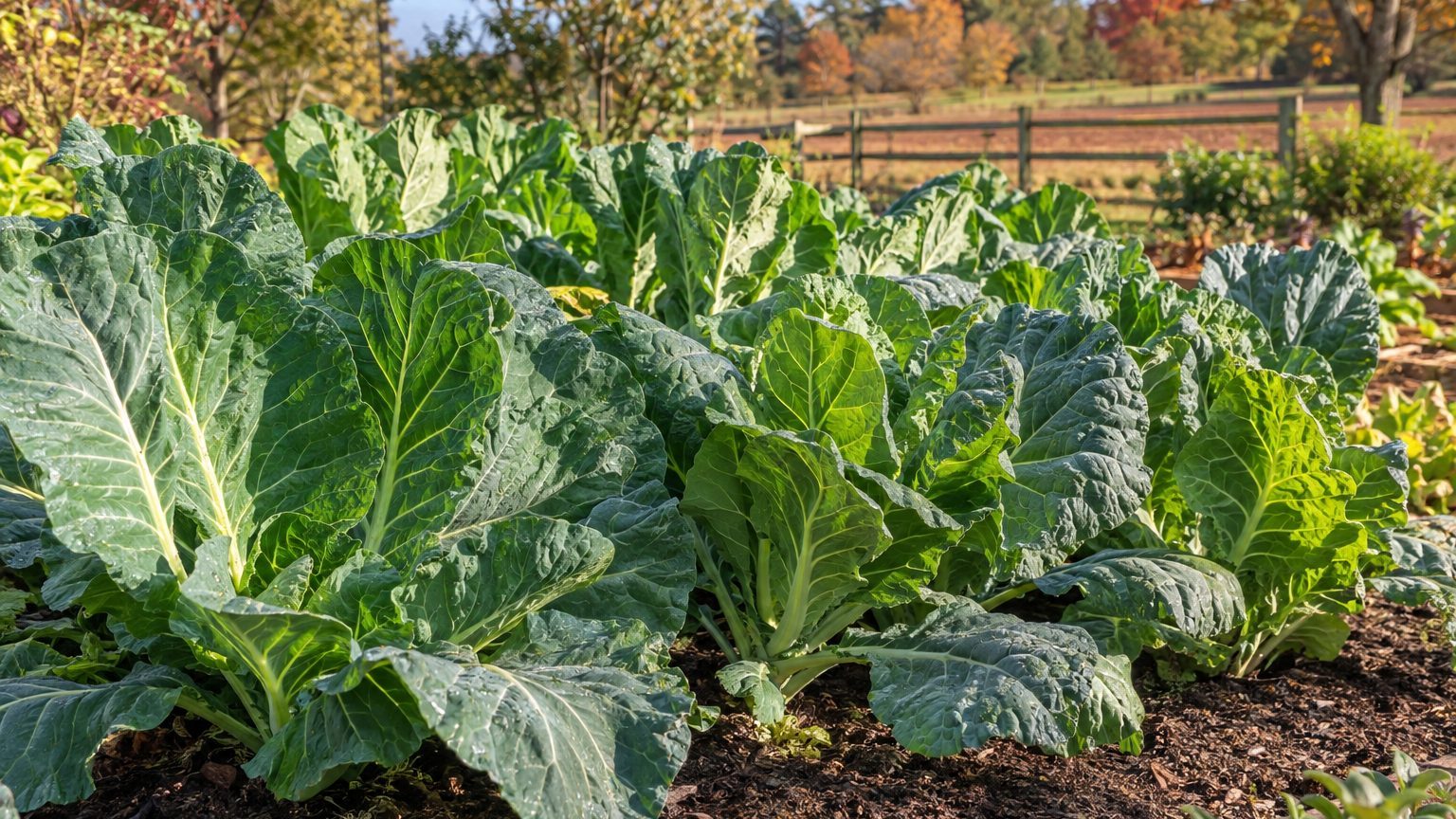

Plant a fast, cold-tolerant collard such as Vates or Flash as a transplant, and plan a harvest that runs past the first fall frost. Minnesota’s season is long enough for collards but too short for the biggest, slowest Southern heirlooms to finish well in every garden. Kale, mustard and turnip greens fill the gaps where collards fall short.
The short answer for Minnesota
The best collards for Minnesota are compact, quick, cold-hardy types, with Vates as the dependable standard and Flash as the speedier option. Set them out as transplants rather than sowing seed in the garden. Save the large heirlooms, Georgia Southern among them, for the mild south of the state, and expect smaller plants even there.
The reason is the length of the season. In the Twin Cities, the last spring 32°F freeze falls between April 17 and April 30, and the first fall one between October 11 and October 23. Those are probabilities of a 32°F freeze, not promises. Inside each band, the chance of a freeze on the far side of that date runs between 30 and 70 percent, so it is close to a coin flip. Collards shrug off light frost, which means a transplant can go out near the early end of the spring band if it has been hardened off. The details of timing are laid out in When to Plant Collards in Minnesota, and the broader growing basics are in Growing Collards in Minnesota.
Choosing by type
Collards split into a few types, and the split matters more here than any single variety name.
| Type | Examples | Fit for Minnesota |
|---|---|---|
| Compact, cold-tolerant open-leaf | Vates | Best all-round choice, finishes in a short season and handles cold nights |
| Fast, smooth-leaved | Flash | Good for a midsummer transplant aimed at a fall harvest |
| Tall, large-leaved heirloom | Georgia Southern | Needs a long season, best reserved for the warmer south and an early start |
| Heading, cabbage-like | Morris Heading | Worth a trial, though it asks for more time and room |
Greens to grow alongside
Kale is the natural partner, since it takes cold even better than collards and keeps producing after hard frosts. Mustard greens and turnip greens mature fast and suit spring sowing, while Swiss chard handles summer heat with less fuss. A bed that mixes two or three of these gives you something to pick whether the season runs long or short.
What will not work here

Overwintering is the first thing to cross off. The coldest month in the Twin Cities has a mean daily minimum of 8.8°F, and that is the mild reference point, not the harshest corner of the state. A collard plant can sit through a lot of cold, but that kind of winter ends the Southern habit of leaving plants in the ground and picking from them until spring. Treat collards as an annual and plan a new planting each year.
The slowest varieties are the next casualty. A tall heirloom that needs a long, warm run to reach full size starts losing ground when a transplant goes out in late May. By the time the first fall freeze arrives (October 11 to October 23 in the Twin Cities, two to three weeks earlier in the north), the plant is still adolescent, with leaves too small to be worth cooking. Gardeners often blame the variety, but the real culprit was a start date that left too little runway.
Direct-sowing seed into cold spring soil works poorly too. The soil in April and early May is slow to warm, germination drags, and the seedlings that do emerge are small targets for flea beetles, which thrive in just those conditions. Transplants started indoors a few weeks ahead skip that vulnerable stage and give the plant a head start that a short season cannot supply later.
Summer brings a different problem. Minnesota summers can run hot and humid, and a crowded planting holds moisture around the leaves, which encourages fungal leaf spots and gives cabbage worms and aphids a sheltered place to hide. Collards packed shoulder to shoulder look productive in June and turn into a tangle of yellowing lower leaves by August. Give each plant room for air to move through, and pick the lowest leaves first so the base of the stem stays open.
Watering once a week and calling it done does not suit a plant with shallow roots. A cool-season crop stressed by midsummer heat and uneven moisture turns tough and bitter, and it may bolt. Steady moisture, mulch over the root zone, and a midsummer transplant for the fall crop (rather than hoping the spring planting survives July) give far better leaves.
Finally, do not wait on a perfect frost. Cold sweetens collard leaves, but a stretch of hard freezes will end the harvest. Pick generously in the weeks between the first light frost and the first deep one, then freeze or cook what you have.
What changes across Minnesota
Minnesota is not one garden. The USDA Plant Hardiness Zone Map (2023 edition, based on 1991-2020 normals) places the state anywhere from zone 3a to zone 5a. That is a wide spread, and there is no single answer for the whole state. The system is built on one variable, the average annual extreme minimum temperature, so it tells you about winter cold and says little about how fast spring warms or how long summer lasts.
The Twin Cities sit at the mild end, and the frost dates above come from there. Northern Minnesota runs two to three weeks tighter at both ends of the season, so spring starts later and the first fall freeze arrives sooner. Someone gardening near the Canadian border may find the window between the last spring freeze and the first fall one shrinks enough that only the fastest collards, or kale, make sense.
So what should a northern gardener shift? Start transplants indoors on the later side of the local spring window, but give them more time under lights so they are sturdy when they go out. Choose Vates or Flash over any slow heirloom. Use row cover to take the edge off cold nights in both spring and fall, and plant on a south-facing slope or against a wall where heat collects. Kale and turnip greens deserve a bigger share of the bed.
Gardeners in the south and southeast of the state have more room. A spring crop followed by a midsummer transplant for fall is realistic, and a larger-leaved variety may finish if it goes in early. Even so, the cold figure for the coldest month still rules out leaving plants through winter. To see where your own garden falls, look up your location on the USDA Plant Hardiness Zone Map rather than guessing from the nearest big city.
Where to check this for your own county
The best next stop is University of Minnesota Extension. Its county offices and Master Gardener volunteers work with local conditions every season, and they hear about what failed last year and what held up.
Two things are worth looking for there. The first is a planting calendar for your county or region, which will place spring transplant dates and fall sowing dates closer to your own frost pattern than any statewide range can. The second is any information on varieties trialled nearby, particularly for cool-season greens. A variety that did well in a university trial two counties over is a safer bet than one chosen from a seed catalog description alone.
A county recommendation beats a state one, and the picture painted above is the state-wide one. It leans on Twin Cities normals, adjusted by the general rule that the north runs two to three weeks tighter at both ends. Soil type, lake influence, elevation and the shelter of a particular lot all shift the real numbers. If the extension calendar and the statewide ranges disagree, trust the extension calendar.
When you call or visit a county office, bring specifics. Say how big the bed is, how much sun it gets, which variety you tried and when it went in. That turns a general conversation into practical advice, and a Master Gardener can often tell you in a few minutes which pests are active in your area and when they usually show up.
Checking this against your own garden
Your own observations outrank every date in this article. Three are worth watching.
- Soil warmth by feel. Push your hand into the bed in the morning. If the soil feels cold and clammy a couple of inches down, seedlings will sulk and transplants will stall. If it feels cool but not cold, and crumbles instead of clumping, it is ready. A bed that warms early, such as a raised bed or a sunny slope, will let you plant days ahead of a shaded, low-lying neighbor.
- Frost on the grass. Walk out at dawn after a clear, still night. Frost that lingers in one corner of the yard while another stays clear shows you where cold air pools. Collards belong in the clear spots in spring, and the frosty corner can wait for the hardiest greens.
- The first true leaves. Collard seedlings first show two rounded seed leaves, then the true leaves that look like tiny versions of the mature plant. Once a seedling has its first true leaves and has begun to harden off, it can face the garden. Slow or leggy growth at that stage means the plants need more light or cooler indoor conditions.
Write down what you see and the date, year after year. Two or three seasons of notes will tell you more about your own microclimate than a state calendar can.
Common questions
What is the single best collard variety for Minnesota?
Vates is the usual recommendation, because it is compact, handles cold and finishes in a short season. Flash is a good second pick for a fast fall crop.
Can collards survive a Minnesota winter?
Plan on no. The mean daily minimum of the coldest month in the Twin Cities is 8.8°F, and colder still in the north. Grow collards as an annual and replant each year.
Is it better to start collards from seed outdoors or from transplants?
Transplants. They skip the slow, cold-soil stage of spring and give the plant a head start in a season where every week counts.
What should I grow if my collards keep falling short?
Kale is the most forgiving substitute, since it takes cold better and keeps going after hard frosts. Mustard and turnip greens mature quickly and suit a short season.