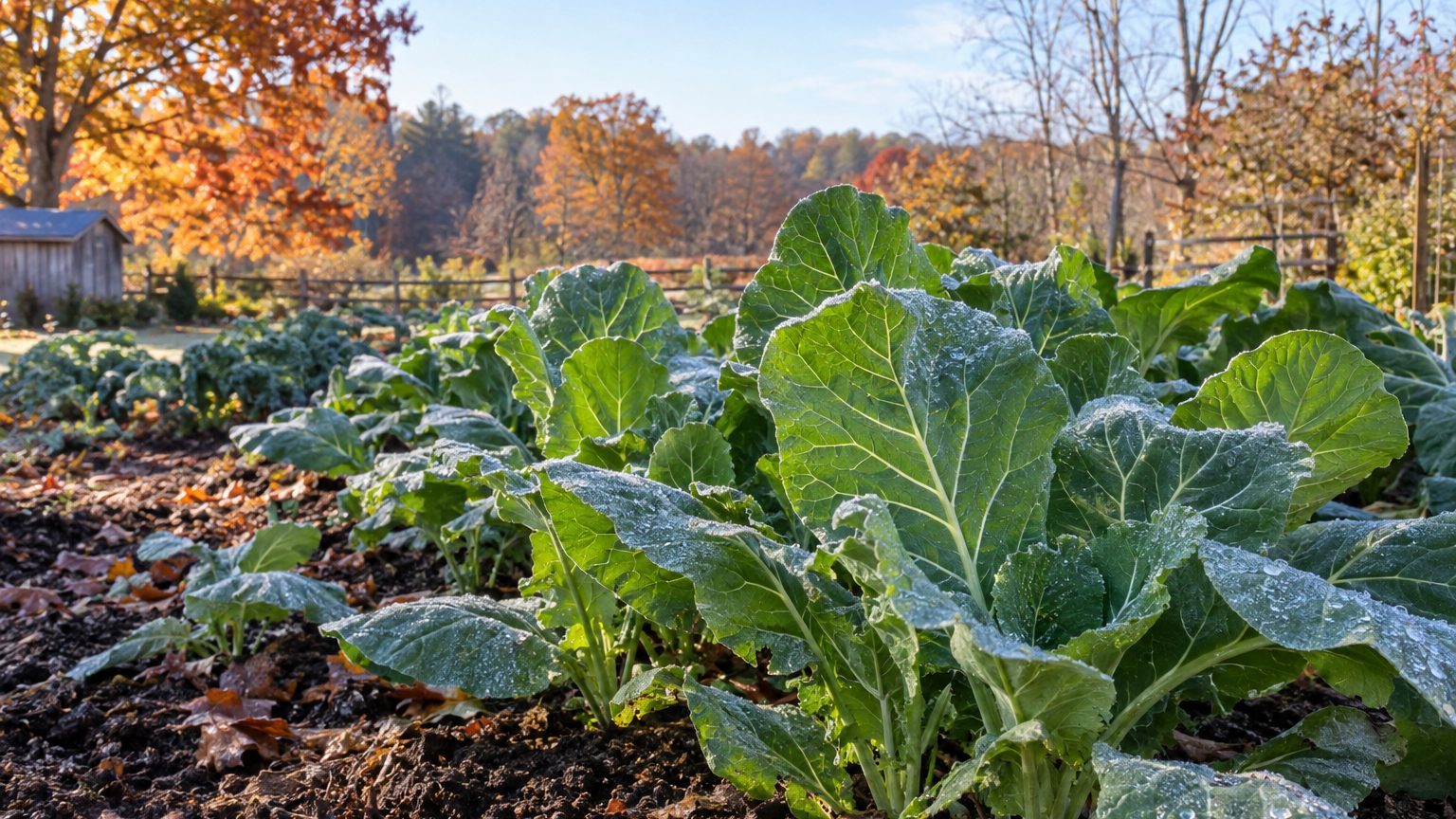

Collards go in the ground twice a year in Missouri: once in early spring, a few weeks ahead of the last freeze, and again in midsummer for a fall crop that matures after the first frosts. Both windows hang on freeze dates rather than calendar dates. Spring plantings get a harvest in before the worst heat, and fall plantings give the sweetest leaves, because cold nudges starch in the leaf toward sugar.
The short answer for Missouri
Plan on getting spring collards in the ground around the last-frost window of April 6 to April 20, and on having fall collards growing strongly before the first-frost window of October 18 to October 29. Those two bands are the whole skeleton of the calendar. Everything else (seed starting, hardening off, midsummer sowing) is counted backward or forward from them.
What are those dates a probability of? They come from NOAA’s 1991-2020 Climate Normals for the Kansas City International Airport station, and they mark the stretch of dates where the odds of a 32°F freeze run between 30 and 70 percent. A freeze after April 20 is less likely, but it still happens in some years. One caution matters for anyone not near the airport: that station sits well north of the city. Downtown Kansas City runs about five days earlier in spring, and southern Missouri is milder still.
Collards are a cool-season crop that tolerates light frost, so the last-frost band is not a hard “do not plant before” line. Hardened-off transplants can go out ahead of it. The band is the point by which they should be in, so the plants are well rooted when the weather turns warm. The roughly six months between the spring and fall bands gives room for both a spring and a fall crop, which is longer than many northern gardeners get.
A working calendar, anchored to the frost dates
| Task | Anchor |
|---|---|
| Start spring seed indoors | Late winter, counted back from the April 6 to April 20 band |
| Set out spring transplants | Before or during the last-frost band, once hardened off |
| Sow or transplant the fall crop | Midsummer, counted back from the October 18 to October 29 band |
| Harvest the sweetest leaves | After the first frosts, through fall |
The fall row takes the most care. Read the seed packet to see whether the days to maturity count from sowing or from transplanting, then count backward from the first-frost band and add a few weeks, since growth slows as days shorten. For more on the crop itself, see Growing Collards in Missouri.
What will not work here
Starting the spring crop in May fails reliably. Collards sown that late meet July heat before they have built much leaf. Plants stall, the leaves toughen and turn bitter, and cabbage worms and aphids have the whole summer to work on stressed foliage. Spring sowing is a race against heat, and the April 6 to April 20 band is the starting gun.
Sowing the fall crop too late fails for the opposite reason. Growth slows sharply once the first-frost band of October 18 to October 29 arrives, and the coldest month brings an average daily low of 19.5°F at the Kansas City reference station. An average low that cold means plenty of nights colder still. A seedling that is only a few inches tall by late October will not bulk up before the deep cold arrives. It will sit there, and it may not make it through.
Counting on collards to overwinter uncovered is a gamble in most of the state. Established plants often come through a stretch of cold, but with January lows averaging 19.5°F, leaves burn and plants can die back in a hard snap. Where winters are gentler, in the southern part of the state, overwintering is more dependable. Where they are not, a row cover or a low tunnel is cheap insurance.
Summer is hard on a hands-off watering routine. Hot, dry spells can arrive in July and August, and a single weekly soaking will not carry a shallow-rooted collard plant through them. Plants wilt, leaves go leathery, and growth halts. Deep watering and a few inches of mulch do more than any other fix.
Humidity calls for the opposite caution from dryness. Where summers are hot and humid, collards planted shoulder to shoulder hold moisture in the canopy, which invites leaf spot and gives aphids and caterpillars a place to hide. Give each plant room for air to move. The long frost-free season does mean even slow-maturing varieties have time to finish if they go in on schedule. For how the types compare, see The Best Collards and Greens for Missouri.
What changes across Missouri
Missouri is not one garden. The USDA Plant Hardiness Zone Map (2023, built on 1991-2020 normals) runs from 5b to 7b across the state, so there is no single answer to when to plant. The northern tier and the southern edge differ by several half-zones. Each half-zone is a 5°F step in the average annual extreme minimum, and that gap shows up in how early spring work can start and how long fall harvests last.
Keep in mind what hardiness zones measure. The system uses one variable, the average annual extreme minimum temperature. That predicts whether a perennial survives winter. It does not set a planting date, which depends on the frost dates above. The frost dates in this article describe Kansas City’s airport station, so treat them as a reference point, not a rule for the whole state.
From that reference point, the adjustments go in predictable directions. Gardeners in the north should expect the spring window to open later and the fall frost to arrive earlier, which leaves less margin on both ends. They should favor faster-maturing varieties, start transplants indoors, and consider row cover for the fall crop. Readers in the south, where spring is milder, can move their spring work earlier, and overwintering becomes more realistic. The Ozark hills add a wrinkle, since higher ground and cold hollows can run colder than a nearby town, and a low spot can hold frost long after the ridge above it has cleared.
Nobody should guess their own zone from a state average. The USDA Plant Hardiness Zone Map lets you look up your ZIP code, and that is the place to find it.
Where to check this for your own county
University of Missouri Extension is the best next stop. It runs a county office in nearly every part of the state, staffed by specialists and trained Master Gardeners who know local soils, weather quirks, and pest pressure. Start by finding the local planting calendar for your county. It will list vegetable sowing and transplanting windows tuned to the area, which is more precise than any statewide range.
Look next for the varieties trialled near you. Collards and other greens that do well in one part of the state may struggle in another, and extension trials and county recommendations show what has actually grown there. If a county office offers a vegetable guide or answers questions by phone or email, ask which collard types hold up through summer heat in your area and when local gardeners start their fall crop.
A county recommendation beats a state one. Anything written for the whole state, including the frost bands above, has to average over a lot of ground, and the difference between a river bottom and a hilltop can be bigger than the difference between two cities. Use the dates here to set up a first-draft calendar, then let the county office correct it.
Checking this against your own garden
Your own observations outrank every date above, and three of them cost nothing.
- Soil warmth by feel. In spring, push a hand into the bed. If the soil crumbles instead of clumping into a cold, wet ball, and it no longer feels chilly, it is workable. A bed that warms early is a good candidate for the first transplants. One that stays cold and soggy is telling you to wait.
- The first true leaves. Seedlings first show two rounded seed leaves, then the first true leaves with the shape and veining of a collard leaf. Hardening off and transplanting makes sense once seedlings have a few true leaves. If they stay small and pale after that, the spot is too cold or too shaded.
- Your first and last frost. Note the dates of the last frost on the lawn or car windshield in spring and the first in fall. If your garden has a low corner that frosts earlier than the rest, that is a cold pocket, and it should hold your hardiest crops or none at all.
Keep notes for a few seasons. A garden log with sowing dates, frost dates, and how the plants performed will end up more accurate for your yard than any regional chart.
The Moon calendar is a separate, older custom: see when to plant collard greens by the moon, written as tradition rather than fact.
Common questions
Can I plant collards in the fall?
Yes, and many gardeners prefer the fall crop. Start it in midsummer so plants are well grown by the first-frost band of October 18 to October 29. Cool weather and light frost improve the flavor.
How early can I set out spring transplants?
Collards tolerate light frost, so hardened-off transplants can go out ahead of the April 6 to April 20 last-frost band. Be ready to cover them if a hard freeze threatens.
Do collards survive Missouri winters?
Sometimes. The coldest month averages a daily low of 19.5°F at the Kansas City reference station, and that is cold enough to burn leaves or kill plants in a hard snap. Mulch and row cover improve the odds, and the milder south does better than the north.
Should I sow seed directly or use transplants?
Either works. Transplants save time in spring, when the window before summer heat is short. For the fall crop, direct sowing in midsummer is common, but summer soil dries fast, so keep the seedbed evenly moist. Check whether the packet counts days to maturity from sowing or from transplanting, because the difference changes your last safe planting date by several weeks.