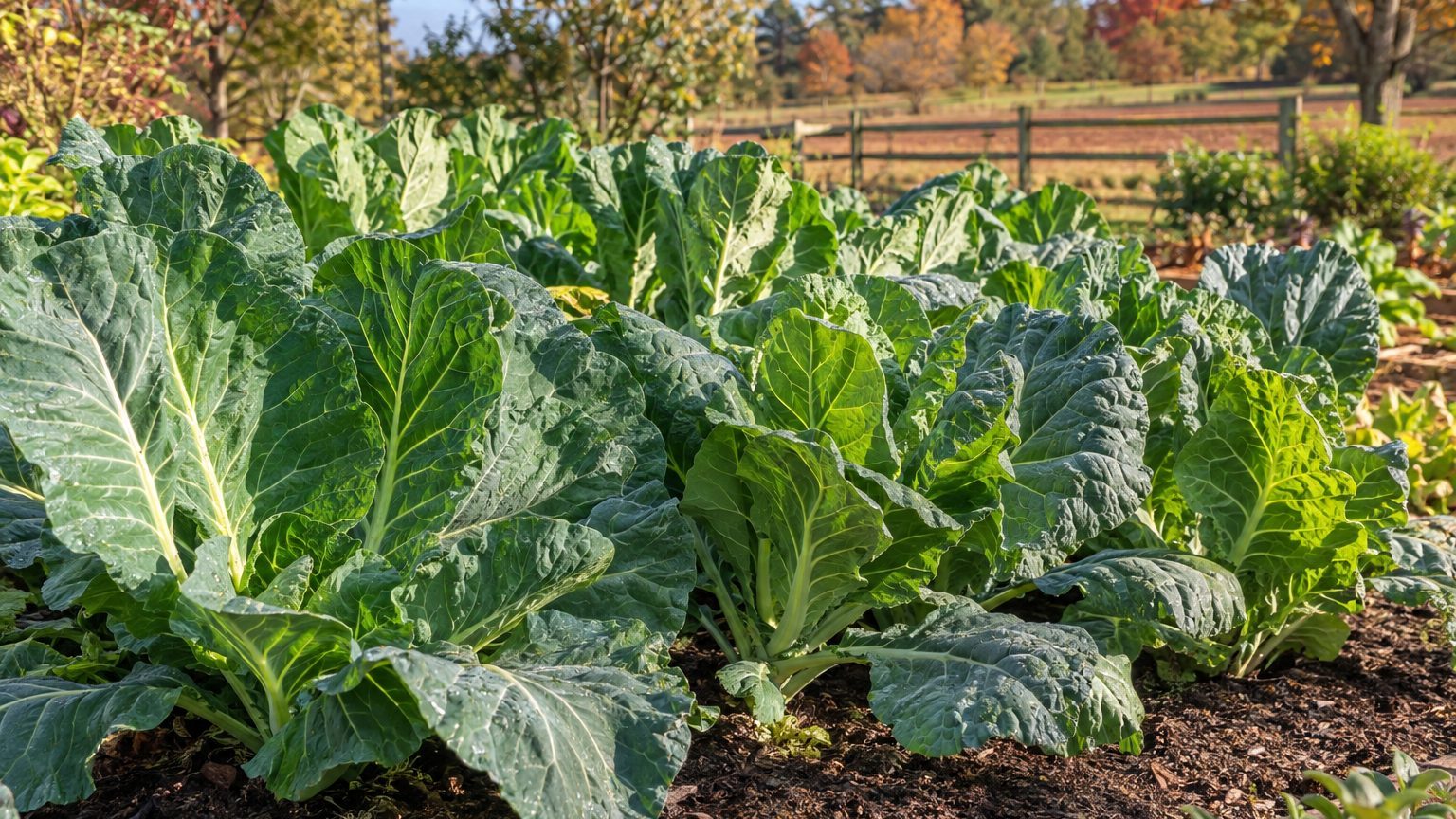

Quick-maturing, compact collards and hardy kale are the safest choices for New Brunswick. Big, slow Southern types are a gamble in a season this short. Collards handle cool weather well, so the real question is how much of the season a variety needs to fill out. Start seed indoors, grow a spring and a fall crop, and favor speed over size.
The short answer for New Brunswick
Choose by type: fast, compact, non-heading collards for the main crop, kale and other cold-loving greens beside them, and the largest slow-growing Southern collards only as an experiment. The reasoning is plain arithmetic. Moncton’s 1981-2010 climate normals put the last spring frost on average on May 23 and the first fall frost on average on October 2, which leaves roughly 132 days between the two.
Those are mean dates, not safe dates. In about half of years the last frost lands after May 23, and in about half the first fall frost arrives before October 2. Treat each as the middle of a window. Collards shrug off light frost, so hardened-off transplants can go out a little ahead of the spring date under row cover. The planting calendar for collards in New Brunswick works through that window in detail.
Collards by type
| Type | Fit for a ~132-day average season | What to watch |
|---|---|---|
| Compact, quick non-heading collards (Vates and Flash are widely sold examples) | Best bet. Usable leaves well before fall frost. | Still start indoors and harden off. |
| Large, slow Southern-type collards (Georgia Southern is the classic) | Marginal. They want a long, warm run. | Late, thin harvest if set out after early June. |
| Loose-heading types such as Morris Heading | Possible, but heading takes time you may not have. | Harvest leaves rather than waiting for a head. |
| Kale (Siberian and Russian types) | Excellent. Hardier than collards. | Keep covered against pests early on. |
Greens to grow beside them
Turnip greens and mustard are quicker than any collard and tolerate cool weather. They make a good fill-in for a gap in spring or a second sowing in late summer. Kale deserves the most space after collards, since it carries on well past the first frosts. For the full growing routine, see Growing Collards in New Brunswick.
What will not work here
Overwintering in open ground will not work. The mean daily minimum of the coldest month is -13.9 °C (6.9 °F), and that is an average night, so many nights run colder. Collards are fine with frost but are not built for months at that temperature. Treat them as an annual, even though they are technically biennial in milder climates.
The slowest collards
Large Southern collards that want a long, warm run fit poorly into about 132 frost-free days. Set them out after a slow start and they will be half-grown when October frost arrives. You will pick a few small leaves where a compact variety would have given you steady cuttings for weeks. Late sowing in July makes the problem worse, because cool nights slow growth just as the plants should be bulking up.
Trusting a single date
May 23 is the middle of the range, not a green light. Because the last frost falls later than that date in roughly one year out of two, a gardener who plants tender seedlings on the date itself will lose plants about half the time. Collards survive light frost better than most garden crops, but a hard freeze on unhardened transplants can still set them back or kill them. Row cover and a few days of hardening off are cheap insurance.
Crowding in damp weather
Humid, damp late summers and fall mornings keep leaves wet longer, and wet leaves invite fungal and bacterial leaf disease. Spacing collards lets air move through the planting, and it matters most for the big varieties. Crowded rows also hide pests, which chew small holes in young leaves in warm spells. Lightweight row cover from planting until the plants are established blocks most of that damage.
What changes across New Brunswick
The reference city, Moncton, sits in Canadian hardiness zone 5a, according to Natural Resources Canada’s 1991-2020 normals. That system is not the USDA map. It combines seven climate variables, where the USDA uses one, and NRCan itself says there are no simple conversions between them. Canadian zone 4a, for instance, overlaps nine USDA zones, from 3a to 7a. A Canadian zone number should never be read as a USDA zone.
A province is not one garden, either. Moncton’s frost dates and zone are those of one city. Northern and upland districts run weeks behind it, so there is no single answer for the whole of New Brunswick. To find where your own garden falls, look up your municipality on Canada’s Plant Hardiness Site, and compare it with Moncton’s zone before borrowing any dates.
If you garden in the north or at elevation, shift your plan in a few specific ways:
- Choose only the fastest compact collards and kale, and skip the large slow types.
- Start seed indoors earlier, but set plants out later, hardened off and under row cover.
- Sow or transplant the fall crop earlier in summer, so plants are established before nights turn cold.
- Use a sheltered, south-facing spot and stay away from low ground where cold air settles.
Coastal sites, valley floors and hillsides can differ from each other by the same weeks.
Where to check this for your own county
Start with Agriculture and Agri-Food Canada, which links through to provincial agriculture resources. Look for two things: a local planting calendar with frost dates for your region, and any vegetable variety trials run in your part of the province. A trial that grew collards or kale in your region is more useful than any national seed catalog, because it was tested in your soil and your growing season.
A county or district recommendation beats a provincial one, and this is the provincial one. Frost dates here come from Moncton’s 1981-2010 climate normals, while the hardiness zone uses 1991-2020 data, and the US numbers on this site use 1991-2020 as well. Normals shift over time, and a recent local source may show an earlier spring or a later fall frost than the older figures.
When you find a regional frost date, use it in place of May 23 and October 2, and keep the idea of a window, not a deadline. Ask a local garden center or seed supplier, too. Their stock usually reflects what has done well nearby.
Checking this against your own garden
What you see in your own yard outranks any date in print. Three observations are worth making each spring.
Soil warmth by feel. Push your bare hand a few inches into the bed. If the soil feels cold and clammy, hold off on direct sowing. Warmth that arrives early on a slope and late in a low spot tells you where your earliest ground is.
First true leaves. The first pair after the seed leaves tells you the seedlings are ready to harden off. If they take much longer than a packet suggests, your window is running late, and a faster variety is the wiser choice.
Frost on tender neighbors. Watch where frost blackens early plantings, or where it lingers on the grass in the morning. A patch that stays frosty after the rest of the yard has thawed is a cold pocket. Put your earliest collards elsewhere, and leave that corner for a later crop of hardy greens.
Common questions
Can collards survive a New Brunswick winter outdoors?
Not reliably. The coldest month’s mean daily minimum is -13.9 °C (6.9 °F), and the plants are not built for months at that temperature. Grow them as an annual and enjoy the sweeter leaves after fall frost.
What is the best collard for a first-time grower here?
A compact, quick-maturing non-heading type, started indoors and set out hardened off. It gives usable leaves well before the average first frost on October 2.
Is kale a better choice than collards?
For a short season, often yes. Kale is hardier and keeps producing later into the fall. Collards are worth growing for their broad, sturdy leaves, so many gardeners plant both.
Do I need a second sowing for fall?
It helps. A summer planting of collards, kale or turnip greens matures in cool weather, and frost sweetens the leaves, so the fall harvest is often the best-tasting one.