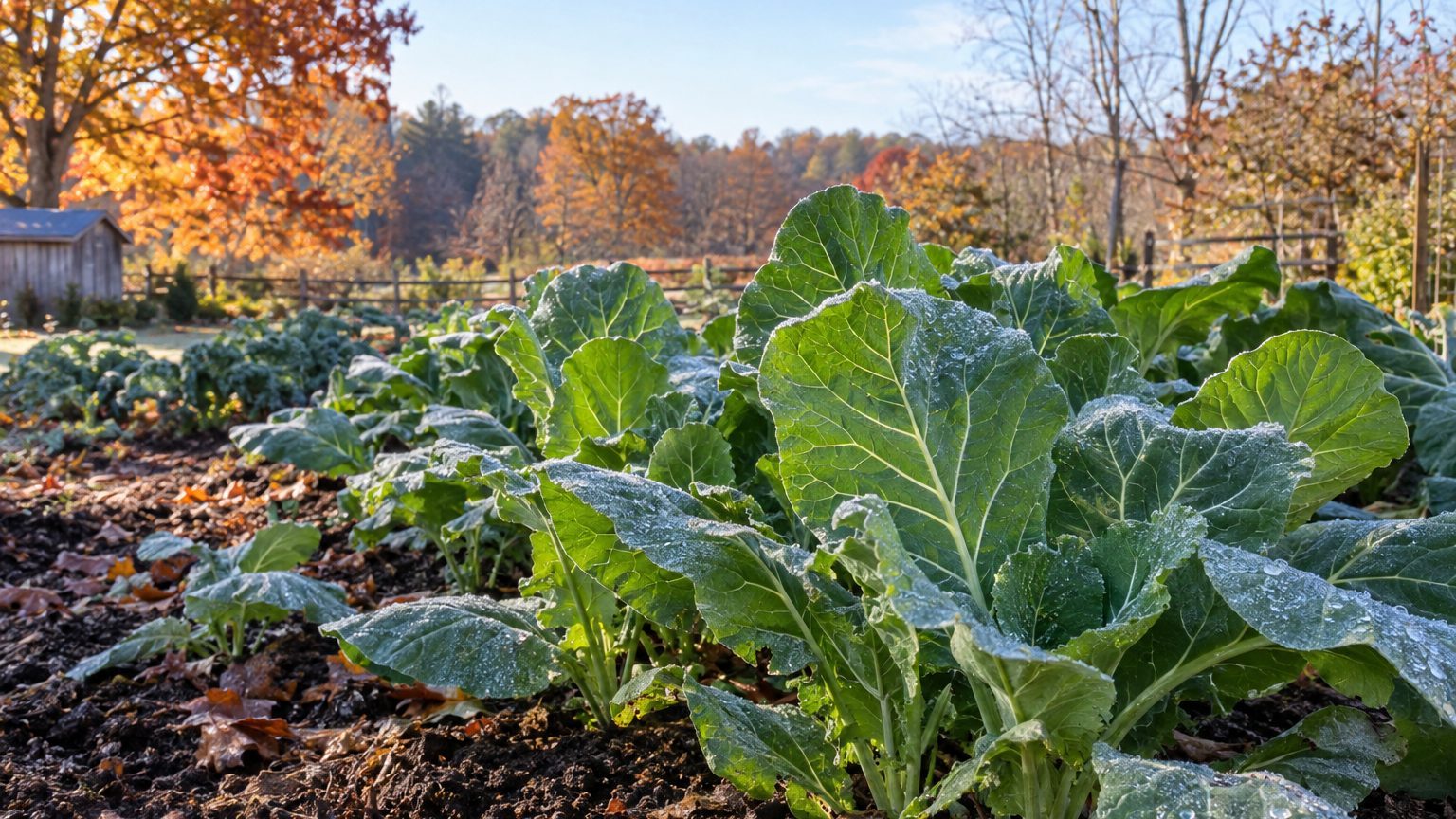

Start collard seed indoors in early to mid April and move seedlings out around the third week of May. Sow a second batch in midsummer for a fall crop. Those dates hang on Moncton averages: May 23 for the last spring frost, October 2 for the first fall one. Both are midpoints, so half of all years break them.
The short answer for New Brunswick
Environment and Climate Change Canada’s 1981-2010 normals for the Moncton station put the average last spring frost on May 23 and the average first fall frost on October 2. Each date is a 50 percent mark. In one spring out of two, the last frost lands later than May 23. In one fall out of two, the first frost arrives earlier than October 2. Treat both as the middle of a window, never as a safe date.
That leaves about 132 days between the two averages. It is enough for collards, which are slow, leafy brassicas, but only if the plants start as seedlings rather than seed sown into cold ground. The table below turns those two dates into a working calendar.
| Task | Timing | Anchored to |
|---|---|---|
| Sow spring seed indoors | About April 10 to 15 | Roughly six weeks before May 23 |
| Harden off, then transplant | Mid-May to early June | Collards take a light frost; keep cover on hand until after May 23 |
| Sow fall crop (indoors or in a nursery bed) | Mid-June to early July | Working back from October 2 |
| Transplant fall crop | By mid-July | About 11 weeks before the average first frost |
| Harvest | Young leaves from late June; fall picking through and after the first frosts | Leaves sweeten in the cold |
Spring crop
Collards tolerate light frost far better than tomatoes or beans, so transplants can go out a week or so before the average last frost date, as long as they have been hardened off for several days. A floating row cover covers the gamble. If the forecast drops well below freezing, a sheet or an upturned bucket will do for a night.
Fall crop
The fall planting often outperforms the spring one. Cool nights improve the flavour of the leaves. Count the days to maturity on the seed packet from transplanting, since collards are set out as seedlings, and subtract that from October 2. Slower varieties need to be in the ground earlier. The best collards and greens for New Brunswick are the ones that finish inside this window, and the full guide to growing collards in New Brunswick covers the rest of the season.
What will not work here
Southern planting calendars are the first thing to discard. Advice written for places where collards go in during February, or where a single sowing feeds a household from fall through spring, does not survive a Moncton winter. The mean daily minimum of the coldest month is -13.9 °C (6.9 °F). That is an average of the nightly lows, so individual nights fall well below it. Collards survive light frost and even a hard freeze for a few hours, but they do not overwinter at those temperatures, least of all in a winter with little snow cover. Plan each planting as an annual that ends when the cold settles in.
Direct sowing into cold May soil fails more quietly. Seed sown in early May may sit for weeks, or sprout slowly. Starting indoors gives plants a head start, and that head start matters in a short season. A packet that says “sow outdoors after the last frost” is written for a longer summer than this one.
The slowest varieties are the next casualty. A strain that needs a long stretch of heat to reach full size, sown or set out in late June, will not reach full size before the October 2 midpoint. If the frost arrives early, the plants are cut off at their smallest. Pick quicker types for any planting after mid-June, or accept that you will be harvesting young, tender leaves instead of full-size ones.
Crowding fails for a different reason. Close spacing suits a hot, dry climate where plants shade each other’s roots. In the damp air of a New Brunswick summer, with coastal fog and frequent rain, leaves that touch stay wet longer, and wet foliage invites leaf spots and gives caterpillars shelter. Giving each plant room keeps air moving between leaves. Rotating the bed so brassicas do not return to the same soil for a few years also cuts the odds of soil disease.
Finally, trusting the average date as a guarantee. May 23 is the middle of the distribution, not the end of it. Gardeners who set out unprotected tender transplants on that day lose them in roughly half of years.
What changes across New Brunswick
The Moncton numbers describe one station, and a province is not one climate. Natural Resources Canada places Moncton in Canadian plant hardiness zone 5a, based on 1991-2020 normals. That is a Canadian zone, built from seven climate variables, and it does not convert to a USDA zone, because the two systems measure different things. Other districts fall into other zones, so there is no single answer for the province. To see where your own town sits, consult the Plant Hardiness Zone by Municipality map from Natural Resources Canada rather than guessing from a neighbor’s garden.
The practical effect is that northern and upland districts run weeks behind Moncton. Spring arrives later there and fall frost comes earlier, which squeezes the growing season from both ends. A gardener in those districts should push the indoor sowing back by the same number of weeks that the thaw is delayed, and treat the fall planting as the priority: sow it earlier, so the plants reach size before the first frost. Fast, cold-tolerant varieties stop being a preference and become the whole strategy.
Distance from the coast and elevation both matter at a smaller scale too. A low spot where cold air pools can hold frost after the hill above it has warmed, and a south-facing slope can start ahead of a shaded yard on the same street. River valleys, hilltops and sheltered backyards each run their own calendar. Anyone gardening more than a short drive from Moncton should treat the dates above as a rough starting point, then adjust using local frost dates and their own observations, which the last two sections cover.
Where to check this for your own county
The dates in this article are provincial averages from a single station. A recommendation written for your own county will be more accurate, because it reflects local frost records, local soils and the varieties that have actually been grown there. When a county calendar and a provincial one disagree, follow the county.
Start with Agriculture and Agri-Food Canada, which links to provincial and regional agricultural services. The New Brunswick provincial agriculture department is the closer source, and its horticulture advisers are the people who know which areas run late. Two things are worth looking for. The first is a local planting calendar for cool-season vegetables, ideally one that lists brassicas such as cabbage, broccoli and kale, since collards follow the same schedule. The second is any record of varieties trialled in your area, because a variety that performed well in a trial near you has already passed the test that matters here: finishing before the first fall frost.
Local garden clubs and farmers’ market growers are also a good source of frost dates, since they plant on them every year.
Checking this against your own garden
Every date above is a starting point. What your own yard does outranks all of them, and three observations tell you more than any calendar.
Soil warmth by feel. In spring, push your bare hand into the bed to wrist depth. If the soil feels cold and clings in a wet clump, it is too early for transplants. If it crumbles and feels cool but not chilling, the roots will take hold. A bed that passes this test a week before the neighbor’s tells you that you have a warm microclimate, perhaps from a south-facing wall.
The first true leaves. Indoor seedlings first show a pair of rounded seed leaves, then the first true leaves, which look like small versions of the adult leaf. Once seedlings carry true leaves, they are ready to harden off. If they reach that stage faster than expected, your indoor setup is warmer or brighter than average, and you can sow a few days later next year.
Frost on the grass. Check the lawn, car roof or garden bed on clear, still mornings in May and again in late September. The spot where white frost appears last in spring and first in fall marks the edge of your season. Write the dates down for a few years, and you will have a frost record for your own yard that no provincial average can match.
The Moon calendar is a separate, older custom: see when to plant collard greens by the moon, written as tradition rather than fact.
Common questions
Can collards be direct sown in New Brunswick?
They can, but only for the fall crop, sown when the soil is warm. For the spring crop, indoor starts are far more reliable, because seed sown into cold May ground germinates slowly and loses weeks of a short season.
How late can collards be planted for a fall harvest?
Transplants set out by mid-July have until the average first frost of October 2. Later plantings can still give young leaves, but they will not reach full size. Count the packet’s days to maturity back from October 2, and choose a faster variety the later you go.
Will collards survive a New Brunswick winter?
Not reliably. The mean daily minimum of the coldest month at Moncton is -13.9 °C (6.9 °F). Plants may survive early frosts and even some hard freezes, but they should be treated as annuals and harvested before deep winter.
Do the Moncton frost dates apply across the province?
Only roughly. Northern and upland districts run weeks behind Moncton, and individual yards vary too. Use the dates as a starting point, then adjust with local frost records and your own observations.