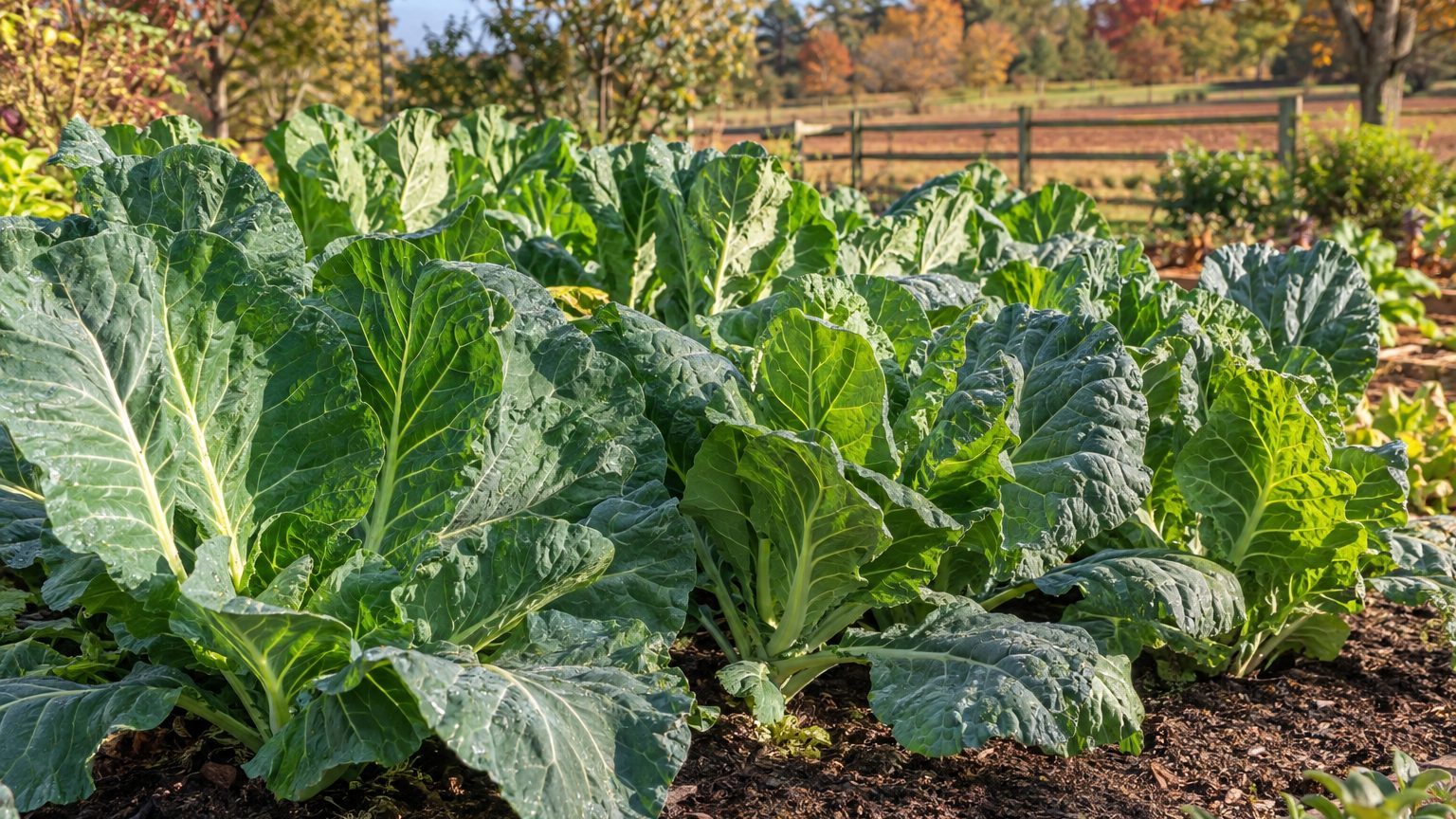

For most New Jersey gardens, the best collards are open-pollinated standards such as Georgia Southern and Vates, grown mainly as a fall crop, with a fast type like Flash for spring. The season is long enough for any of them. It is not forgiving enough for every planting date or spacing. Kale and mustard cover the gaps collards leave. Below is the choice by type, and what to skip.
The short answer for New Jersey
Start with the frost dates, because they set the length of the growing window. At the Newark reference station, the last spring frost falls between March 29 and April 6, the span where the odds of another 32°F freeze run between 30 and 70 percent. The first fall frost falls between November 4 and November 16, the same 30 to 70 percent band for a first freeze. That leaves roughly seven months between the two windows. Suburban and rural gardens usually see the last spring frost one to two weeks later and the first fall frost one to two weeks earlier, and more so at elevation. Treat the Newark dates as a reference city, not a promise for your yard. The planting calendar for collards in New Jersey turns those windows into sowing and transplanting dates.
Seven months is generous for a crop that takes far less time from transplanting, depending on the variety. Summers are hot and humid, which is the real constraint. Collards handle heat better than cabbage or broccoli, but a July heat wave still slows seedlings and invites pests. The choice by type follows from that.
| Type | Examples | Best role in New Jersey |
|---|---|---|
| Compact, cold-tolerant standard | Vates | Main fall crop; the best bet for standing into early winter |
| Large, slow heirloom | Georgia Southern | Spring transplants set out early, or a fall crop started in midsummer; tolerates heat well |
| Fast, early type | Flash | Spring crop, harvested before the worst summer heat |
| Kale, as a companion green | Lacinato, curly types | Holds up through hard cold, especially in the north |
If you plant only one, make it Vates for fall. Its upright, compact habit suits close beds and humid air, and a fall crop ripens as cool nights sweeten the leaves. The best-known collards for New Jersey gardens are all in that standard group. Mustard and turnip greens grow quickly in cool spring and fall weather and bolt in summer heat, so use them as quick fillers, not as a summer crop.
What will not work here
Planting collards in the ground in July without protection. Seedlings set out in July face hot soil, afternoon sun and a heavy flush of cabbage white caterpillars and flea beetles. Transplants of any variety struggle. A better approach is to start them in pots in light shade, or set them out on a cloudy day and shade them for the first week.
Counting on a spring crop that goes in late. Collards set out in late May reach harvest size just as summer settles in. Slow heirlooms planted that late spend most of their life in heat, grow bitter and fibrous, and draw aphids by midsummer. If spring planting slips past about mid-April, switch to Flash or a similar quick type, or wait and plant for fall.
Close spacing in humid air. New Jersey summers hold moisture, and crowded leaves stay wet long after rain or overnight dew. That sets up black rot and leaf spot diseases, which move fastest where air barely circulates. Give standard collards room between plants, and a little more for the big heirlooms. Crowding that looks tidy in June becomes a disease problem by August.
Treating winter survival as a given. The mean daily minimum of the coldest month at Newark is 25.5°F. Collard leaves usually take that without damage, which is why fall plantings keep producing deep into the season. But a mean minimum is not the extreme. Single-digit nights, which the hardiness zone range of 6a to 7b allows, burn the leaves and can kill the plant. A collard that lives through winter in one garden is a dead stalk in another a few counties north. Do not plan around a perennial patch the way Southern gardeners do.
Watering lightly and often. Shallow, frequent watering encourages shallow roots and keeps leaves wet. A deep soak, applied at the base of the plant and in the morning, works better. Mulch cuts evaporation and keeps soil temperature steadier through July.
What changes across New Jersey
The state does not have one growing climate. The USDA Plant Hardiness Zone Map (2023 edition, built on 1991 to 2020 normals) places New Jersey in zones 6a through 7b. That is a spread of several zones, each defined by the average annual extreme minimum temperature. There is no single answer for the whole state, and the Newark dates describe only the area around that airport.
In the northwest hills and higher ground, expect a later spring and an earlier fall than the reference city, by more than the usual one to two weeks. Spring planting shifts later, so favor Flash or another fast type to beat the heat, and put the main emphasis on a fall crop of Vates or kale. Overwintering collards is a gamble there. A foot of snow can protect plants, but a bare-ground cold snap will not.
Closer to the coast and in the southern part of the state, the season stretches. Ocean air moderates winter minimums, spring warms a little sooner, and fall frost can arrive later. Collards sown in midsummer for fall can produce well past Thanksgiving, and a row of Vates may carry greens into winter. Heat and humidity are stronger there too, so spacing and airflow matter even more.
Which zone applies to your address is something to look up, not assume. The USDA zone map lets you enter a ZIP code. Be aware that zone alone says little about the growing season, because it measures the cold extreme rather than the frost dates. A garden in a low pocket, on a south-facing slope or next to a warm wall can run off its neighbors.
Where to check this for your own county
The Rutgers extension service, Rutgers New Jersey Agricultural Experiment Station, runs county offices staffed by agents who know local soils and local pest pressure. Two things are worth looking for. The first is a local planting calendar for leafy greens and brassicas, which should give sowing and transplanting windows for your county, not for the state as a whole. The second is a list of varieties trialed nearby, since a variety that performed well in a research plot in your region has already handled the weather you will have.
Many offices also publish seasonal bulletins on pests such as cabbage worms, flea beetles and aphids, with timing tied to local conditions. If a local agent or master gardener volunteer is available, ask when the spring heat usually arrives in your area and when fall frosts have come in recent years. Those answers beat any average.
A county recommendation will always outrank a state one. Statewide guidance has to average across coastal plain, piedmont and highlands, so it works as a starting point and nothing more. When the county calendar and the state window disagree by a week or two, follow the county.
Checking this against your own garden
Your own observations outrank every date in a guide. Three are easy to make without special equipment.
- Soil warmth by feel. In spring, squeeze a handful of soil from a few inches down. If it crumbles instead of clumping into a cold, wet ball, and feels cool but not chilling against your palm, it is workable for transplants. A bed that stays cold and sodden after neighboring beds have dried is telling you it is shaded or poorly drained.
- First true leaves. Collard seedlings open two rounded seed leaves first, then the first true leaves with their familiar shape. Seedlings with true leaves are ready to harden off and move out. If they stay small for weeks, the space is too cool or too dark.
- Where frost lingers. On cold mornings, notice which patches of lawn stay white longest. Low spots and shaded corners hold frost later in spring and catch it earlier in fall, so those are the places to plant a little later in spring and a little earlier for fall.
After a season or two of notes, your garden’s dates become more reliable than any average, and the variety choice gets easier to adjust.
Common questions
What is the best collard variety for New Jersey?
Vates is a dependable all-around pick for fall, thanks to its compact habit and cold tolerance. Georgia Southern suits gardeners who want large leaves and have the space, and Flash works for a quick spring harvest.
Can collards survive a New Jersey winter?
Often, but not reliably. Leaves handle typical winter cold, yet hard single-digit cold can kill them, especially in the north and at elevation. Mulch and a row cover improve the odds, and kale is the safer bet for winter.
Is spring or fall better for collards here?
Fall is usually better. The crop matures as nights cool, frost sweetens the leaves, and pest pressure drops. Spring planting works if it goes in early, ideally with a fast variety.
Which other greens pair well with collards?
Kale holds on through the coldest weather. Mustard and turnip greens give quick harvests in cool spring and fall weather, and they bolt in summer heat, so time them around it.