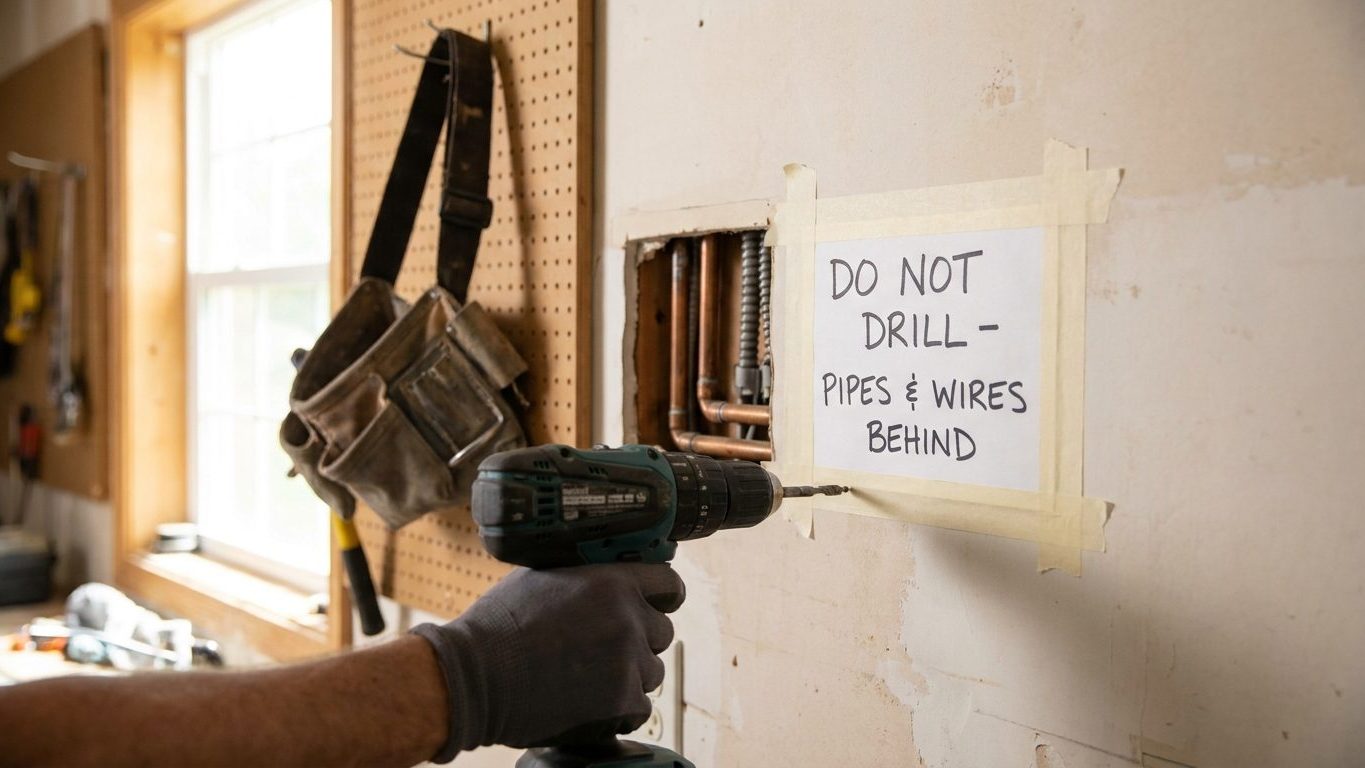

The stretch of wall directly above a switch or socket is the one zone worth naming before any other. Cable runs tend to travel straight up or down from these fittings rather than sideways, so that vertical band is effectively occupied whether or not you can see anything. Check the area with a cable detector before you touch it, and if you don’t have one, treat the whole column as off-limits.
Knowing what is behind a wall comes before every other decorating decision that involves a fixing.
What is actually going on

A wall is not a solid, uniform slab. Behind the plaster or drywall there is usually a cavity, framing timber or masonry, and running through or across that structure, a scatter of hidden services: electrical cable, and in kitchens, bathrooms and utility rooms, sometimes water pipe or gas pipe as well. None of it is visible from the front, and none of it announces itself until a drill bit hits it.
Conventions, not guarantees
Electricians and installers tend to follow habits when they run cable: keeping it vertical or horizontal rather than diagonal, running it to and from switches and sockets in straight lines, keeping it near the edges of stud bays rather than through the middle. These habits make a wall more predictable, and that predictability is exactly why people repeat rules like “never drill directly above a socket.” But a habit is not a regulation enforced retroactively on every wall ever built. It is a convention, and conventions get broken by renovations, by additions, by whoever rewired the house forty years ago and had their own logic.
Older houses are the least reliable of all. A property that has been extended, rewired more than once, or had a bathroom added where a bedroom used to be, can have cable and pipe running in directions no modern rule of thumb would predict. Chimney breasts hide flues you cannot see from the room. Solid walls hide chases cut for pipework and then skimmed over so smoothly you’d never know the plaster there is thinner than everywhere else.
Before a hole goes into any wall, you need to know, as far as you reasonably can, what is behind that particular patch of plaster. A detector sweep, a look at any accessible loft or under-floor void where the same run might be traceable, or a professional locate for anything you genuinely cannot see, all count as “checking.” Guessing does not. If you cannot check a spot with any confidence, the working rule is simple: do not drill there, and choose a different spot or a different fixing method instead. This site’s guide to hanging things without drilling exists precisely for the walls, or the exact points on a wall, where that’s the safer call.
None of this is electrical work and none of it should turn into electrical work. If a job in front of you involves a new socket, a moved switch, or rewiring a light fitting, that is a job for a licensed electrician, full stop.
Doing it
Once you accept that services can be anywhere, the practical task is narrowing down which parts of a specific wall are most likely occupied, and confirming or ruling that out before the drill goes in. Treat the following as a sequence, not a menu to pick from.
The zones to treat as occupied
| Zone | What’s usually there | Why it’s risky |
|---|---|---|
| Directly above or below a switch or socket | Electrical cable | Cable runs typically travel in a straight line to the fitting |
| Around a fuse box or consumer unit | Multiple cables converging | Density of wiring is highest here, on any wall |
| Near a boiler, radiator, sink or bath, including the wall above and below | Water or gas pipe | Pipe often runs vertically to feed a fixture one floor up or down |
| Chimney breasts and old flue routes | Flue liner or void, sometimes disused pipework | The cavity behind the plaster can be deeper or shaped differently than expected |
| Corners and internal angles | Cable turning a corner between two runs | A convenient-looking corner fixing point is also a convenient cable route |
- Sweep the spot with a cable and pipe detector before marking a hole. Skipping this is how a routine shelf job turns into a call to a tradesperson.
- Check both sides of the wall where you can, since a service that isn’t obvious from one room can be obvious from a socket, radiator or stopcock on the other side.
- Note what’s directly above and below on other floors. A pipe feeding an upstairs bathroom often runs down through the wall you’re about to drill, even a floor away from the fixture itself.
- Drill a shallow pilot hole first rather than driving a full-depth hole straight away. If you hit resistance, a change in sound, or see anything unexpected in the dust (fine gray dust from masonry is normal, anything darker or oily is not), stop immediately.
- If you cannot detect or verify what’s behind a spot with confidence, don’t drill it. Move the fixing point, or use a fixing method that doesn’t need a hole at all. What kind of wall you’re dealing with changes which of these options are realistic, and what your wall is made of is worth confirming before you decide.
Skipping the detector sweep is the single most common shortcut, usually because the job “feels routine,” a shelf bracket or curtain pole in a spot that looks identical to a dozen others in the house. It is exactly that assumption of sameness that gets people into trouble, because the wall two feet to the left may have been rewired and the one in front of you never was.
What it looks like when it goes wrong
Hitting a service
Drilling into an electrical cable usually announces itself immediately: a spark, a scrape of resistance the drill shouldn’t be making, or a circuit breaker tripping. This is a safety failure, not a cosmetic one. Stop drilling, don’t touch the bit or the cable, and get an electrician to inspect and repair the cable before that wall is used again. Don’t attempt to cap, tape or reconnect anything yourself.
Hitting a water pipe is sometimes immediate, a spray or a slow weep from the hole, and sometimes delayed, a damp patch that only shows up on the wall days later as the leak tracks through the plaster. Either way it’s a plumbing repair, not a DIY fix with sealant. Hitting gas pipe is rarer, since gas runs are usually more heavily protected and routed away from likely drill points, but if you ever smell gas after drilling, stop, leave the area ventilated, and call for emergency help rather than investigating further yourself.
Cosmetic and structural failures
Not every failure is dangerous. A fixing that spins loose in the hole, crumbling plaster around the edges, or a bracket that pulls straight out of the wall under load are cosmetic and structural problems, not safety ones, and they’re usually down to using the wrong plug or anchor for the wall type rather than anything hidden inside it. These can be corrected: enlarge and refill the hole, switch to a fixing rated for that wall, and try again a short distance away.
A hole drilled into a hollow section that turns out to be a service void, rather than solid structure, will often show as a hollow sound and a fixing that never bites. That’s not damage, just a wasted hole, patch it and move over. The failures that must be redone rather than patched are the ones involving cut or nicked cable and pipe: those need proper repair by someone qualified, not filler.
What to settle first
What the wall is
Before anything else, work out what kind of wall you’re actually dealing with, since that decides which detection methods and fixings will work. A solid masonry wall behaves differently under a detector and under a drill than a stud wall with a drywall skin, and the two need different approaches to both checking and fixing. If you haven’t already worked through this, the page on what your wall is made of covers how to tell them apart before you commit to a hole.
What’s inside it
Second, settle what services are likely nearby using the zones and checks already described, and don’t treat a clean detector sweep as infallible on its own. Detectors can miss deep cable, and older or unusually routed pipework can sit outside every convention. Where doubt remains, especially near a fuse box, a chimney breast, or a wall shared with a kitchen or bathroom, the safer route is to avoid that exact spot rather than push ahead on a partial check.
Whether the load belongs on that wall
Third, and easy to skip, is whether the wall should be carrying the weight at all. A stud wall has a limited safe load compared with masonry, and heavy items are usually better fixed into a stud itself rather than the drywall between studs. This decision sits alongside, not instead of, the service check: a spot can be perfectly safe from a cable’s point of view and still the wrong spot structurally. The broader question of what a wall can and can’t carry, and how to plan a fixing around it, is covered in “/decor/”>hanging, shelving and fixing: the wall decides, which is worth reading in full before you drill anything you’re not confident about.
Where any of this is genuinely uncertain, whether that’s the type of wall, what’s running through it, or whether it’s load-bearing in a way that matters, the honest answer is to get it checked by someone qualified rather than proceed on a best guess. A skipped check costs a few minutes. A wrong guess costs a repair, at minimum, and in the case of cable or gas, a genuine safety problem.
Common questions
Can a cable detector give a false clear?
Yes. Detectors can miss cable that’s deeply buried, shielded behind metal lath, or running at an angle the sensor isn’t reading well. A clear sweep lowers the risk, it doesn’t remove it, which is why the pilot-hole-first approach still matters even after a detector pass.
Is it safe to drill into a wall with a stud finder alone?
A stud finder locates timber framing, not cable or pipe, so it answers a different question. You need a dedicated cable and pipe detector, or a professional locate, to check for services, and a stud finder on top of that to check for framing if you’re hanging something heavy.
What if I’ve already drilled and I’m not sure if I hit anything?
Stop drilling and look at what’s coming out of the hole rather than pushing on. Fine, pale dust is normal for masonry or drywall. Anything metallic, dark, wet, or smelling of gas means stop immediately and get it checked before doing anything else with that wall.
Do older houses really ignore the usual wiring conventions?
Often, yes. A property that’s been rewired more than once, extended, or had rooms repurposed can have cable and pipe running in directions that don’t match modern habits at all. Treat conventions as a starting guess in an older house, never as a substitute for checking.