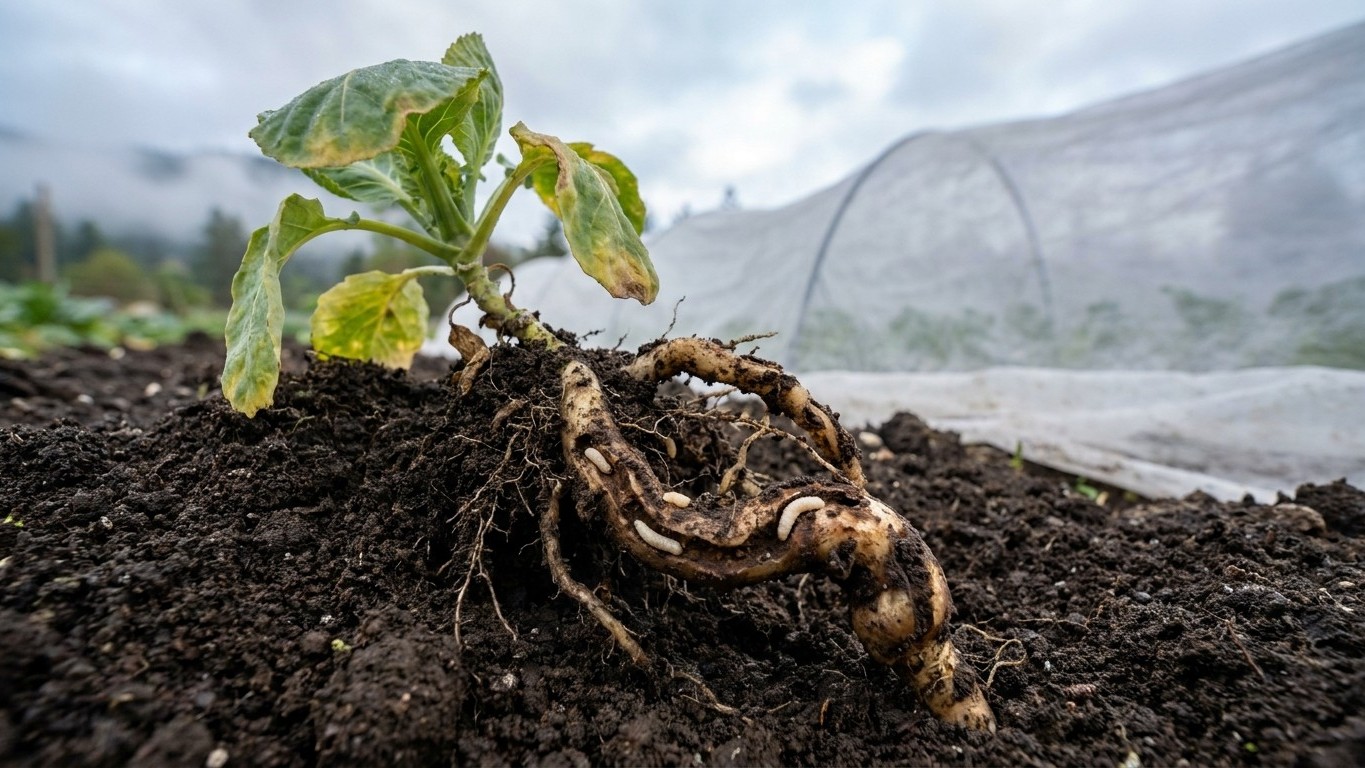

Set sweet potato slips into Vermont soil from the last week of May to about the middle of June. Go earlier and cold ground stalls them. Go later and the vines run out of season before the first fall frost. The window is tighter here than in most of the country, and it shifts by a week or two between the Champlain Valley and the hills.
The short answer for Vermont
Late May through mid-June is when slips go in the ground. The two dates that frame that window are April 30 to May 10 for the last spring frost and October 3 to October 13 for the first fall frost. Both come from NOAA’s 1991-2020 Climate Normals for Burlington.
Those dates are probabilities of a 32°F freeze. The spring span marks where the odds of one more freeze still ahead fall between 70 and 30 percent. The fall span marks where the odds that a freeze has already happened run between 30 and 70 percent. A freeze after May 10 is still possible in some years, and one before October 3 is too.
The last spring frost date is a safety line, not a planting date. Sweet potatoes are tropical vines. Frost kills the foliage outright, and soil below roughly 60°F leaves slips sitting without growing. Roots want soil near 65°F and nights that stay mild. In Vermont the soil usually reaches that two to three weeks after the last frost, which puts the earliest sensible planting in the final days of May. Black plastic laid over the bed for a week or so beforehand can speed that up.
The fall side sets the cutoff. Most varieties need somewhere between 90 and 120 days from transplanting to make a decent harvest. A slip planted on June 1 has about 124 days before October 3, and one planted on June 15 has about 110. Past mid-June you are betting on the shortest-season types and a mild fall. The The Best Sweet Potatoes to Grow in Vermont guide sorts varieties by exactly that clock.
Slips are the young rooted shoots you plant, and they are the right starting point here. Order them for delivery in the last week of May so they arrive when the ground is ready. For the full season-long picture, from slips to curing, see Growing Sweet Potatoes in Vermont.
What will not work here
Long-season varieties fail first. A type that wants a long season has no margin when the earliest safe planting leaves little time before the first frost band. The vines may look healthy in September, but the roots under them stay thin and pale-skinned. Pick varieties rated for 90 to 100 days and treat anything slower as a gamble.
Planting on May 10 because the frost table says it is safe also fails. The air may be frost-free while the soil is still cold from a long Vermont spring. Slips set into it stall, yellow and sometimes rot. Waiting a fortnight costs little, since the plants catch up fast once the ground warms.
Counting on summer heat to do the work is another mistake. Burlington averages only 5.4 days a year at 90°F or above. Most Vermont summers are mild by sweet potato standards, and the cooler hills see even less heat. Bare soil under a cool July simply grows slower roots. Black plastic mulch, or a dark mulch pulled aside to let soil warm, gives back some of the warmth the weather withholds. Lightweight row cover over the first two weeks protects slips from a cold June night.
Flat beds in heavy soil work against you too. Summer brings about 11.9 inches of rain at the reference station: 4.26 in June, 4.06 in July and 3.54 in August. A clay surface holds that water for days, and roots that sit wet crack, rot or turn out misshapen. Ridges drain the root zone and also warm faster. On sandy ground the same rain drains away within the day, and the dry stretches in August may call for a deep soak. A rain gauge on your own plot tells you which case you are in.
Last, a sprouting grocery-store root rarely fits this calendar. It needs several weeks indoors before it throws slips worth planting, and grocery roots are sometimes treated to resist sprouting. Starting from purchased slips saves the time Vermont does not have to spare.
What changes across Vermont
Vermont is not one garden. The USDA Plant Hardiness Zone Map (2023 edition, built on 1991-2020 normals) places the state in zones 3b to 5b. That is five half-zone steps, so no single planting date fits everyone.
Hardiness zones are built on one variable, the average annual extreme minimum temperature. They say little about summer warmth, but in Vermont they track elevation and latitude closely, and those are what shorten the growing season. The Burlington dates above describe the mildest corner of the state, on Lake Champlain. The Green Mountains and the Northeast Kingdom run substantially shorter, with later last frosts and earlier first ones.
If you garden in the north or at altitude, shift everything toward the safe side. Push planting a week or two later, into the first half of June, and wait for soil warmth rather than the calendar. Choose only the earliest-maturing varieties. Treat plastic mulch and low tunnels as standard equipment, not extras. A south-facing slope with good air drainage beats a low spot, because cold air settles in hollows and a frost pocket can end the season weeks early.
In the coldest sites, growing sweet potatoes in large fabric pots on a sunny deck, or inside an unheated greenhouse or high tunnel, can be more reliable than open ground. Containers warm quickly, and you can carry them under cover when a frost warning comes.
Which zone your own garden falls in is something to read off the USDA map by entering your ZIP code. Use that as a guide to how far to shift the Burlington dates.
Where to check this for your own county
Your state extension service is the best next stop. University of Vermont Extension is the land-grant program for the state, and its horticulture staff work with growers in every county.
Look for two things there. The first is a local planting calendar, ideally one that gives frost dates for a station near you rather than Burlington. The second is any record of the sweet potato varieties trialled in your county, with notes on which ones reached a good size before frost. A variety that did well in a lakeside trial may sulk at 1,500 feet, so trial results from comparable ground are worth more than a general variety list.
A county recommendation beats a state one. The window given here rests on a single station on Lake Champlain, and Vermont’s hills, valleys and lake shore differ enough that a county agent often knows when the ground really warms in a given town. If the extension office offers soil testing, it is also worth doing. Soil texture and organic matter decide how well your beds drain, and that matters for the ridges mentioned earlier.
Checking this against your own garden
Your own observations outrank every date above. Three are worth watching.
The first is soil warmth by feel. Push your hand a few inches into the bed in the morning. If the soil feels cool and damp against your palm, it is not ready, even if the calendar says June. If it feels neutral to mildly warm, planting can go ahead. Do this in a few spots, because the sunny edge of a bed and the shaded corner can differ by a week or more, and that difference is your microclimate.
The second is new leaf growth on the slips. In the first two weeks after planting, fresh leaves should unfold at the growing tip. If the slips just hang on with the old leaves, the soil or nights are still too cool. A bed where new leaves appear within a week is a warm one, and next year you can plant there first.
The third is how fast the vines close the row. In a warm, well-drained site the runners start spreading and meet across the row. If they are still short by mid-July, the garden is running cool or wet, and you should plan for a smaller harvest and an earlier variety next time. Write the dates in a notebook. Two or three seasons of your own notes will tell you more about your plot than any regional table.
If you follow the almanac, here is when to plant sweet potatoes by the moon. It is a tradition, not a proven method.
Common questions
Can I plant sweet potatoes in Vermont in early May?
Not in open ground. The last spring frost span runs April 30 to May 10, and even after it passes, the soil is usually still too cold. Early May is the time to start slips indoors or order them for late May.
How late can I plant sweet potato slips in Vermont?
About the middle of June is the practical limit. A slip planted June 15 has roughly 110 days before the first fall frost span begins on October 3, which suits only the quickest varieties. In the north or at altitude, aim for the first week or two of June instead.
When should I start slips indoors for Vermont?
Plan on several weeks before your planting date. For a late May or early June planting, that means starting in late March to mid-April. Buying slips for late May delivery skips this step.
When do I dig sweet potatoes in Vermont?
Dig around the first fall frost span, October 3 to October 13 at Burlington, and earlier in colder areas. If frost blackens the vines, cut them back and dig within a few days. Roots then need to cure in a warm, humid spot before storage.