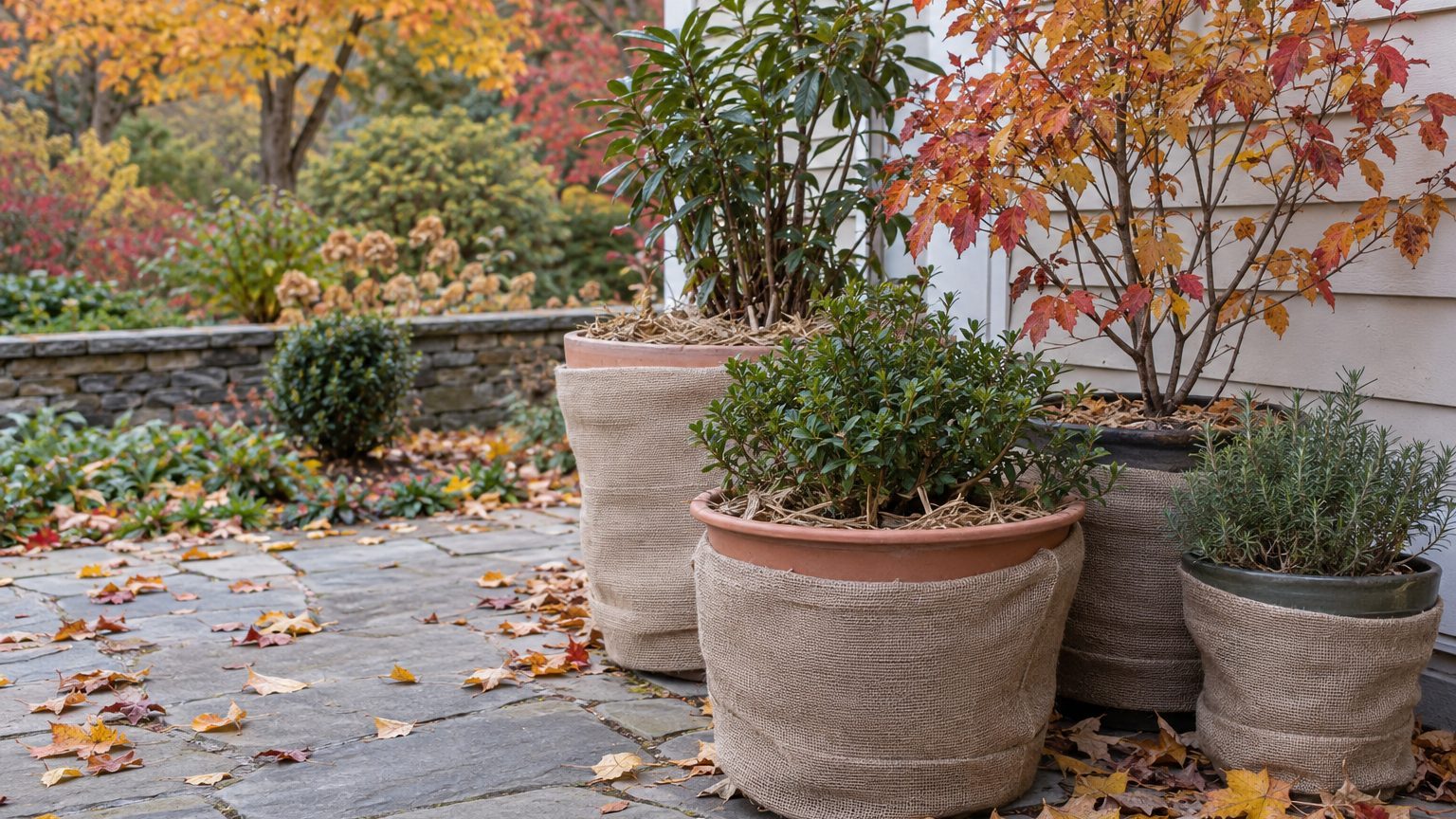

Container roots sit exposed to cold air on every side, and they are far less hardy than the stems and leaves above them. That is why a pot left on the patio can fail where the same plant in the ground would have lived. Surround the roots with soil, loose mulch or a shelter and most hardy plants come through. Before the ground freezes, decide for each pot whether it gets buried, wrapped or moved into an unheated building.
Roots in a pot freeze long before the top does

Iowa State University Extension and Outreach states it plainly: the roots of plants in containers are far less cold hardy than their aboveground parts. A shrub can look fine in early winter and still be dead at the root. The same extension service notes that soil is a good insulator and will protect the plant’s roots from extreme cold. A pot has only a thin wall between the root ball and the air, so every method is a way of putting soil, mulch or a roof back around the roots.
Choose plants that can take the exposure
Not every plant belongs in this plan. The University of Illinois Extension gives a general rule for plants that will winter in pots: select plants that will survive two zones cooler than where the plant will be growing. If you garden in zone 7, for example, look for plants rated hardy to zone 5. Plants that fall short of that margin are candidates for a frost-free room instead, and the last section covers them.
Zones here are USDA hardiness zones. If you garden in Canada, use the Canadian zone map and the Canadian rating on the plant tag, because the two systems do not line up number for number. Check the tag or the nursery’s catalogue entry before you count back two zones.
Let the plant go dormant first
Your season is set by your own weather, not by a calendar. Look up your area’s first frost dates by state and use them as a rough warning, then watch the plant itself. Leaves yellowing and dropping, growth stopping and stems hardening off all tell you it is entering dormancy. Do not move or bury a plant that is still actively growing. The steps below depend on dormancy, and the ground has to stay workable until you are done.
A short checklist before you start:
- Find each plant’s hardiness zone and subtract two from your own.
- Tag any pot that fails that test for indoor storage.
- Identify which pots are clay or ceramic (see the last section).
- Choose a sheltered spot for the survivors.
Bury the pot, or wrap it
Heel it into the ground
Iowa State Extension says plants overwintered in containers should be heeled into the ground after they go dormant but before the soil freezes. Dig a hole or trench deep enough to take the whole pot, set it in so the rim sits near the soil surface, and backfill around it. The surrounding earth does the insulating that the pot wall cannot. A vegetable bed that has finished for the year is a convenient place, and so is any corner of the yard with soil you can still dig.
Then add a cover. After the plants have gone dormant, Iowa State recommends placing 6 to 12 inches of straw, pine needles or other loose mulch over the buried containerized plants. Loose material traps air and keeps the soil beneath from swinging between freeze and thaw. Our page on mulching goes through which materials stay loose and which pack down into a wet mat.
Wrap a pot that stays above ground
Sometimes a pot is too big to dig in, or there is no soil to spare. NC State Extension describes another route. The container can be loosely wrapped with chicken wire, and the area between the pot and the wire filled with inches of leaves or straw for insulation. You are building a cage around the pot and stuffing it, so the root zone gets a thick jacket of dry material. Keep the wire loose enough that the fill is not squeezed flat against the pot. Fallen leaves are free, which makes this the cheapest wrap.
Gather pots together before you wrap them. A cluster shares the insulation, and one cage around several containers takes less fill than a cage around each. Our guide to winter protection covers wrapping the tops of shrubs and evergreens, which is a separate job from protecting the roots.
Pick the right spot
Position matters as much as material. The University of Illinois Extension advises looking for an area that does not receive strong winds or too much sunlight, such as the north or east side of a building. Wind dries stems and chills the pot wall. Too much sun can warm the container on a bright day and then let it drop hard at night, and the cycle is what hurts. A north or east wall steadies the temperature around the roots.
For a quick comparison of the three approaches above:
| Method | What surrounds the roots | Source |
|---|---|---|
| Heel into ground | Soil, then loose mulch on top | Iowa State Extension |
| Wire cage and fill | Leaves or straw around the pot | NC State Extension |
| Sheltered spot | Building wall that blocks wind and strong sun | University of Illinois Extension |
These methods stack. A wrapped pot on the north side of a house does better than the same pot in an open yard.
In an unheated garage or shed
When the yard offers no good spot, an unheated building works. Iowa State Extension suggests placing dormant plants in a moderately cold location, with temperatures from 20 to 45°F over the winter months, such as an unheated structure. The aim is to hold the plant cold enough to stay dormant and mild enough to spare the roots the worst of the freeze. A garage attached to the house often fits. A tin shed that swings with the weather may not. Put a thermometer in the space and read it on a cold morning before you commit a plant to it.
Watering a dormant plant
Dormant does not mean forgotten. Iowa State says that in an unheated structure, water may be needed as often as once every two to three weeks if temperatures are above freezing. That is a ceiling on how long you can leave them, and a dry spell in a heated-by-sun garage can shorten it.
NC State Extension gives the same warning in simpler terms. When overwintering plants, the moisture in the potting mix should be periodically checked, and dry containers watered if the temperatures are going to be above freezing. Poke a finger into the mix. If it is dry below the surface, water lightly. Skip the watering if a hard freeze is forecast, since water sitting in a frozen pot does no good and adds to the damage. A plant sitting in soggy mix at low temperatures is also a poor outcome, so give a little and let the pot drain.
The pot itself
The container can fail before the plant does. NC State Extension warns that ceramic pots may crack when moisture in the porous clay expands and contracts with freezing and thawing. Virginia Cooperative Extension goes further: terra cotta containers and other such porous materials exposed to freezing conditions will have a relatively short life, since they will crack and shatter. A pot holding wet soil through repeated freezes is the worst case. Move clay and glazed ceramic pots under cover, or transplant the contents into something sturdier before the cold sets in. Burying a clay pot in the ground changes the exposure, but a pot left sitting empty and damp on the patio will break.
Tender plants come indoors
Everything above applies to plants that are hardy enough to take winter outside. Tender plants do not qualify, and no amount of mulch makes up the difference. Pelargoniums need their own routine, laid out in how to overwinter geraniums. Tropical foliage plants have a different cutoff, covered in when to bring houseplants inside. Herbs vary widely in toughness, and the notes on overwintering herbs sort the hardy ones from those that need a windowsill.
Common questions
Can I leave hardy plants in their pots on the patio?
Only if the plant is hardy and you add protection. Iowa State Extension notes that roots in containers are far less cold hardy than the top growth, so a bare pot on open paving is the weak point even for a tough shrub. Grouping pots against a wall and wrapping them gives a better chance than leaving them scattered.
What if the ground has already frozen and I haven’t buried the pot?
Skip the digging. Iowa State Extension advises heeling plants in before the soil freezes, so frozen ground is the wrong moment to try it. Move the pot to a sheltered wall or an unheated garage or shed, or build the wire cage and fill described by NC State Extension.
Do plastic pots survive winter better than terra cotta?
The cracking warnings from NC State and Virginia Cooperative Extension concern porous clay and ceramic, so a plastic or other nonporous pot is less likely to split. It gives the roots no more insulation, though. A plastic pot still needs burying, wrapping or shelter.
I’m in Canada. Which hardiness map do I use?
Use the Canadian zone map. The University of Illinois Extension rule of choosing plants that survive two zones cooler than your own is written around USDA zones, so apply it with the Canadian rating shown on your plant’s tag, and ask a local nursery if the two systems disagree.
Winter guidance and local recommendations change, so confirm current advice with your county or provincial extension office before you act.