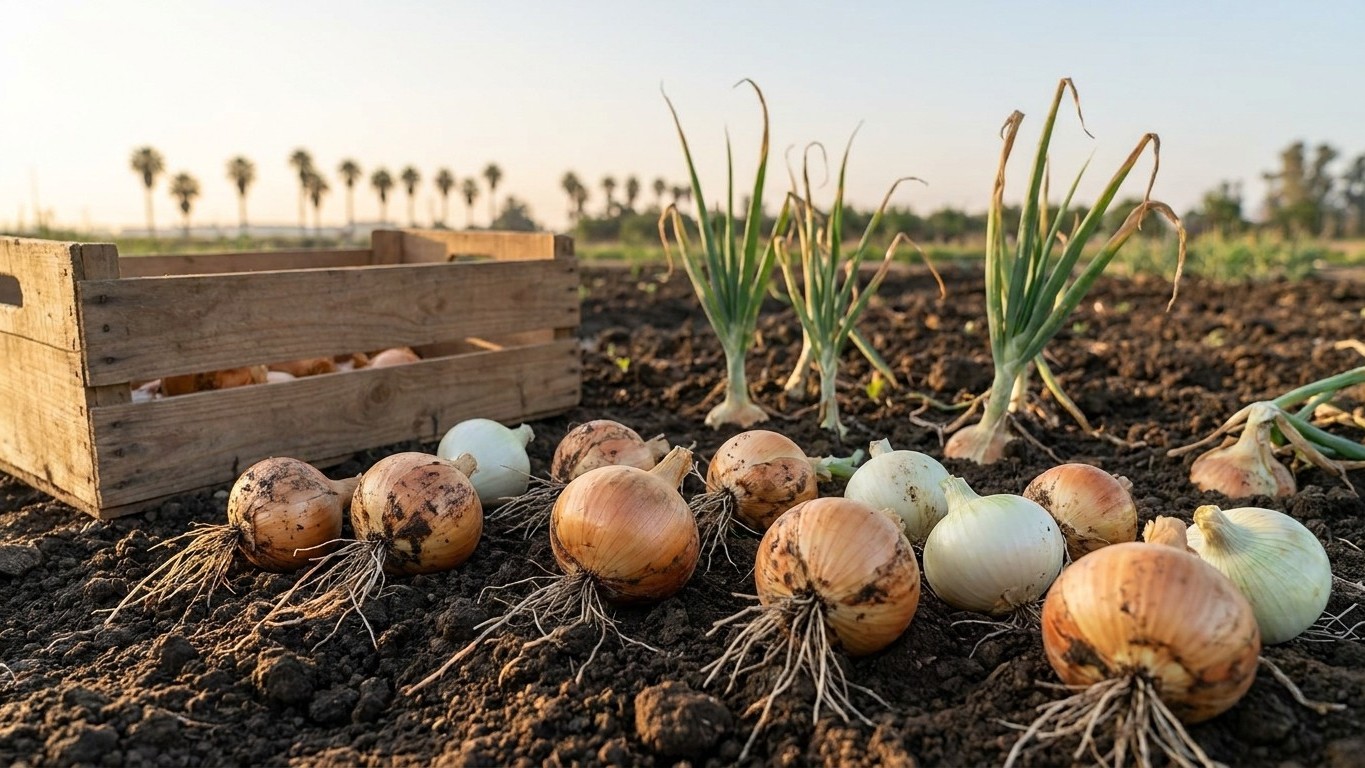

Lift onions when most of the tops have yellowed and flopped over, which in Connecticut means mid to late summer. Cure them in a warm, dry, shaded spot with good airflow until the necks are tight and the skins feel papery. Only then do they go into storage, in a cool, dry place around 45 to 55 °F. Bulbs stored before they are cured rot from the neck down. For the full growing season, start with Onions in Connecticut.
Keeping them, and for how long
How long an onion lasts depends on two things: how pungent the variety is and how well it was cured. The bite of an onion comes from volatile sulfur compounds, and those same compounds protect the bulb in storage. University of Missouri Extension states the trade-off directly: “As a rule, ‘sweet’ onions do not store as well as the more pungent types.” A sweet variety carries fewer of those compounds. It tastes better raw and will not last the winter.
Day length lines up with this. Short-day types run sweeter, and long-day types keep longer. At the reference station, 41.16 degrees north, the longest day of the year has 14 h 58 of daylight. Long-day onions wait for 14 to 16 hours before they start making a bulb, so they bulb in Connecticut. Clemson Cooperative Extension puts the trigger for short-day types at about 12 hours, which means they bulb early and stay small this far north. Latitude shifts a little between the shoreline and the northwest hills, so a gardener near the edge of the state should check their own. Variety choices are covered in The Best Onion Varieties for Connecticut.
When are onions ready to lift?
Watch the tops, not the calendar. When the bulb finishes, the necks soften and the leaves fold over and yellow, usually beginning with the earliest plantings. Once most of the tops are down, stop watering and wait for a dry spell. Loosen the soil with a fork, lift the bulbs by hand, and handle them gently, because a bruise is where rot starts. Leave the tops attached for now.
Connecticut summers can turn wet in August. A bulb pulled on a soggy day stays damp at the neck and cures slowly. If rain is forecast, lift anyway and finish the drying under cover instead of leaving the bulbs sitting in wet ground.
How do you cure onions before storing them?
Spread the bulbs in a single layer where air moves freely and the sun does not hit them directly. A covered porch, a shaded breezeway, or a barn with open doors all work. Full sun can scald the outer layers. A closed, humid room is worse, because moisture hangs in the necks.
Curing is done when the neck is tight and dry, with no give when you squeeze it. The outer skins should be papery and rustle in your hand, and the roots should be wiry and dry. Then trim the roots and cut the tops down to a short stub. Sort as you go. Any bulb with a thick, soft neck, a bruise, or a bite taken out of it goes in the kitchen basket to be used first. Damage from insects is an open door for rot, which is one reason What Eats Onion in Connecticut, and When is worth a read before next season.
What temperature and humidity keep onions longest?
Clemson Cooperative Extension’s Home & Garden Information Center gives the target in one line: “Ideal conditions are between 45 °F and 55 °F, and 50 to 60 percent humidity.” Both halves of that matter. Onions want dry air, which is the opposite of what carrots and other roots need, so a single cellar cannot hold both well. The full factsheet is on the Clemson HGIC site.
Treat any storage length as a ceiling reached only under those conditions with a well-cured, pungent bulb. A long-day onion stored well can carry a household into March. A sweet onion is for eating in the first weeks after harvest. Whatever the variety, a warm or damp spot shortens the time, and a bulb that sprouts or softens has passed the point of keeping.
Where in the house that actually is
The target range is narrow, and most rooms miss it in one direction or another. A refrigerator runs colder than that range, and its crisper drawer is humid on top of it. That is the wrong air for a cured onion. A heated living space sits well above 55 °F, and the bulbs will dry out, sprout, or both. A garage looks promising, then swings with the weather. It can be hot in August and freezing in January, and an onion that freezes and thaws turns to mush.
The room that usually comes closest in a Connecticut house is an unheated but frost-free space inside the building envelope. That might be a cool corner of the basement away from the furnace and water heater, or a back closet or pantry on the north side. Basements here have a different problem. They are often damp from late spring through early fall, and damp air pushes humidity past 60 percent. An onion in a basement that runs cool but muggy will start to rot at the neck.
Before the bulbs go in, put a thermometer and a hygrometer in the spot and read them for a week. A cheap pair is enough. Skipping this step is how a whole crop gets lost to a room that felt fine. Check again after the first hard cold snap, because a closet against an exterior wall can drop quickly. If humidity runs high, a small dehumidifier or a fan moving air across the shelf can bring it back into range.
Store the bulbs in mesh bags, slatted crates, or old nylon stockings with a knot between each bulb, anything that lets air pass. Plastic bags trap moisture. Keep onions apart from potatoes, which want a damper space and give off humidity. Once a month, go through the lot and pull out any bulb that has gone soft. One bad onion will take its neighbors with it.
Common questions
Can I store onions in the refrigerator?
Whole, cured onions do better outside it. A refrigerator is colder than the 45 °F floor of the ideal range and humid besides. Once an onion is cut, wrap it and use it within a few days, since it will not keep as a whole bulb does.
Should I lift onions if the tops have not fallen over?
Wait if you can. Green, upright tops mean the bulb is still sizing up. If the tops are still standing but a hard rain has left the bed soggy and the necks look soft, lift them and cure them under cover. Use those bulbs first, as they are less likely to keep.
Will sweet onions last through winter?
Not as a rule. Sweet types have fewer of the sulfur compounds that protect a bulb in storage, so they are best eaten soon after curing. If you want onions on the shelf into March, grow a pungent long-day variety and give it the dry, cool conditions above.
How do I know the curing is finished?
Squeeze the neck. It should be tight and dry all the way down, with no moisture and no give. The outer skins should be papery and the roots wiry. If the neck still feels thick or damp, give the bulbs more time in a warm, airy, shaded spot before trimming and storing them.