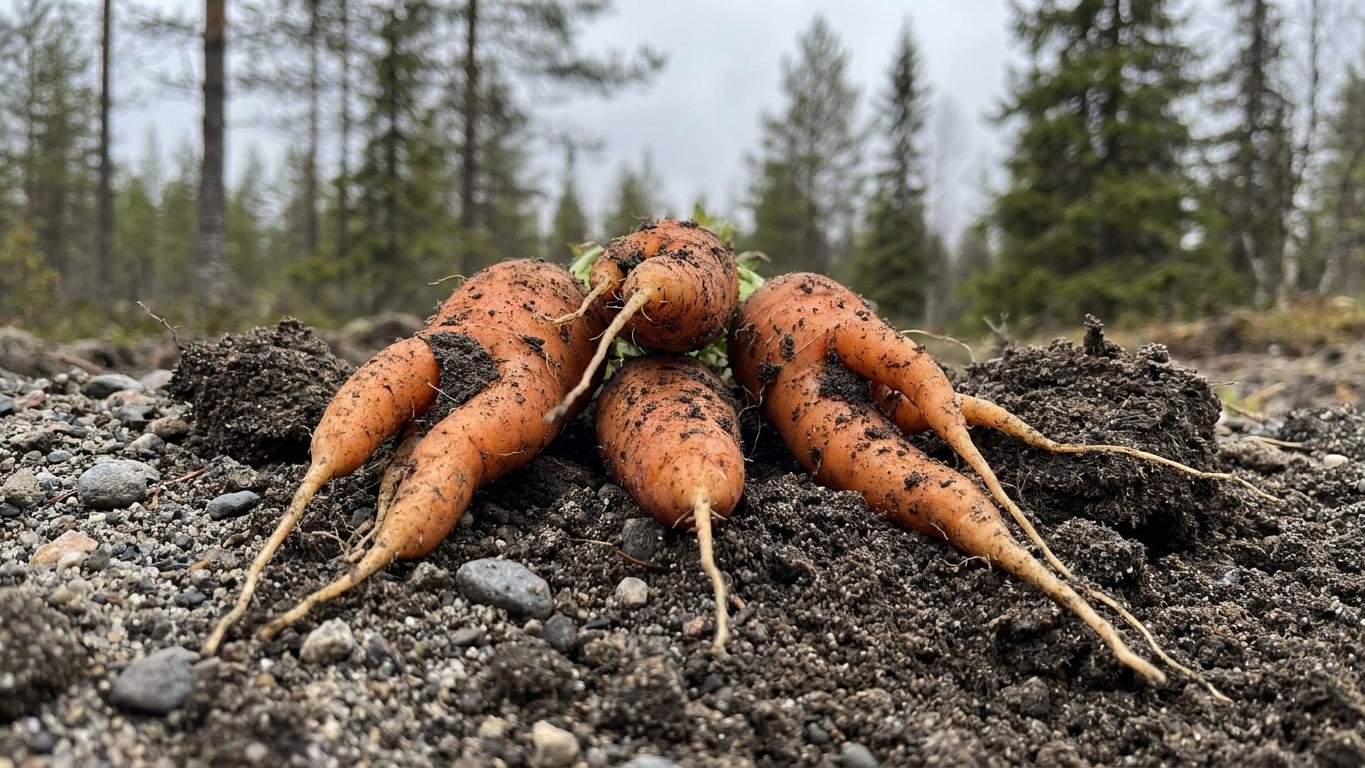

Pull carrots when the roots reach the width the seed packet promises, usually 70 to 100 days from seeding and before the ground freezes solid. To keep them, cut the tops off, set the roots in a cold, humid spot just above freezing, and count on weeks to months, depending on how close you get to those conditions. With the leaves left on, carrots last only 10 to 14 days.
How do you know when carrots are ready to pull?
Carrots are sown in place, so the clock starts the day the seed goes into the ground. Seed packets commonly list 70 to 100 days. Clemson Cooperative Extension puts the harvest at about 65 to 75 days after planting. Read the early end as the time to start checking, because the roots keep sizing up for weeks after that.
The check itself is simple. Brush the soil away from the top of one root and look at the shoulder. If its width matches what the packet describes and the color runs deep and even to the crown, pull that one and taste it. If it is thin or pale, cover the shoulder back up and wait another week. Carrots sweeten as fall weather cools, so a row left a little longer is rarely a loss.
Soil decides how easily they come out. Wisconsin’s state soil, the Antigo series, is a well-drained loam to silt that runs about 20 percent sand, 10 percent clay and 70 percent silt, with roughly 3.0 percent organic matter in the surface layer. Ground like that is well drained and lifts easily when it is moist. Water the row the day before, or wait for a soaking rain, then loosen the soil beside the row with a garden fork and lift the roots. Yanking on the tops mostly snaps them off.
That soil is a starting point, not a diagnosis. Wisconsin has hundreds of soil series, and a river-bottom lot, a hillside or a yard a builder has scraped and filled can be nothing like Antigo. Utah State University Extension says carrots want deep, sandy, well-drained soil rich in organic matter, and that heavy or rocky ground makes the root fork. Two checks settle your own bed. Dig a spade-deep hole, fill it with water and see how long it takes to drain. Then shake a jar of soil and water and let it settle to see the layers of sand, silt and clay. The full story on misshapen roots is in Will Carrots Fork in Wisconsin Soil?
Where the ground freezes solid in winter, pull whatever is left before it does. Some gardeners leave carrots in the row under a thick layer of straw or leaves and dig them as needed, which works only while the ground stays workable. Roots left in the soil also stay exposed to the animals that tunnel into them, a problem covered in What Eats Carrot in Wisconsin, and When. For the whole season from seed to harvest, start with Growing Carrots in Wisconsin.
Keeping them, and for how long
Clemson Cooperative Extension’s Home & Garden Information Center gives the target in its carrot, beet, radish and parsnip fact sheet: store carrots at 33 °F and high humidity to prevent wilting. That is barely above freezing, colder than any cellar corner most houses have in early fall. The same fact sheet says bunched carrots, meaning plants with the tops still on, keep for about 10 to 14 days.
Treat every storage duration as a ceiling reached under ideal conditions. It is not a promise. A carrot held a few degrees warmer, or in dry air, will not make it to the end of the range.
Why should you cut the tops off first?
The leaves keep pulling moisture out of the root after harvest. A root with its tops on shrivels and goes rubbery while the greens are still green, which is why the bunched figure is only 10 to 14 days. Twist or cut the tops off close to the crown on the day you pull. Trimmed roots, held cold and humid, keep for months at best, a very different timeline from a bunch lying on the counter.
The greens are edible, so use them that week or toss them in the compost. Do not leave them attached “for freshness.”
What happens if the storage spot is too warm?
Warmth is the usual way stored carrots fail. At 50 °F, a temperature many people would call a cool cellar, carrots sprout and soften in a fraction of the time they would last at 33 °F. The root starts to behave as if spring has come, spending its sugar on new top growth and going soft in the process. Dry air does the opposite damage, pulling water out until the carrot bends instead of snapping.
To hold humidity, brush off the loose soil and pack the roots in a perforated plastic bag or a lidded container with a few air holes. Some people layer them in barely damp sand or sawdust. Check the stash every few weeks and pull out any root that has gone soft before it spreads rot to its neighbors.
Where in the house that actually is
The refrigerator comes closest to the 33 °F target, and carrots handle the cold fine. Some crops suffer in a domestic fridge, but carrots are not among them. The crisper drawer, with the carrots in a perforated bag, is the best spot for a few pounds. The limit is space, since a full row’s worth of roots will not fit.
Any heated room fails the test. A kitchen counter, a pantry beside the furnace or a closet on an interior wall sits far above 33 °F, and carrots there go limp within days.
A garage swings with the weather. On a cold Wisconsin night it can drop below freezing, and a sunny afternoon can warm it well past what carrots like. Roots that freeze and thaw turn mushy, and the temperature shifts also pull moisture out of the roots. An attached garage buffers some of that. Even so, it is a gamble in late fall and winter.
For a large harvest, the best option in most Wisconsin houses is an unheated basement or cellar, ideally along a north or buried wall away from the furnace and water heater. It is cold enough in late fall and winter to come close to the target, though early fall is often too warm. An enclosed unheated porch can work the same way in a mild stretch but may freeze in a hard cold snap.
Do not guess. Set a thermometer in the spot you are considering and read it morning and evening for several days before you commit the harvest. Skipping that step is how a whole season’s carrots end up sprouted or soft by midwinter. You are looking for a steady reading as close to 33 °F as you can get without freezing. If the thermometer says 45 or 50 °F, use that space for a few weeks and put the rest of the roots in the fridge. Humidity is easy to judge by touch. A bag with a light film of moisture inside is right, a pool of water means too wet, and carrots that bend after a week mean the air is too dry.
Common questions
How long do carrots last in the refrigerator?
With the tops on, about 10 to 14 days at most, according to Clemson Cooperative Extension. Trimmed carrots in a humid bag last much longer, up to months under ideal conditions. A fridge that runs warm or a bag that is too dry will cut that short.
Can carrots stay in the ground over winter?
Only while the soil stays workable. A deep layer of straw or leaves over the row delays freezing and lets you dig roots as you need them. Where the ground freezes solid, pull everything before it does. Roots left in the soil also stay exposed to tunneling animals.
Should I wash carrots before storing them?
Brush off the loose soil and leave the rest. Wet roots sealed in a bag are prone to rot, so if you do rinse them, let them dry fully first. Many gardeners simply wash each carrot just before eating.
Do forked carrots store as well as straight ones?
Forked roots are safe to eat and keep the same way, but they are harder to peel and clean. Forking comes from heavy or rocky soil, so the fix is more compost, double digging or a raised bed rather than a change in harvest time. A drainage test and a jar test on your own bed will show which problem you have.