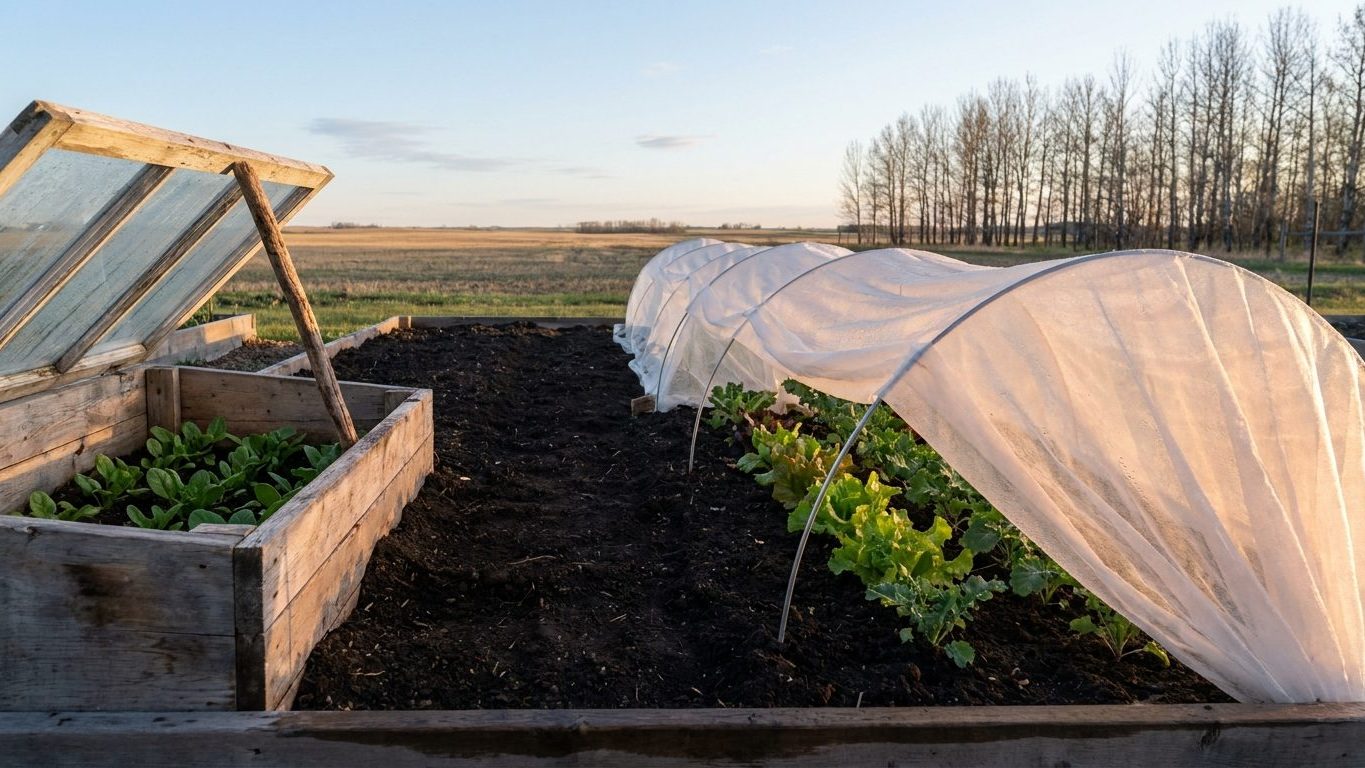

Wind shelter comes first in Nunavut, and heat comes second. The extenders that earn their keep are raised beds topped with a rigid cold frame or an anchored low tunnel, plus a small greenhouse for crops that want real warmth. Loose fabric laid over the ground rarely survives. With a growing season this short, the aim is to plant earlier and keep plants alive through the first cold snaps. The wider Extending the Growing Season in Nunavut guide covers the overall approach.
The short answer for Nunavut
For lettuce, spinach, radishes, kale and other quick leafy crops, a cold frame or an anchored low tunnel over a raised bed is the best first investment. For warmth-loving crops such as tomatoes and cucumbers, only a greenhouse gives them a real chance. Everything else is a supporting player.
How long is the growing window at Rankin Inlet?
The reference station at Rankin Inlet has about 86 frost-free days between the mean last spring frost on June 19 and the mean first fall frost on September 13. Both are mean dates, so they mark the middle of a window. In one year out of two, the last spring frost comes after June 19, and in one year out of two the first fall frost arrives before September 13. Treat neither as a safe date. These are 1981-2010 normals, and a cover is what buys you margin at both ends.
The station sits at 62.82 degrees north, so midsummer days are very long. Light is rarely what holds a plant back in July. Cold soil and cold wind are. That is why a good extender here is judged by two jobs: how much it warms the air and soil, and how well it blocks wind. Crops that respond to day length, onions for example, get plenty of it, but the bulbs still need warm enough soil to get going.
Which extender suits which job?
| Extender | What it does well | Weak point in strong wind | Best used for |
|---|---|---|---|
| Cold frame (rigid lid, solid sides) | Holds heat, blocks wind, easy to vent | Lid must be latched or weighted | Early lettuce, spinach, radishes, hardening off |
| Low tunnel (hoops, anchored cover) | Covers a whole bed cheaply | Loose edges flap and tear | Leafy greens, root crops, early starts |
| Floating row cover | Light frost protection, easy to move | Blows off or shreds if not pinned down | Short cold snaps, used under a tunnel |
| Small greenhouse | Gives the most warmth and growing room | Needs a real anchor and sturdy glazing | Tomatoes, cucumbers, transplants |
What will not work here
Light fabric alone is the most common failure. Open, windswept ground and thin row cover are a bad match, because fabric that is not buried or pinned along every edge ends up in a neighbor’s yard. Even a good low tunnel needs heavy anchoring, and tall hoop houses with thin plastic are a bigger gamble than a low, sturdy frame.
Long-season crops are the second failure. About 86 frost-free days sounds workable until you subtract the cold soil of late June and the slow start of anything sown outdoors. Melons, winter squash, sweet corn and most tomato varieties want more warm days than an open bed provides, and a cover only stretches the season at the edges. A tomato in a frame can survive a cold night. It cannot make up for a month of cool weather.
Overwintering under covers fails too. The mean daily minimum of the coldest month at Rankin Inlet is -34.3 °C (-29.8 °F). No cold frame, tunnel or unheated greenhouse holds crops through that. Garlic, hardy greens and other plants that survive winter protected in milder regions will not make it here under a cover. Treat extenders as a way to add weeks in spring and fall, never as winter protection.
Fall extension is shorter than gardeners from the south expect. The mean first frost of September 13 comes when days are already shrinking fast, so a cover that holds off frost for another week or two protects plants that have little light left to grow with. It saves what is nearly ready. It does not turn September into a second growing season.
In-ground planting is the last weak spot. Cold, shallow, often rocky soil warms slowly and drains poorly, and in many places the ground below is permafrost. Raised beds and large containers filled with imported soil warm sooner and give you control of the mix. A cold frame set straight onto native ground may never warm up enough to be worth the effort.
What changes across Nunavut
Nunavut is not one garden. Rankin Inlet is in Canadian plant hardiness zone 0a, according to Natural Resources Canada. That is the Canadian system, built on seven climate variables, and it does not convert to a USDA zone. The territory covers a huge span of latitude, from the west coast of Hudson Bay to the high Arctic islands, so there is no single answer for the whole place. The spread inside its borders is wide.
The figures above belong to one station at 62.82 degrees north. A reader farther north should expect a later last spring frost, an earlier first fall frost and a shorter list of crops that finish. In the north, lean harder on a greenhouse and on the fastest crops, such as radishes and leafy greens. Closer to the southern edge, or in a sheltered spot, a cold frame or low tunnel may stretch further. Coastal sites often warm later in spring because the sea ice and cold water hold temperatures down, while inland spots can warm faster but are more exposed to frost on clear nights.
Local conditions inside a single community matter as well. A south-facing wall, a slope that sheds cold air, or a spot behind a building can change a bed’s performance more than a hundred miles of latitude. To see where your own location falls, look it up on Canada’s Plant Hardiness Site, which maps the zones by municipality, rather than assuming Rankin Inlet’s zone applies to you.
Where to check this for your own county
Nunavut has no counties, so the practical unit is your community. Start with Agriculture and Agri-Food Canada, the federal department, for guidance on growing in northern conditions. Look for a planting calendar suited to your region and for any trial results showing which vegetable varieties have been grown in conditions like yours. A variety that performs well at a southern research farm tells you very little about a northern bed.
A recommendation for your own community beats a territory-wide one every time, and the advice above is the territory-wide kind. It tells you what category of extender suits the climate. It cannot tell you which hoop spacing survives your harbor’s winds or which week your soil is workable. People who garden in your community can. If there is a community greenhouse or garden group, ask what they planted, when they covered and what blew away. Those answers come from the same wind, soil and snowmelt you will be dealing with.
Keep one more point in mind when comparing sources. Canadian frost normals here cover 1981-2010, while American figures often cover 1991-2020. Treat any date, from any source, as the middle of a range, and plan around the possibility of a frost on either side of it.
Checking this against your own garden
Your own observations outrank every date above. Three of them tell you most of what you need to know, and none requires any equipment.
First, feel the soil. Push your hand a few inches into the bed, inside the cover and outside it. If the soil still feels cold enough to make your fingers ache, seeds will sit and wait. If it feels cool but not painful, hardy crops like radishes and spinach will move. A noticeable difference between the covered and uncovered soil tells you the extender is doing its job, and a very small one tells you the cover is too leaky or too shaded.
Second, watch for the first true leaves. The seed leaves that appear first are only the plant’s stored energy. The true leaves that follow mean the seedling is actually growing. If they show up quickly inside the cover and slowly outside, you have found a microclimate worth using. If neither is moving after a couple of weeks, the bed is too cold or too shaded for that crop.
Third, notice where the snow leaves first and where frost lingers on a clear morning. Bare patches in spring mark the warmest, best-drained ground in your yard. Frost that stays in one corner of the garden marks a pocket where cold air settles. Put your earliest beds in the first spot and your frames in the second. Then check When to Cover Your Garden in Nunavut for how to time your covering and uncovering.
Common questions
Do I need a greenhouse to garden in Nunavut?
Not for hardy, fast crops. Radishes, lettuce and spinach can do well in a raised bed under a cold frame or an anchored low tunnel. A greenhouse becomes worth the effort for tomatoes, cucumbers and anything else that needs sustained warmth, or for starting transplants well ahead of the outdoor season.
Will floating row cover survive the wind?
Only if every edge is buried or pinned down, and even then it is better used under a sturdier tunnel than on its own. Used loose over open ground, it blows off or tears quickly.
Can covers carry plants through winter?
No. The mean daily minimum of the coldest month at Rankin Inlet is -34.3 °C (-29.8 °F), which is far beyond what a cold frame, tunnel or unheated greenhouse can handle. Covers extend spring and fall by weeks.
Is June 19 a safe date to plant?
No. June 19 is the mean last spring frost at the Rankin Inlet station, so in one year out of two the last frost comes later. Hardy crops under a cover can go in before it, and tender plants should wait until your own soil and nights have warmed.