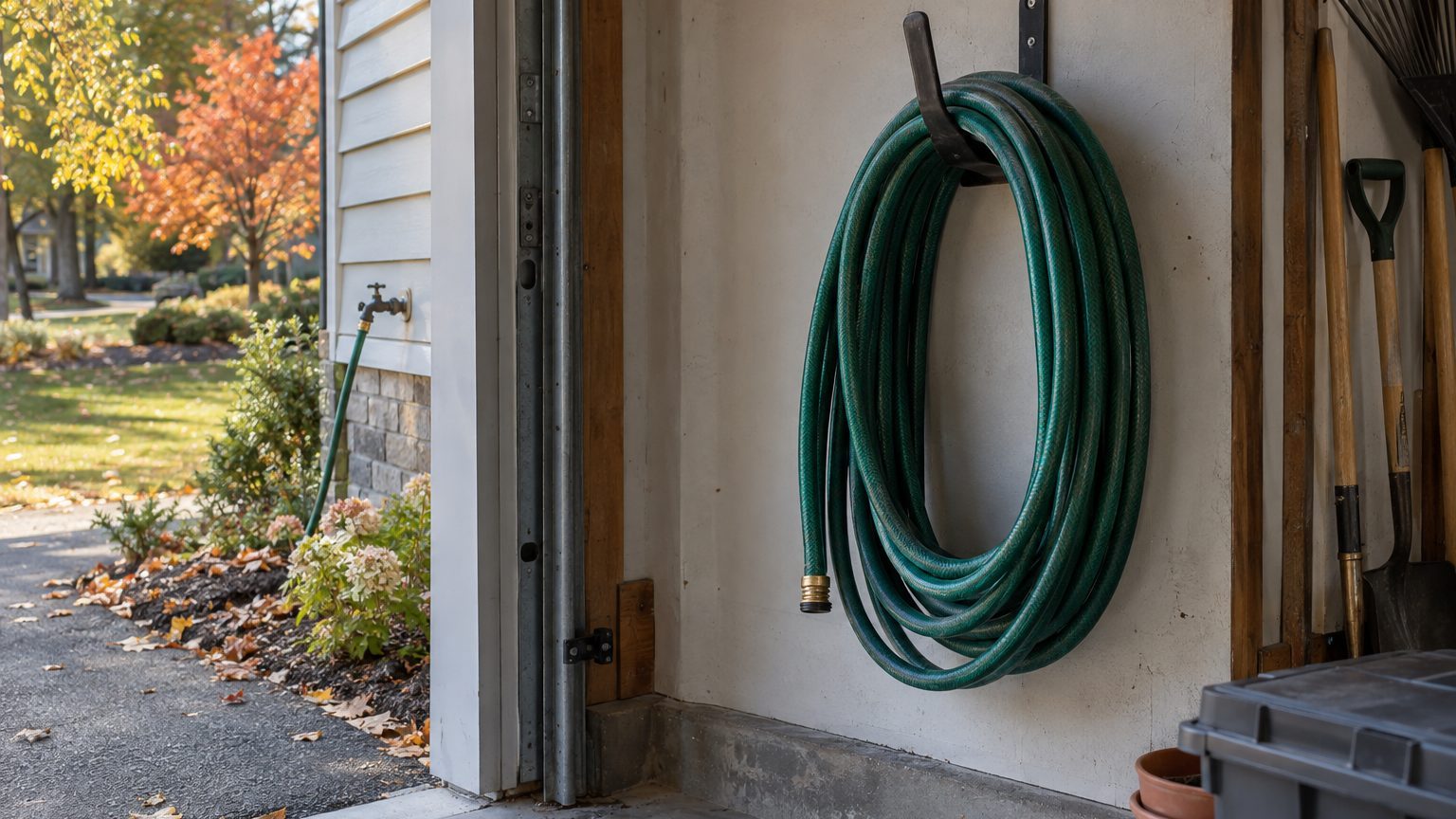

That hose still screwed onto the outdoor spigot is the one to deal with first. Take it off, empty it, coil it loosely, and carry it into a dry spot indoors. Do it before the first hard freeze, not after you hear the forecast. Then go back outside and look at the bare faucet, because that is where the real risk sits.
Disconnect, drain, roll it up, bring it in

Mississippi State University Extension Service says to drain your garden hose, roll it up, and store it indoors. University of Illinois Extension warns that leaving a hose connected to a spigot during a hard freeze could lead to disaster, because water trapped in the nozzle or spigot can expand until it bursts, and freezing water can creep back into the house and burst a pipe indoors.
What a connected hose does to the spigot
A hose holds water and has nowhere to send it. The spigot is the only exit, and it is the same short run of metal that feeds your plumbing. Illinois Extension describes two failures. One is a burst nozzle or spigot outside. The other is worse, because freezing water can work its way back toward the house and split a pipe where you cannot see it. A forgotten hose is an easy route to frozen pipes in a basement wall or crawl space.
Anything threaded onto the end counts too. Take off the spray nozzle, wand, sprinkler, splitter or timer. Illinois Extension specifically names the nozzle as a place water can sit, and every fitting you leave on is another small pocket for it.
Where it goes once it is rolled
Indoors means a garage, basement, shed or utility room, somewhere the hose will not sit in a puddle. Roll it in wide, loose loops. A tight coil forces sharp bends that crack the hose over time, and the kinks are the spots that will hold water you missed.
A reel or a wide wall hook keeps the hose off the floor and keeps the ends pointing down, so any last drops keep leaving. A pile on the concrete does neither.
Store the nozzle and fittings with the hose, in a bucket or a bin beside the reel. You will not want to hunt for them on the first warm day of spring.
Frost-free spigots too
A frost-free spigot does not excuse you from this job. University of Illinois Extension puts it plainly: your frost-free spigot is not frost-free if water is trapped by a garden hose left connected all winter.
The reason is in how the fixture works. A frost-free design is meant to let the water in the pipe behind the faucet drain out once you shut it off. A hose with a nozzle on the far end keeps that water in place, and the drain-out never happens. The fixture is only as protected as the water you let it shed.
If you are not sure which type you have, or how yours should be shut down, read our page on frost-free hose bibs. Whatever the faucet is, the hose comes off for the winter.
How to drain a hose
Oregon State University Extension Service says hoses can be drained easily by running them over a tall place where gravity forces the water to exit the hose. That is the whole method, and it needs nothing but a rail, a fence or a ladder.
- Disconnect the hose from the spigot and take off everything on the other end, so both ends are open.
- Run the hose over a tall place, such as a deck rail, a fence top or the rungs of a stepladder, so both ends hang lower than the highest point. Let gravity do the work until nothing more comes out.
Open ends matter. A nozzle left in place can hold back the last of the water, which is the water Illinois Extension is worried about.
Drain first, then roll. Mississippi State lists the steps in that order, and coiling a hose that still holds water just gives the water more bends to hide in. Once nothing comes out, roll it up and carry it in.
Then close the outdoor faucet
Shut it off and let it drain
The Philadelphia Water Department tells residents to disconnect garden hoses and shut off the outdoor water supply. It then says to leave the outside faucet open to drain the remaining section of pipe. The two steps work together. The shutoff stops new water from arriving, and the open faucet gives whatever is left in the pipe somewhere to go.
Where the shutoff valve sits depends on your house. It is often on the line inside, but plumbing varies, so find yours before the cold arrives rather than during it. Our guide to winterizing outdoor faucets goes through the steps in more detail.
Cover it
The City of Portland Water Bureau advises covering outdoor faucets and hose bibs with insulating covers to lower the risk of your pipes freezing. Note the wording: it lowers the risk. A cover is one layer of protection. It does not replace taking the hose off or draining the line.
Put the cover on after the hose is gone, so it sits snug against the wall and the fixture. A cover wrapped around a faucet with a hose still attached shelters the very thing you should have removed.
Your own state and your own utility
Winter plumbing advice depends on where you live, and each state has its own mix of utilities and extension offices. We have written one state-by-state example, winterizing outdoor water (Ohio example), and other states have guidance of their own, so check your county extension office or water utility. A Canadian reader should use Canadian guidance wherever it differs from what is written here.
When the hose is in, the faucet is shut off and the cover is on, the rest of your seasonal list is next. Our fall home maintenance checklist picks up with the other outdoor jobs that are easy to forget.
Common questions
Can I leave a drained hose outside for the winter?
Mississippi State University Extension Service says to store it indoors. Oregon State University Extension Service has a page asking this exact question, and it shows how to drain a hose over a tall place, but the guidance we have does not say that leaving it out is safe. Indoors is the safer choice, and it is also kinder to the hose.
Can I just coil the hose up without draining it first?
Drain it first. Mississippi State lists draining before rolling, and the Oregon State method takes little time. Water sealed inside loops is harder to get out later, and it stays against the fittings.
Should the outside faucet be open or closed once the water is shut off?
Open, according to the Philadelphia Water Department, after you have shut off the outdoor water supply. The open faucet lets the remaining section of pipe drain. If your setup has no separate shutoff, check with a plumber or your water utility before leaving it open.
If I drained the hose, do I still need an insulated faucet cover?
The Portland Water Bureau recommends covers as a separate step, to lower the risk of your pipes freezing. Draining the hose protects the hose and removes the trapped-water problem. It does not insulate the faucet itself.
Water rules and utility guidance change over time, so confirm the current advice with your water utility or county extension office before you act.