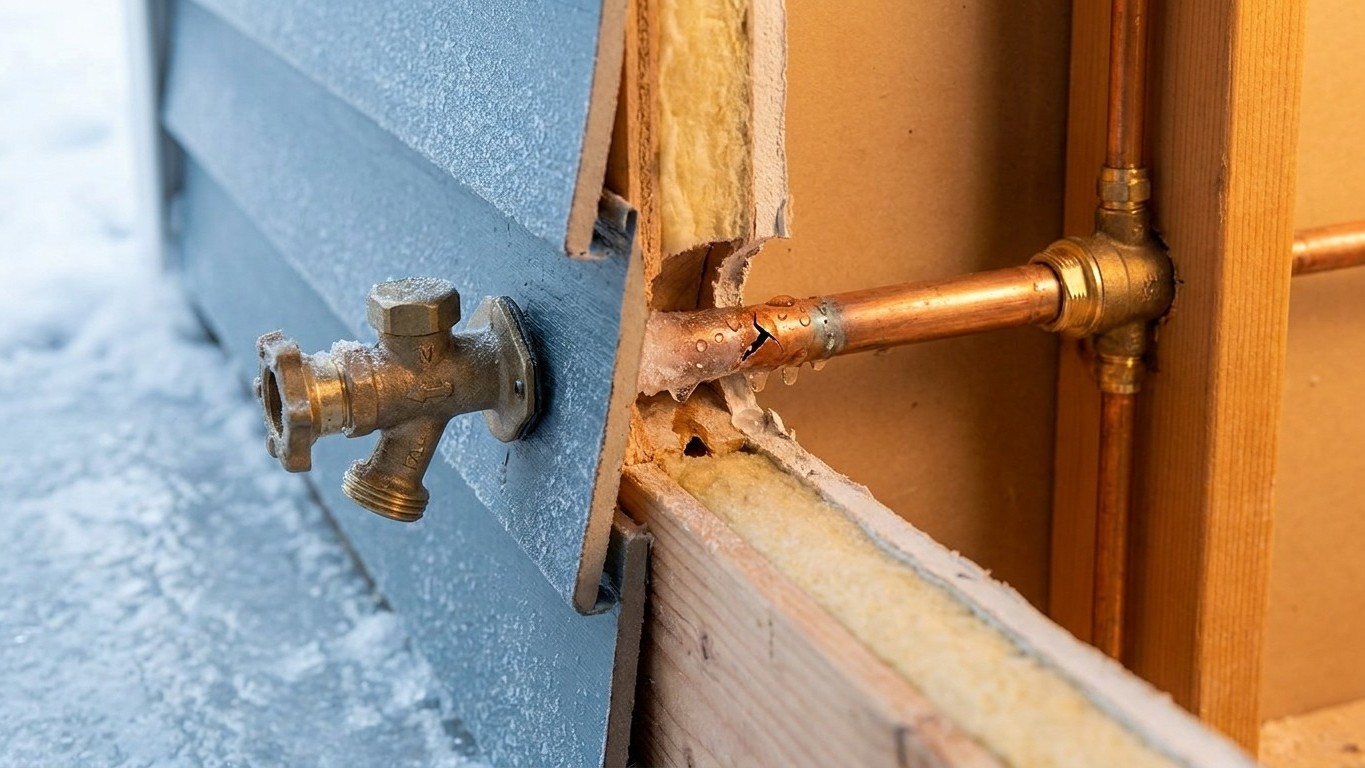

A frost-free hose bib fails for one main reason: something keeps the barrel full of water after the valve closes. The valve itself sits well inside the heated wall, so shutting off the water is supposed to let gravity drain the exposed pipe outside. When that drainage doesn’t happen, standing water freezes, expands, and cracks the pipe from the inside. The fixture still looks fine from the outside. The damage shows up later, often behind the wall.
What is actually happening
The design is simple once you see it. Unlike a standard outdoor spigot, where the shutoff washer sits right at the wall, a frost-free bib has a long stem, sometimes a foot or more, that runs the valve seat back into the heated part of the house. When you turn the handle off, you’re not just stopping the flow at the exterior wall. You’re closing a valve that sits deep inside, in warm space, well past the point where a pipe would normally freeze.
Here’s the part that makes the whole thing work: the section of pipe between that inner valve and the outside spout is supposed to empty out completely after each use. There’s no water left standing in the cold part of the pipe, because gravity pulls it back toward the valve and out a small weep hole, draining harmlessly into the surrounding soil or a gap in the wall assembly. No standing water, nothing to freeze, nothing to crack. That’s the entire principle, and it works reliably in the vast majority of installations.
The thing to understand here is that this drainage depends on one condition: the outside end of the pipe has to be open to the air. If a garden hose stays connected all winter, even loosely, it creates a trap. Water can’t drain out through the spout because the hose is sitting there full of water at the low point, holding the far end of the pipe closed. The barrel of the fixture, the section closest to the outside, stays wet. When the temperature drops, that trapped water freezes right where the pipe is narrowest and least able to flex, and it splits.
The crack rarely shows up right away. Ice doesn’t always break the pipe the moment it forms. Often the split happens quietly over a hard freeze, and nothing leaks until spring, when the ice melts and water starts running through the crack into the wall cavity instead of out the spout. By the time anyone notices a wet patch on interior drywall or a damp smell near a mudroom, the freeze that caused it happened months earlier. That lag is why so many homeowners insist the fixture “worked fine last time” right before finding a soaked wall.
Other blockages cause the same failure by the same mechanism: a shutoff valve that isn’t fully closed, a vacuum breaker stuck in the wrong position, or sediment sitting in the barrel from hard water. Anything that keeps water sitting in the cold section defeats the design, regardless of how well the fixture itself was installed.
What to check, in order
Work through these from cheapest and most likely to more involved. Each result tells you something specific about where the problem sits.
- Is a hose, splitter, or timer still attached? Disconnect everything from the spout, including anything left on from summer. If a hose was on, that alone is often the entire problem, and simply removing it before the next freeze may fix things going forward.
- Does water still trickle out after you close the valve? Turn the handle fully off, then open the spout briefly. A slow trickle or dribble that continues for more than a few seconds suggests the inner valve isn’t seating fully, which means water is still sitting in the cold section.
- Is the exterior vacuum breaker cap moving freely? Most frost-free bibs have a small cap or collar near the spout tip. If it’s stuck, corroded, or caked with mineral buildup, it can block the weep hole that lets the pipe drain.
- Is there an interior shutoff valve for this line, and is it fully open? Many installations include a separate valve inside the house, in a basement or crawlspace, dedicated to that one outdoor spigot. If it’s partially closed, it restricts flow and can also interfere with drainage.
- Does the spout drip or weep at the wall plate after use? Water appearing right at the point where the pipe enters the house, rather than at the spout tip, is a sign the barrel itself may already be cracked and is leaking internally rather than draining as designed.
- Is there any staining, softness, or smell on the interior wall near where this pipe runs? That tells you water has already gotten past the fixture and into the structure, which changes the priority from “fix the tap” to “find out how far the water traveled.”
- Has the fixture been slanted or shifted since installation? A bib that’s tilted upward, even slightly, from settling or from being used as a step or handhold, can stop the pipe from draining downhill the way it’s supposed to, even with nothing blocking it.
What it costs to leave it
A cracked frost-free bib rarely announces itself with a flood. More often it’s a slow seep behind a wall, which is exactly the kind of leak that adds up before anyone notices. The scale of that problem nationally is documented by the EPA’s WaterSense program, which estimates that “household leaks can waste nearly 1 trillion gallons of water annually nationwide”, and that “the average household’s leaks can account for more than 9,300 gallons of water wasted every year.”
Some leaks are worse than others, and a frozen, cracked outdoor tap belongs in the higher-volume category rather than the drip-drip nuisance category. WaterSense notes that “nine percent of homes have leaks that waste 50 gallons or more per day”, a group that tends to include exactly this kind of hidden, continuous leak rather than a faucet that merely drips. By comparison, the program points out that “a leaky faucet that drips at the rate of one drip per second can waste more than 3,000 gallons per year,” and that “a showerhead leaking at 10 drips per minute wastes more than 500 gallons per year.” A cracked hose bib feeding water into a wall cavity every time the line pressurizes can easily outpace both.
These national figures exist to show scale, not to tell you what your own leak is costing. A trillion gallons nationwide, or 9,300 gallons per average household, says nothing about the specific crack behind your siding. The only number that matters for your situation is the one your own water meter can show you, by checking usage when nothing in the house is running. This site’s page on finding a hidden leak walks through exactly how to read that meter and isolate which fixture is responsible, which is a more useful exercise than comparing your bill to a national average.
WaterSense also frames the upside plainly: “fixing easily corrected household water leaks can save homeowners about 10 percent on their water bills.” A cracked outdoor spigot, caught early, is usually a cheap fix. Caught late, after it has soaked framing or subflooring, it stops being a plumbing repair and becomes a construction repair.
When to stop and call a plumber
Some of this is reasonable for a homeowner to check and fix directly. Disconnecting a hose, testing whether the spout drains, cleaning a stuck vacuum breaker cap, these are within normal DIY range for anyone comfortable with basic tools. But there’s a clear line where the smart move is to stop and bring in a licensed plumber instead of pushing further.
That line sits wherever the problem moves behind a wall. If you’ve found staining, softness, or a persistent damp smell on interior drywall near where the pipe runs, you’re no longer dealing with a fixture, you’re dealing with a wall cavity that may have wet insulation, framing, or subflooring behind it. Opening that up, drying it properly, and confirming there’s no hidden mold growth is a job that benefits from someone who does it regularly.
The same applies to anything involving the home’s main water supply line rather than an isolated branch. If closing the interior shutoff for the outdoor spigot doesn’t stop the flow, or if you’re unsure which valve controls what, that uncertainty is itself a signal to call in a professional rather than start shutting off valves at random.
A gas water heater anywhere near the affected plumbing run is another firm stopping point. Water leaks near gas appliances, gas lines, or electrical panels carry risks beyond simple water damage, and that combination is not the place for trial and error.
Finally, any leak that has already wetted structure, meaning it has soaked into wood framing, drywall paper, or flooring rather than just sitting on a surface, needs a professional assessment of how far the water traveled and whether anything needs to be opened up, dried, and rebuilt. A frost-free bib that’s cracked is a small, well-understood problem. Water sitting inside a wall for an unknown length of time is not something to diagnose by guesswork.
Common questions
How do I know if my outdoor tap is frost-free or a standard spigot?
Look at how far the handle stem extends into the house from the outside wall, if visible in a basement or crawlspace. A frost-free bib has a long stem, often a foot or more, running the actual valve well inside the heated structure, whereas a standard spigot has its valve right at the exterior wall.
Can a frost-free hose bib still freeze if nothing is attached to it?
Yes, though it’s less common. A stuck vacuum breaker, a valve that isn’t seating fully, sediment buildup in the barrel, or a fixture that’s shifted out of its proper downward slope can all trap enough water to freeze even with no hose connected.
Is it safe to leave a hose connected to a frost-free bib year-round in a mild climate?
Even in regions with occasional light freezes, a connected hose defeats the drainage design every time. The fixture is built around water draining freely out the spout; a hose creates a trap regardless of how mild the overall climate is.
What’s the first sign that a frost-free bib has already cracked?
Often it’s not visible outside at all. The earliest sign is usually a wet or stained spot on interior drywall, trim, or flooring near where the pipe runs, sometimes not appearing until the following spring thaw, well after the freeze that actually caused the crack.