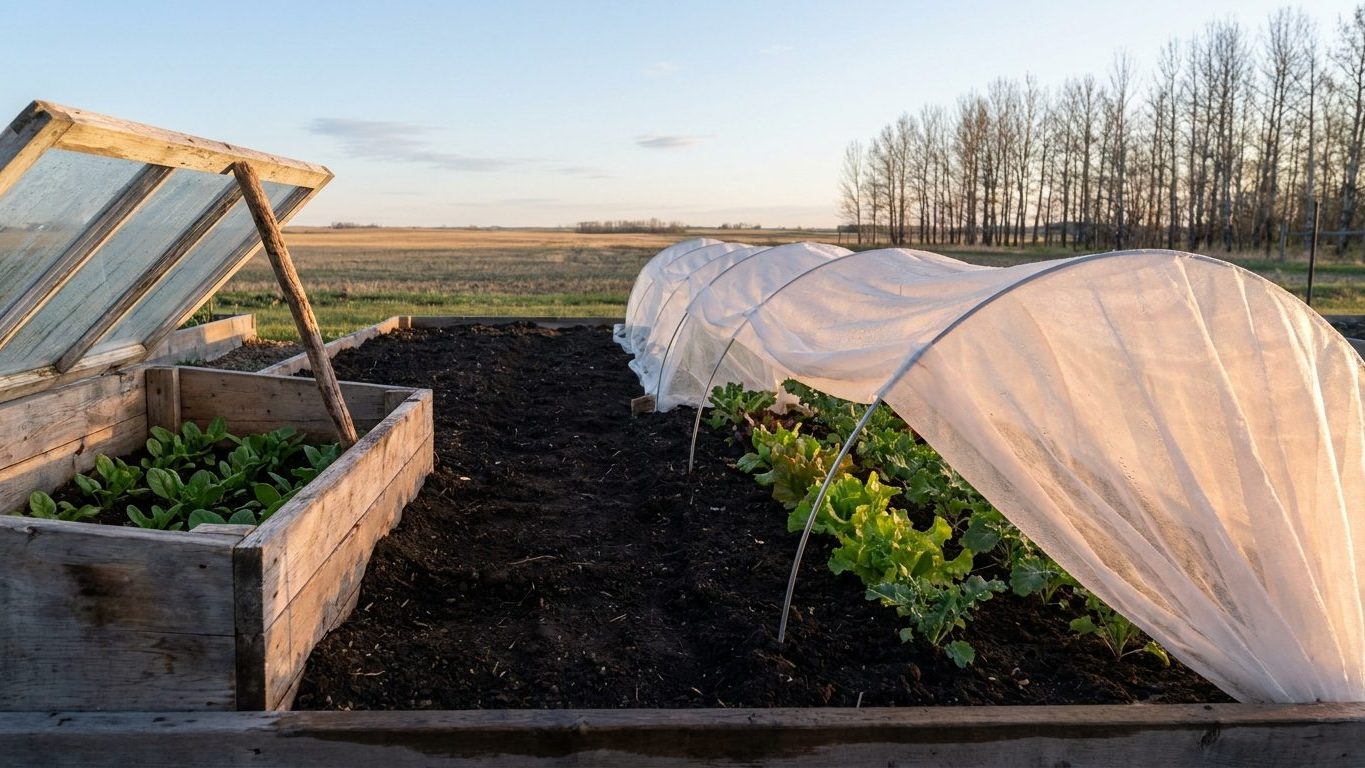

Lightweight row cover on wire hoops is the extender that works across most of New York. A cold frame or a plastic-covered low tunnel handles winter greens. Together they add a few weeks to each end of the season, which is a realistic goal. Heated greenhouses and plastic sheeting laid flat on crops cost more and return less. How much cover you need depends on where in the state you garden.
The short answer for New York
Start with the dates a cover has to beat. At the New York City reference station in Central Park, the last spring freeze at 32°F falls between March 23 and April 3, and the first fall freeze between November 14 and November 27. Each range is the stretch where the odds of a 32°F freeze sit between 30 and 70 percent. A freeze before or after those dates is normal, not a surprise. These are city numbers. Upstate New York and the Adirondacks frost far earlier in fall and later in spring.
A cover works by trapping the heat the soil gives off overnight and by blocking wind. That is worth a few degrees, enough to carry tomatoes, peppers, and basil past a light fall frost or to protect early lettuce and peas in March. It will not turn January into May. The coldest month at the city station has a mean daily minimum of 27.9°F. Nights that average only a few degrees below freezing are easy for spinach, kale, and mâche once they have a cover over them. The average hides cold snaps, though, and those decide which layer you need.
Which season extenders suit New York gardens?
| Extender | What it does | Best use in New York |
|---|---|---|
| Lightweight row cover | Holds a few degrees of frost protection and lets light through | Frost nights in spring and fall over tomatoes, peppers, beans, and young greens |
| Heavyweight or double-layer row cover on hoops | Holds more heat, cuts more light | Hardy greens, carrots, and beets in late fall and early spring |
| Low tunnel (plastic over hoops) | Warms air and soil on sunny days, needs venting | Early spring sowings and winter greens |
| Cold frame | Glass or rigid plastic box that sits on the ground | Lettuce, spinach, and mâche from fall through early spring |
| Black plastic mulch | Warms the soil, gives no frost protection | Spring transplants of squash, melons, and peppers |
| Individual cloche or water-filled wrap | Protects one plant | Early tomato transplants |
What is the best first purchase?
Buy hoops and a roll of lightweight row cover. The same setup protects a bed on a frost night in October, shades seedlings in a hot spell, and keeps flea beetles off arugula. Add a cold frame next, since it is the cheapest way to keep a patch of greens alive from November to March. Our guide to Extending the Growing Season in New York covers how to build the full sequence around these two pieces.
What will not work here
Short winter days limit any cover. The city station sits at 40.78 degrees north, and in the weeks around the winter solstice, daylight is short enough that growth nearly stops under any cover. A bed sown in November will sit idle until late winter. The method that works is sowing in late summer so crops reach harvest size before the light fades, then picking from them all winter. Covers keep that food alive. They do not grow it.
Tender crops hit a harder limit upstate. In the Adirondacks, where frost comes far earlier in fall than the November 14 to November 27 window in the city, a single layer of fabric will not save tomatoes or peppers for long. It might buy a night or two. After that, ripening slows with the shorter days and cooler nights, and the plants stall. Gardeners in the cold parts of the state do better picking varieties that finish early than hoping a cover will rescue a long-season one.
Winter is the other failure point. A mean daily minimum of 27.9°F in the coldest month sounds mild, but the hardiness map for the state runs from zone 3b to 7b. That system is built on the average annual extreme minimum, the single coldest night of a typical year, not the average night. In the colder zones a lone sheet of floating fabric will not protect a crop through an extreme night. Double covers, a cold frame with an added blanket on the coldest nights, or a move to cold-hardy crops like kale and leeks is the realistic answer.
Sealed plastic is a quiet killer in March. On a clear day in early spring the air under a closed tunnel can climb well past what spinach or lettuce can take, and the plants bolt or scorch. Tunnels need venting by mid-morning, with the ends opened or the sides lifted, then closing again before the afternoon cools. Anyone who is away all day should choose fabric, which breathes, over plastic.
Wind and snow wreck weak hoops. Upstate lake-effect snow can flatten thin wire hoops and tear covers, and in any part of the state a loose cover will lift and flap in a March gale. Anchor the edges with soil, boards, or sandbags, and knock heavy snow off the tunnel before it settles. Covers should also come off squash and cucumbers when the flowers open, or bees cannot reach them.
What changes across New York
No single answer covers the state. The USDA Plant Hardiness Zone Map (2023 edition, built on 1991 to 2020 normals) places New York anywhere from zone 3b to 7b. That is a spread of zones, from the mildest coastal pockets to the coldest Adirondack valleys. A gardener in Brooklyn and one near Lake Placid work with different calendars, different covers, and often different crops.
In the city and on Long Island, a lightweight cover and a cold frame cover most needs. Fall frost holds off until mid to late November, so a cover can stretch tomatoes and peppers a few extra weeks, and hardy greens carry on into winter. Spring covers start earlier too. Latitude matters as well: Central Park sits at 40.78 degrees north, and the north of the state lies several degrees farther north. Onions, which start bulbing when days reach a set length, behave differently there. A reader near the edge of the state should check their own latitude before copying dates from the city.
Farther north or at altitude, shift everything. Start spring covers later, because the ground thaws later and a cover cannot warm frozen soil quickly. Put fall covers on earlier, and use two layers or a heavier fabric. Choose short-season varieties and cold-hardy crops over anything that needs a long, warm run. A cold frame becomes a necessity rather than a bonus. Valleys also trap cold air, so a garden at the bottom of a slope may frost before one higher up.
To find which zone your own address falls in, use the USDA map and enter your ZIP code. Our guide on When to Cover Your Garden in New York pairs the covers above with the timing for each part of the state.
Where to check this for your own county
The state’s land-grant extension network is the best next stop. Cornell Cooperative Extension has a local office serving each county, staffed by people who know the soil, the frost pockets, and the pests of that county. Search by county on the site, or call the office with your questions.
Look for two things. The first is a local planting calendar, which gives sowing and transplanting windows built for that county’s frost dates rather than the city’s. The second is the list of varieties trialled in the county. A variety that finishes well in the Hudson Valley may be too slow in the North Country, and county trial results will show it. Many offices also run master gardener help lines where a volunteer can answer questions about row cover, cold frames, and winter crops for your area.
A county recommendation beats a state one. Anything written for all of New York, this article included, has to span zone 3b to 7b and a wide range of frost dates. The county office works with a much narrower range of conditions. Where the two disagree, go with the county.
The city’s dates are a good reference point, because they come from NOAA’s 1991 to 2020 climate normals. Still, a single downtown park station cannot speak for a hilltop in Delaware County or a lakeshore in Niagara County. A call to the local office can save a season.
Checking this against your own garden
Your own garden outranks every date above. Three things to watch will tell you more than any calendar.
Soil warmth by feel. Push your hand a few inches into a bed in early spring. If it feels cold enough to chill your fingers within seconds, seeds will sit and rot. Test several spots, such as a bed beside a south-facing wall, an open bed, and one under a tunnel. The difference shows you how much a wall, a slope, or a cover warms the ground.
The first male flowers on squash or cucumbers. Male blooms open before females. When they appear in one bed days before another, the earlier bed is the warmer one. That tells you where to plant your most heat-hungry crops and where a cover pays off most.
The first true leaves. The first pair of leaves a seedling shows are seed leaves. The second set, the true leaves, means the plant is growing on its own energy. Compare a covered row with an uncovered one sown the same day. The gap between them is what the cover earns you in your own garden.
Write the dates in a notebook for a couple of seasons. Patterns appear quickly: one corner always frosts first, one bed always warms early, and a certain wall holds heat well into October.
Common questions
Can I grow vegetables through winter in New York without heat?
Yes, with the right crops and cover. Spinach, kale, mâche, carrots, and leeks hold up under a cold frame or a double-layer tunnel in much of the state. In the coldest zones, expect to harvest only what grew before the days shortened.
What is the cheapest season extender?
Lightweight row cover draped over hoops or laid directly over young plants. A roll lasts several seasons if you store it dry and anchor it against wind.
When should I put covers on in fall?
Before the first night forecast at or near 32°F. In the city, that probability sits in the November 14 to November 27 range. Upstate and in the Adirondacks, frost comes earlier, so watch the local forecast from September.
Does a cold frame work upstate?
Yes, and it matters more there. Add an extra blanket or straw on the coldest nights, vent it on sunny days, and brush off snow so light still reaches the plants.