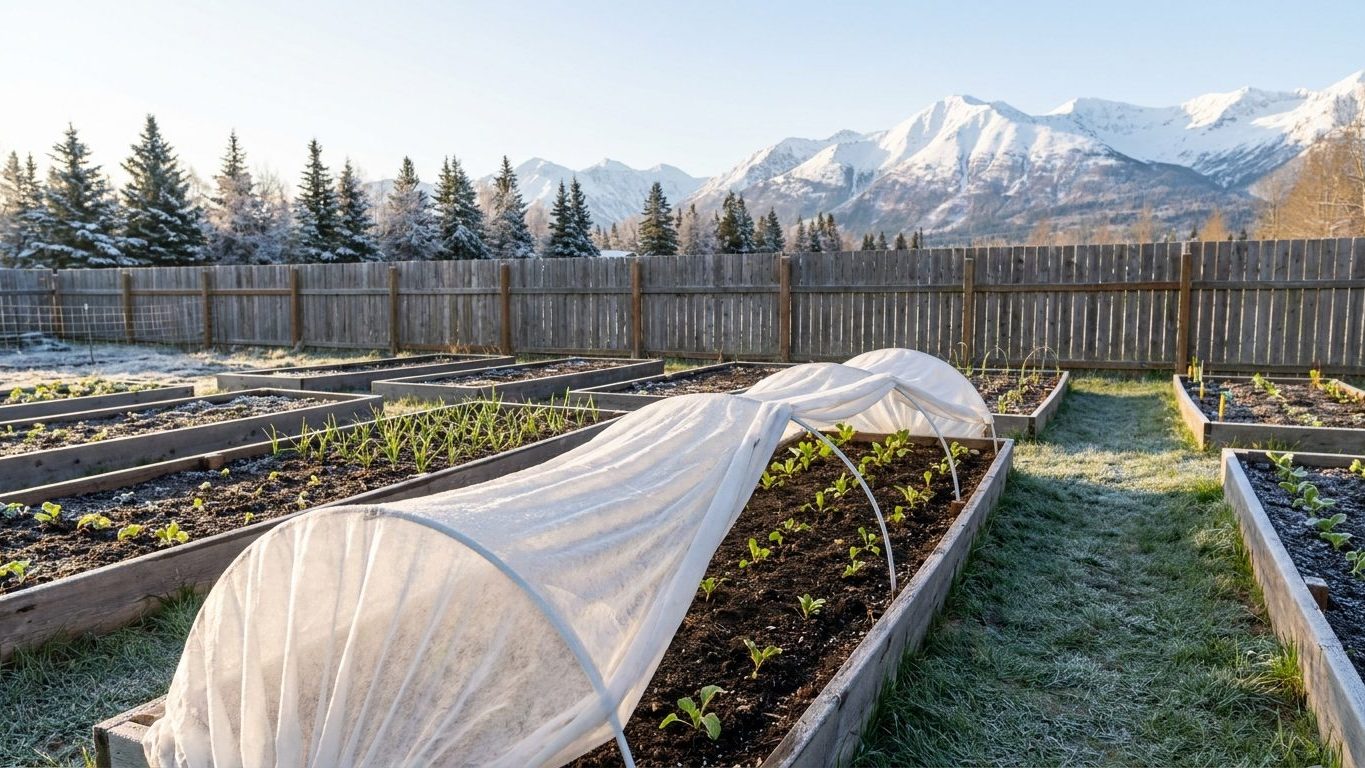

Cover the garden any night the forecast low is at or below 32°F. For tender crops like tomatoes, peppers and basil, start covering when the low heads for the mid-30s on a clear, calm night. In New Jersey that gives you two stretches: spring until nights warm up, and fall from the first frost until winter settles in. The dates below show where each stretch starts and stops.
The short answer for New Jersey
Cover tender plants on any spring night with a near-freezing forecast from late March into mid-April, and again from early November in fall. At the Newark reference station, the last spring frost falls between March 29 and April 6, and the first fall frost between November 4 and November 16.
Both ranges come from NOAA’s 1991-2020 U.S. Climate Normals and describe 32°F freeze probabilities in the 30 to 70 percent band. In spring, that band is the stretch of days when the chance of one more freeze drops from 70 percent to 30 percent. Fall runs the same band in reverse. After the later date a freeze can still happen, just less often. The dates describe odds, and every spring has a few years that break them.
Newark’s weather station sits at an airport, in the warm, paved urban corridor of the state. Suburban and rural gardens typically see the last spring frost one to two weeks later and the first fall frost one to two weeks earlier, and more than that at elevation. A garden a few counties from Newark should push the spring cover window toward mid or late April and start watching fall forecasts in late October. The Extending the Growing Season in New Jersey guide covers the broader picture of how much extra time covers can buy.
How cold is cold enough to cover plants?
It depends on the plant. Tender crops take damage at 32°F or a little above it on a still night, because leaf surfaces run colder than the air around them. Hardy greens and roots shrug off frost and need help only in a deep freeze. These are rough working thresholds for forecast lows:
| Crop group | Examples | Cover when the forecast low reaches |
|---|---|---|
| Tender | Tomatoes, peppers, cucumbers, squash, beans, basil | About 35°F on a clear, calm night |
| Half-hardy | Lettuce, broccoli, cabbage, potato foliage | About 30°F |
| Hardy | Kale, spinach, garlic, carrots, collards | The mid-20s, or a hard freeze with no snow cover |
What time of day should you put the cover on?
Late afternoon, while the soil still holds the day’s warmth. The cover traps that heat overnight. Take it off the next morning once the temperature climbs above freezing and the frost on the leaves has melted. A cover left on in a sunny stretch will overheat the plants underneath.
What will not work here
Planting by the calendar date alone is the most common failure. March 29 to April 6 is the Newark window for the last freeze, and the range covers only the middle 40 percent of years. A tomato seedling set out on April 7 with no cover on hand is a gamble, and a garden even ten miles inland from the airport may still be losing that bet in mid-April.
Winter is the other wall. The mean daily minimum of the coldest month at Newark is 25.5°F. That is an average, so many nights run colder. A light row cover adds only a few degrees of protection, which is nowhere near enough to carry tomatoes, peppers or basil through a stretch of lows in the 20s. Once the first hard freeze arrives, the tender crops are done, and the best use of the cover is to protect the hardy ones. The Which Season Extenders Work in New Jersey article sorts out which structures can handle those colder nights and which cannot.
Will a row cover protect tomatoes in a hard freeze?
No. A light fabric cover buys a few degrees, enough for a night that threatens to dip to 31°F or 32°F, but a freeze into the mid-20s will still kill tender plants. For those nights, a heavier fabric or a frame with a double layer holds more heat. Even then, tomato vines that have already blackened once are not coming back.
Can you leave plastic on all day in spring?
Not when the sun is out. Clear plastic over a hoop can climb well into the 80s or 90s inside on a sunny March afternoon, even when the air outside is in the 40s. Seedlings cook. Vent the ends or pull the plastic off by mid-morning and put it back before dark.
Summer humidity causes a different problem. New Jersey summers are humid, and covers left tight over crops in warm, damp stretches of early fall hold moisture against the leaves and invite fungal disease. Pull them back in the daytime, and put them on only when a frost is actually forecast. Cover that touches the foliage also conducts cold, so use hoops or stakes to hold the fabric off the leaves, and anchor the edges against wind with soil, boards or staples.
What changes across New Jersey
New Jersey has no single answer. The USDA Plant Hardiness Zone Map (2023 edition) puts the state in zones 6a through 7b. The USDA hardiness zone is built on the average annual extreme minimum temperature, and the range from 6a to 7b means the coldest and mildest parts of the state differ in winter hardiness. A gardener in the northwest hills and one on the southern coast are working with different winters.
The zone describes winter survival, meaning whether a perennial lives through the coldest night of the year. It does not set frost dates, though the two tend to move together. Colder zones usually bring later spring frost and earlier fall frost, which shrinks the window where tender crops can grow uncovered. A reader in the northern highlands or at elevation should expect the Newark dates to be too optimistic: spring covers stay on well past the April range, and fall covers come out of the shed by mid-October.
The Newark figures also belong to a specific latitude, 40.68 degrees north. The state stretches north and south of that line, and a reader near its northern or southern edge should check their own latitude rather than assume it. The southern and coastal areas, where the ocean moderates temperatures, run milder, and covers there may be needed for fewer nights each spring and fall.
Nobody can tell you your zone from a column of text. The USDA Plant Hardiness Zone Map lets you enter a ZIP code and read it off directly. Use that to see where you sit between 6a and 7b, then shift the Newark dates earlier or later to match.
Where to check this for your own county
Rutgers New Jersey Agricultural Experiment Station and Cooperative Extension is the state’s land-grant extension service, and each county has its own office with agents who know local conditions. Start there before you settle on any date.
Look for two things. The first is a local planting calendar with frost dates for your county, which will be more accurate than a single airport reading. The second is a list of varieties trialed in your county, because a cultivar that performs well in a coastal garden may sulk in a cold valley in the northwest.
Ask the county office about the typical last spring frost and first fall frost for your area, and about when local growers set out tomatoes and peppers without covers. Extension agents often have years of experience with the local frost pockets, and they will tell you which low fields and river valleys run colder than the rest of the county.
A county recommendation outranks a state one. Any statewide guidance, including the Newark-based dates above, gives way to what your county agent tells you. It is a starting point for planning and not a fixed rule for any single backyard.
Checking this against your own garden
Your own observations outrank every date here. Three things are worth watching, and none of them needs equipment.
Soil warmth by feel. Push your hand a few inches into the bed in the morning. If the soil feels cold and damp, tender transplants will stall no matter what the calendar says. A bed that feels warm earlier than the rest of the yard points to a sunny, well-drained spot, and that is where your first plantings belong.
The first flush of male flowers. When they appear, the plants are established enough to be growing steadily. If they show up earlier in one corner of the garden than another, that corner is your warmest microclimate.
The first true leaves. The first pair of leaves on a seedling are seed leaves. The true leaves that follow show the plant has started to grow on its own. Seedlings that hold their color and push out true leaves under a cover are safe in that spot. Seedlings that yellow or stall are telling you the spot is colder than you thought.
Frost on the grass is a bonus clue. Walk the yard at dawn after a clear, cold night and note where the white stays longest. That low spot is a frost pocket, and it is where covers matter most.
Common questions
What temperature should I cover my garden in New Jersey?
Cover tender crops like tomatoes, peppers and basil when the forecast low reaches about 35°F on a clear, calm night. Half-hardy crops like lettuce and broccoli can wait until about 30°F. Hardy greens and roots like kale, spinach and carrots need cover only when lows drop into the mid-20s.
When is the last frost in New Jersey?
At the Newark reference station, the last spring frost falls between March 29 and April 6, based on NOAA’s 1991-2020 normals for 32°F freeze probabilities in the 30 to 70 percent band. Suburban and rural gardens typically see it one to two weeks later, and areas at elevation can be later still.
When does the first fall frost arrive in New Jersey?
At Newark, the first fall frost falls between November 4 and November 16. Gardens away from the airport often see it one to two weeks sooner, and higher ground can see it earlier than that. Start watching forecasts in late October if you garden outside the urban corridor.
Should I cover plants if it is only going to be 33°F?
For tender crops, yes. Leaf surfaces can run several degrees colder than the air on a clear, still night, so a 33°F forecast can still deliver a frost on the plants. Cloudy, windy nights hold more heat and carry less risk. Hardy crops will be fine without cover at that temperature.