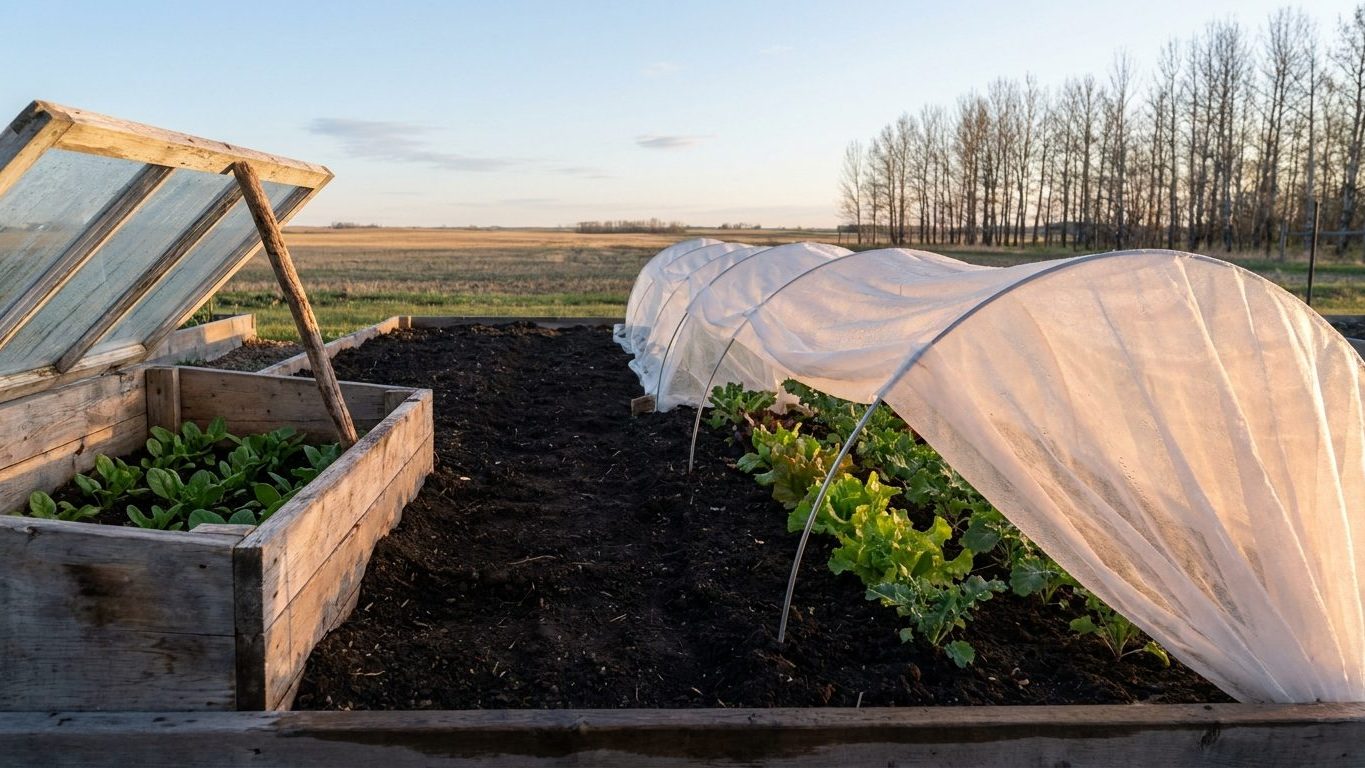

Lightweight row cover, low tunnels and cold frames are the season extenders that pay off in Ontario. A walk-in hoop house is worth the money only if you want to harvest hardy greens into winter. Each one adds a few degrees and a few weeks at the edges of the season. None of them changes the calendar enough to turn a short-season garden into a long one.
The short answer for Ontario
Pick the extender by the job. Row cover handles frost nights in spring and fall. A low tunnel covers hardy greens and early direct-sown crops. A cold frame holds salad greens and seedlings through the shoulder months. A hoop house is for gardeners who want to keep picking after the first hard freezes. For a wider look at the options, see Extending the Growing Season in Ontario.
The numbers behind that choice come from the Toronto Pearson station. The mean last spring frost is April 30 and the mean first fall frost is October 16, which leaves about 169 frost-free days between them. Both are midpoints, so in one year out of two the last frost falls after April 30, and in one year out of two the first fall frost arrives before October 16. These are Environment and Climate Change Canada normals for 1981-2010. A cover that protects you on the average date still leaves you exposed in the other half of the years.
Winter sets the ceiling. The mean daily minimum of the coldest month is -10.2 °C (13.6 °F) at the Toronto reference station. A single layer of fabric will not hold a tender plant through that, but hardy crops such as kale, spinach and mâche sit out cold like this under a tunnel or in a frame. Tomatoes, peppers and basil need a frost-free night, and in this climate the extender only buys them an earlier start or a later finish.
| Extender | Best use in Ontario | Where it runs out |
|---|---|---|
| Lightweight row cover | Frost nights near the mean spring and fall dates | Hard freezes; adds only a few degrees |
| Low tunnel (hoops plus fabric or plastic) | Early peas, greens, radishes; fall salad crops | Heavy snow, strong wind, midwinter cold |
| Cold frame | Hardening off seedlings; greens through early winter | Overheats on sunny days unless vented |
| Hoop house or high tunnel | Hardy crops into December; earlier warm-season plantings | Cost, snow load, shortest days of winter |
| Individual cloches or water-filled wraps | A few transplants set out early | Only protect single plants |
Timing matters as much as the equipment. When to Cover Your Garden in Ontario goes through when the covers should go on and come off.
What will not work here
Planting tomatoes and peppers in early April under a cloche will fail. The mean last frost is April 30, so half of all years bring a frost after that date. Even with protection, cold soil stalls those crops, and a single cloche does little against a hard freeze in the first weeks of the month. Wait until the nights settle and use cover to protect plants that are already in the ground.
Trusting the mean date as a safe date fails too. A gardener who plants on May 1 because the average says so will lose plants in roughly one spring out of two. A few extra days of waiting, or a roll of row cover kept within reach, is a cheaper fix than a flat of replacements.
Sealed plastic on a cold frame can ruin a bed. Ontario springs and falls often have cold nights followed by bright sunny afternoons. A closed frame can pass 30 °C (86 °F) on a day that feels cool outside, and the seedlings inside cook. A frame needs its lid propped open on any sunny day, even when the air is cold.
A tunnel will not survive snow load unless you plan for it. Light hoops with thin fabric sag or collapse under wet snow. Brush snow off by hand, or take the cover off hoops for midwinter and leave the plants alone.
Growing through midwinter will not work either. The reference city sits at 43.86 degrees north (Toronto Buttonville station), and at that latitude the shortest days of winter bring very little growth no matter how warm the cover keeps the leaves. Greens planted late in the fall hold in place and stay edible, but they do not size up until the days lengthen again. Plant them early enough that they reach harvest size before the light fades.
Light fabric alone will not beat a deep winter freeze. Winter minimums near -10.2 °C mean a single fabric layer is not a barrier for anything but the hardiest crops.
What changes across Ontario
Ontario is not one garden. The Toronto reference city sits in Canadian hardiness zone 7a. That is a Canadian system, built on several climate variables, and it does not convert to a USDA zone. The province runs from that mild lakeshore climate up through colder zones in the north, so there is no single answer for everyone.
A reader in the north, or in higher ground inland, should shift the whole plan. Frost dates there run weeks behind the Pearson figures. The spring start comes later and fall frost comes earlier, so the frost-free window shrinks at both ends. That makes extenders more valuable in the north, because every week gained is a larger share of the season. It also means the faster cover tools matter more than winter ones. Row cover and low tunnels do the most good in those places. Tender crops need more help: earlier starts indoors, plus a cover on the bed.
Latitude counts too. The 43.86 degrees north figure belongs to Toronto Buttonville. A gardener far north of the Greater Toronto Area has shorter winter days and a shorter run of usable light in late fall, so the fall crop has to be planted earlier. Near the Great Lakes, the water softens the cold and delays the first frost a little. Inland sites a short distance away can frost earlier.
Check your own zone on the Natural Resources Canada plant hardiness map, which uses 1991-2020 normals, while the frost dates above come from the older 1981-2010 period. Look up your municipality and read the zone for yourself. Then shift the dates from this article by the gap you see between your area and the Toronto reference.
Where to check this for your own county
The provincial figures here average very different ground. Ontario’s government agriculture and food pages are the place to start for your region. Look for two things: a local planting calendar for your part of the province, and the vegetable varieties that growers have trialled in your county or nearby.
The calendar tells you when your area usually clears frost in spring and when it returns in fall. It is more useful than the Toronto date if you live a few hours north or east. Variety trials tell you which cultivars handled the actual summers and early frosts of nearby fields. A tomato that ripens fine near the lake can fail to colour before the first frost inland, and a trial result will say so.
A county recommendation beats a provincial one every time, because county ground is closer to your ground. Anything written for the whole province, including the Toronto dates above, is an average across very different gardens. Treat it as a starting point and change it when the local source says otherwise. If your region has a regional agricultural office or a local gardening group, ask them what has worked in the last few seasons.
Checking this against your own garden
Your own observation outranks every date in this article. Three things are worth watching, and none needs a tool.
First, feel the soil. Push your hand into the bed, about 2 to 3 inches down, in the morning. If it feels cold and damp to the touch, seeds will sit and sulk. Compare a covered bed with an open one. A clear difference tells you how much your cover is really adding and how early you can start under it.
Second, watch for the first flush of male flowers on squash and cucumbers. Male blooms open before the females, and their arrival tells you the plants are warm enough to move into flowering. If yours come late compared with a neighbour’s, your site is cooler, and you should plan for a later finish.
Third, count the first true leaves on direct-sown seedlings. The first pair to appear are seed leaves. The true leaves that follow mean the plant has taken hold. If they take a long time under cover, the spot is cold or shaded, and a low spot where cold air collects will hold frost longer than a bed against a south wall.
Common questions
Is row cover enough to protect plants from frost in Ontario?
For a light frost near the mean spring or fall dates, yes. Lightweight fabric adds a few degrees. It will not protect tender plants from a hard freeze, and it does little in midwinter.
When should I put a cold frame to use?
A cold frame works in the shoulder months, from late winter into spring and again in fall. Prop the lid open on sunny days so the plants do not overheat.
Can I grow vegetables all winter in Ontario with a hoop house?
Hardy crops such as kale, spinach and mâche will hold under cover into winter. Growth slows sharply when days get short at this latitude, so plant early enough that they reach size before winter.
Is April 30 safe for planting tender crops?
No. That is the mean last spring frost at the Toronto Pearson station, so in one year out of two the last frost falls later. Northern and upland areas run weeks behind that date.