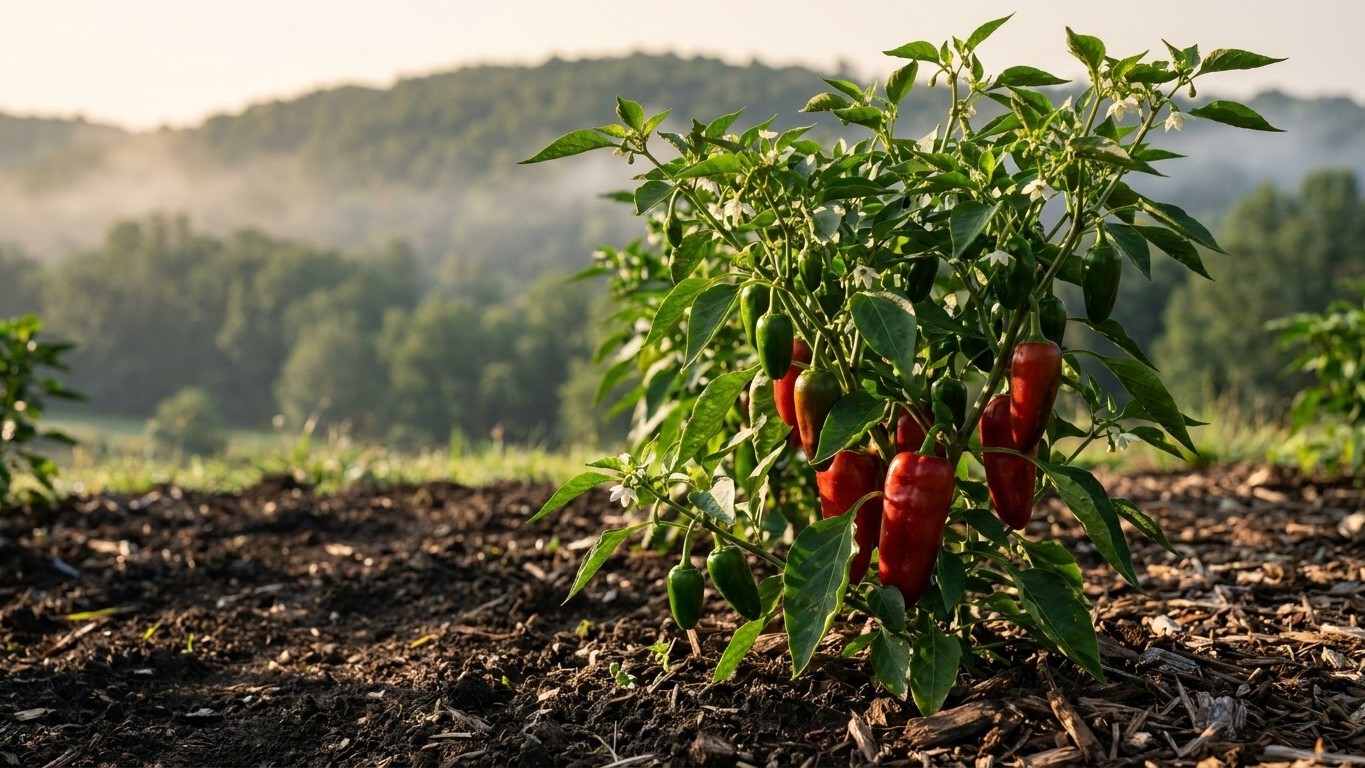

Pick peppers when the fruit has reached full size and feels firm, roughly 70 to 85 days after transplanting. Then keep them out of the refrigerator. Whole peppers hold best at 45 to 50 °F, and a household fridge runs colder than that. The cold pits the skin and softens the flesh within days. In Wisconsin, harvest runs from August until the first fall frost, and a cool room keeps the fruit better than the crisper drawer.
When are peppers ready to pick in Wisconsin?
The clock starts at transplanting. Clemson Cooperative Extension puts harvest at about 70 to 85 days after transplanting, and Utah State University Extension says the transplants themselves need 8 to 10 weeks indoors before they go out. Seed packets that count from sowing run much longer than that, so check which count your packet uses.
The planting date sets the harvest window. The mean last spring frost at the Milwaukee reference station falls between April 16 and April 29, based on NOAA NCEI freeze probabilities in the 30 to 70 percent band. Peppers don’t go out then. Utah State advises waiting until the soil reaches 60 F, after frost, and in most Wisconsin gardens that means late May or later. Peppers are ready for harvest in about 70 to 85 days after transplanting. A planting made two weeks later shifts everything with it.
The fruit tells you more than the calendar. A ready pepper has reached the full size typical of its variety, the skin is glossy, and the wall feels firm when you squeeze gently. Green peppers are edible at that stage. Left on the plant, they turn to their mature color, which takes additional weeks. Cut the fruit with a short stub of stem attached, using pruners or scissors. Pulling can snap a branch, and peppers have brittle branches.
Heat and cold both disturb the schedule. Utah State says fruit set fails at both ends: nights below 55 F or days above 90 F. The Milwaukee reference station averages 7.0 days a year at 90 F or more (NOAA NCEI Climate Normals), so heat seldom stalls Wisconsin peppers for long. Cool nights are the bigger risk, and only your own thermometer can tell you how many you have. A cold snap in June can push the first harvest back by weeks. The full story is in Why Peppers Fail to Set Fruit in Wisconsin.
Waiting too long has a cost. Ripe fruit left hanging invites chewing from insects and rot where the skin splits, and What Eats Pepper in Wisconsin, and When covers who shows up late in the season. Frost sets the final deadline. Lake Michigan delays the first fall freeze at the lakeshore, but inland southern Wisconsin typically freezes in early October, and the north freezes far earlier. When a frost is forecast, pick every fruit that has size, even the ones still green. For the whole season, start with Growing Peppers in Wisconsin.
Keeping them, and for how long
Clemson Cooperative Extension’s Home & Garden Information Center states the storage conditions plainly: “The optimal conditions for storage are temperatures of 45 to 50 °F and 80- to 90-percent relative humidity for two to three weeks.” That is from its pepper factsheet, and it describes the best case. Two to three weeks is a ceiling for fruit picked sound and held in near-perfect conditions. Peppers with bruises, sunscald, or a split in the skin will not last that long. Treat the range as the most you can expect, and plan to use the fruit sooner.
What temperature and humidity do whole peppers need?
The number to write down is 45 to 50 °F, paired with humidity of 80 to 90 percent. The humidity matters because a pepper is mostly water held in a thin wall. In dry air the skin wrinkles and the fruit goes limp, even at the right temperature. A loosely closed, perforated bag helps hold moisture around the fruit without trapping so much that it rots. Keep the peppers dry when they go in, and don’t wash them until you are ready to cook.
Why does the refrigerator damage peppers?
A refrigerator is set for milk and meat, so it runs colder than 45 °F. Below about that point, peppers suffer chilling injury. Small sunken pits appear on the skin, the flesh softens, and the fruit breaks down faster than it would have on a kitchen counter. The damage often doesn’t show until the pepper warms back up, which is why the mistake is so common. The pepper looks fine in the fridge and turns up spotted and soft two days later.
Cold-sensitive crops behave this way because they come from warm climates. Cucumbers, tomatoes, and basil are damaged in a similar manner at fridge temperatures. A pepper that came from your garden in August has no more tolerance for the cold than one from the grocery store.
Cut peppers are a separate case. Once sliced they can’t wait on a shelf, so they go into the fridge in a sealed container and get eaten within a few days. For fruit you can’t use within the storage window, freezing is the better move than cold storage. Slice or chop it and freeze it raw on a tray, then bag it.
Where in the house that actually is
The target of 45 to 50 °F is cooler than any room people live in and warmer than the fridge. A heated kitchen or living room runs well above it, so peppers there ripen quickly, shrivel, and go soft within days. A garage sits at the other extreme. It follows the weather, and a Wisconsin garage in October can be mild at noon and near freezing before dawn. Those swings are worse than a steady temperature a few degrees off.
The best candidates are spots that stay cool and steady. An unheated interior room, a basement corner away from the furnace and water heater, a cold pantry on a north wall, or a root-cellar-style space all come closest. In early fall many Wisconsin basements sit in or near the right range, and by midwinter they may run cooler. Anywhere near a heating duct, a sunny window, or an appliance is too warm.
Don’t guess at the temperature. Set a thermometer where the peppers will sit and read it for several days, mornings and afternoons, before you commit a whole harvest to the spot. A min/max model that records the overnight low is worth the few dollars, since a room that reads 50 °F at noon may drop under 45 °F overnight. A small hygrometer will show whether the humidity is anywhere near 80 to 90 percent. Basements often come out damper than the rest of the house, which suits peppers.
Once you have a spot, check the fruit every few days. Pull any pepper that is softening or marked, because one rotting fruit spreads mold to its neighbors. Keep them in a single layer or a shallow container rather than piled deep. If the best spot you can find runs a little warm, the peppers will still keep for a shorter time, and you can cook or freeze them sooner.
Common questions
Can I put whole peppers in the refrigerator if I have no cool room?
You can, but expect a shorter life and pitting. If the choice is a fridge or a warm kitchen, a few days on the counter out of direct sun usually treats the fruit better than the cold. Use the peppers quickly, or slice and freeze them.
How many days after flowering are peppers ready?
The count that is reliable for planning runs from transplanting, at about 70 to 85 days according to Clemson Extension. Flowering dates are easy to miss, and cool nights below 55 F or days above 90 F can cause flowers to drop without setting fruit. That pushes back the harvest.
Should I pick peppers green or wait for color?
Either works. Green peppers are mature enough to eat once they reach full size and feel firm. Waiting for the mature color means weeks more on the plant, with more exposure to pests, weather, and an early frost. In a short Wisconsin season, picking some green and leaving a few to color is a sensible compromise.
What do I do with peppers when frost is forecast?
Pick every fruit that has reached usable size before the frost, since frost damages both plants and fruit. Inland southern Wisconsin typically freezes in early October, the lakeshore a bit later, and the north far sooner. Store the sound fruit at 45 to 50 °F, and cook or freeze any that are blemished.