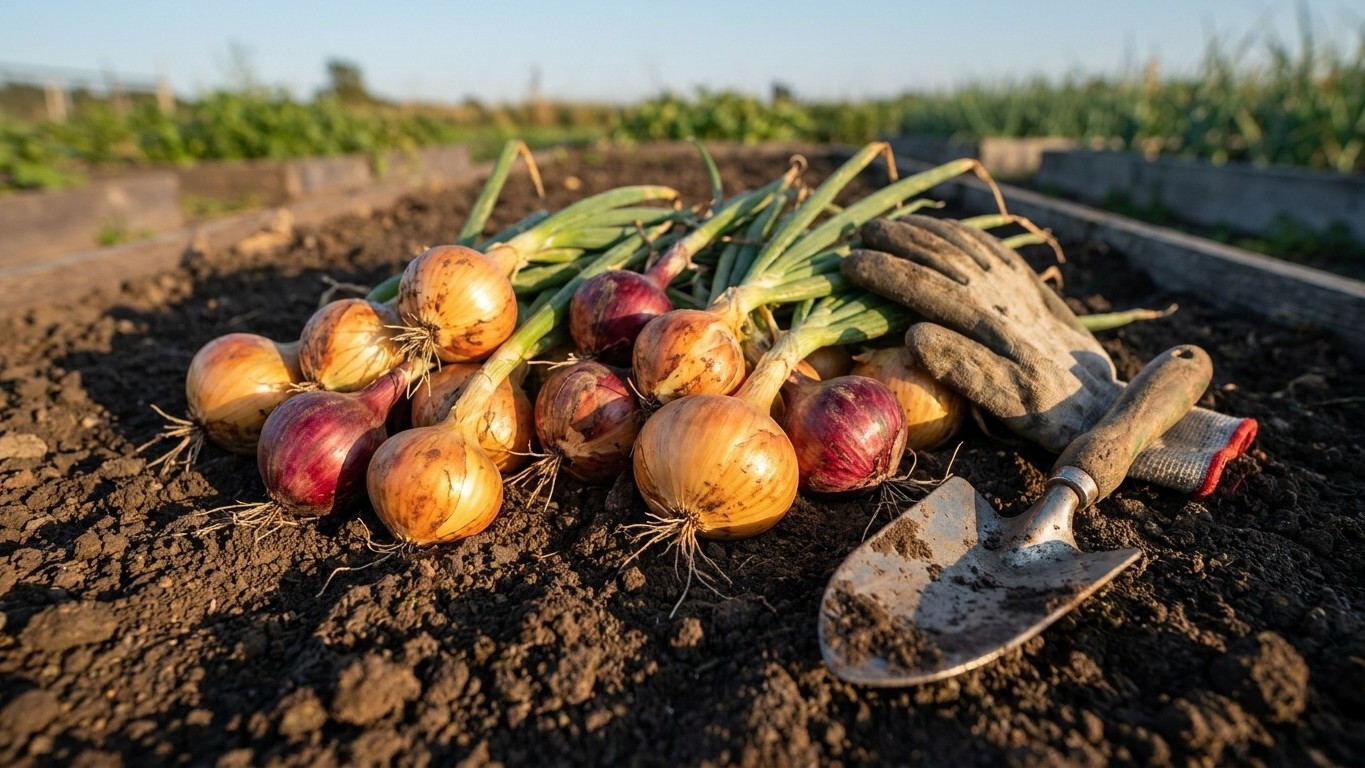

Lift onions in Quebec once the tops have flopped over and started to yellow, which usually happens between late August and September, depending on planting date and summer weather. Pull them on a dry day and cure them somewhere warm and airy until the necks are tight and the skins feel papery. Only then move them to storage at 45 °F to 55 °F and 50 to 60 percent humidity. Skip the curing and even a good crop can rot before midwinter.
How do you know when onions are ready to lift in Quebec, and how do you cure them?
When do the tops tell you to lift?
Day length sets the clock. Montreal sits at 45.47 degrees north, and on the longest day of the year it gets 15 h 29 of daylight. That suits long-day onions, which wait for 14 to 16 hours of light before they start making a bulb. Short-day varieties start bulbing at about 12 hours, according to Clemson Cooperative Extension, so they bulb early here and tend to stay small. If you garden well north or east of Montreal, check your own latitude. The farther north you go, the longer the summer days, but the shorter the season left to finish the bulbs.
Whatever the variety, the bulb is ready when the plant says so. The necks soften, the tops fall over on their own, and the lower leaves turn yellow and brown. You want most of the row down, not one or two plants. Ease off watering as the first tops fall, so the outer skins start to dry while the bulbs are still in the ground. A wet September makes this harder, and bulbs left sitting in saturated soil are more likely to develop neck rot.
Loosen the soil with a garden fork before you pull, and lift the bulbs rather than yanking them by the tops. Bruised or nicked bulbs are the first to go soft in storage. Set those aside to eat first, along with any bulb that was chewed by maggots or has a thick, green, stiff neck. Our guide to what eats onion in Quebec, and when explains which damage is only cosmetic and which opens the door to rot. Your choice of variety also affects how long the harvest will last, which is covered in the best onion varieties for Quebec.
How do you cure onions?
Curing dries the outer skins and seals the neck, so the bulb is wrapped up like a package. Lay the onions in a single layer, tops still attached, on screens, slatted racks or a clean wire shelf. Pick a spot that is warm, dry, shaded and breezy. A covered porch, an open garage or a barn aisle all work. Keep them out of rain, and out of hot direct sun, which can scald the exposed bulbs. In a damp spell, a fan moving air across the rack makes up for the missing sunshine.
Curing takes a few weeks, and the bulbs set the schedule. They are done when the neck is tight and dry, with no moisture when you squeeze it, the outer skins rustle like paper, and the roots are wiry. Then trim the roots, cut the tops to leave a short neck, and brush off loose soil. Do not wash the bulbs. Any water that gets under the skin invites mold.
Keeping them, and for how long
What temperature and humidity do cured onions need?
Clemson Cooperative Extension’s Home & Garden Information Center states the target plainly: “Ideal conditions are between 45 °F and 55 °F, and 50 to 60 percent humidity.” That is the figure to write down and tape up wherever the onions will sit.
The humidity number surprises many gardeners, because the usual advice for root crops runs the other way. Carrots, beets and parsnips keep best in cold, damp storage. Onions want dry air, and in a damp space the necks take up moisture, roots restart and mold moves in. The two crops pull in opposite directions, so a single cellar cannot hold both well. If you grow carrots and onions, plan on two storage spots, or put the onions in the driest corner you have.
The order matters too. Bulbs go into storage only after curing, once the necks are tight and the skins papery. Onions that go straight from the ground into a crate carry moisture in the neck, and one soft bulb can spoil its neighbors.
How long will stored onions last?
Any storage duration is a maximum under ideal conditions, and a rule of thumb at best. Pungent, firm-skinned onions keep longest and can last well into winter when the conditions are right. Mild, sweet types hold far less water-resistant skin and sugar, and they are best eaten in the first weeks or months after harvest. A bulb with a bruise, a wet neck, or a late-season maggot wound will fail ahead of the schedule, no matter how good the room is.
Check the stash every couple of weeks. Sort out any bulb that feels soft, smells sour or has begun to sprout, and use it right away. Storing in mesh bags, slatted crates or hung braids lets air move around the bulbs, which matters as much as the thermometer reading. A solid plastic tub or a sealed bag traps moisture and shortens the keeping time quickly.
Sprouting is the main warning sign that the room is too warm or too damp. A green shoot rising from the neck means the bulb is spending its reserves, and it will go hollow and soft if you leave it.
Where in the house that actually is
Which room comes closest to 45 °F to 55 °F and dry air?
A domestic refrigerator runs colder than that range, and its humidity is too high for onions as well. Bulbs in the crisper can get soft, and they pick up moisture quickly once you bring them out. The kitchen and any heated living space sit above the range, which pushes the bulbs into sprouting. An unheated garage swings with the weather, and in a Quebec winter it can fall below freezing, which turns bulbs to mush once they thaw. Early in fall the same garage can be warm and humid.
The best match in most Quebec homes is a cool, dry interior room. A basement corner away from the furnace and water heater often works, as long as the air is not damp. An unfinished cellar with a dirt floor usually is damp, and that makes it better for carrots than onions. A closed, unheated spare room, a cool pantry, or a closet on an interior wall of a cool basement are other options. Keep the onions away from potatoes, which give off moisture and can shorten the life of the bulbs.
What should you check with a thermometer before the onions go in?
Do not trust your feel for the room. Put a thermometer with a humidity reading in the spot for several days before the onions go in, and watch it through a cold night and a warm afternoon. Skipping this step is how a whole crop ends up in a room that is too warm or too damp, where it spoils quickly and gives no warning until the damage is done.
If the humidity runs high, a small dehumidifier or a fan across the shelves can bring it down. If the temperature runs high, move the crates to the floor or to the coolest wall. Where no room hits the full range, the cooler and drier option is better than the warmer one, as long as the bulbs never freeze. Your county extension office or a local master gardener group can help if you are unsure about a particular space.
Common questions
Can I store onions in the refrigerator?
Short-term, yes, for a cut onion or a few bulbs you plan to use within days. For a full harvest the fridge is too cold and too humid, so the bulbs soften and mold faster than in a cool, dry room.
Can I leave onions in the ground until frost?
It is better to lift them once the tops fall. Bulbs left in cold, wet fall soil are exposed to neck rot, and they cannot be cured properly once the weather turns damp and cool. A light frost on the tops is not usually a disaster if the bulbs are mature, but do not leave them for a long cold wet spell.
What do I do with onions that have thick green necks?
Use them first. A thick neck stays moist and lets rot in, so those bulbs will not keep through the winter even after careful curing. Cut them off, eat or freeze them, and do not mix them in with the keepers.
How do I know the onions are cured enough?
Squeeze the neck. It should be tight, dry and papery, with no give or damp feel. The outer skins should rustle, and the roots should be dry and wiry. If the neck still feels soft, give the bulbs more time on the rack with good airflow.