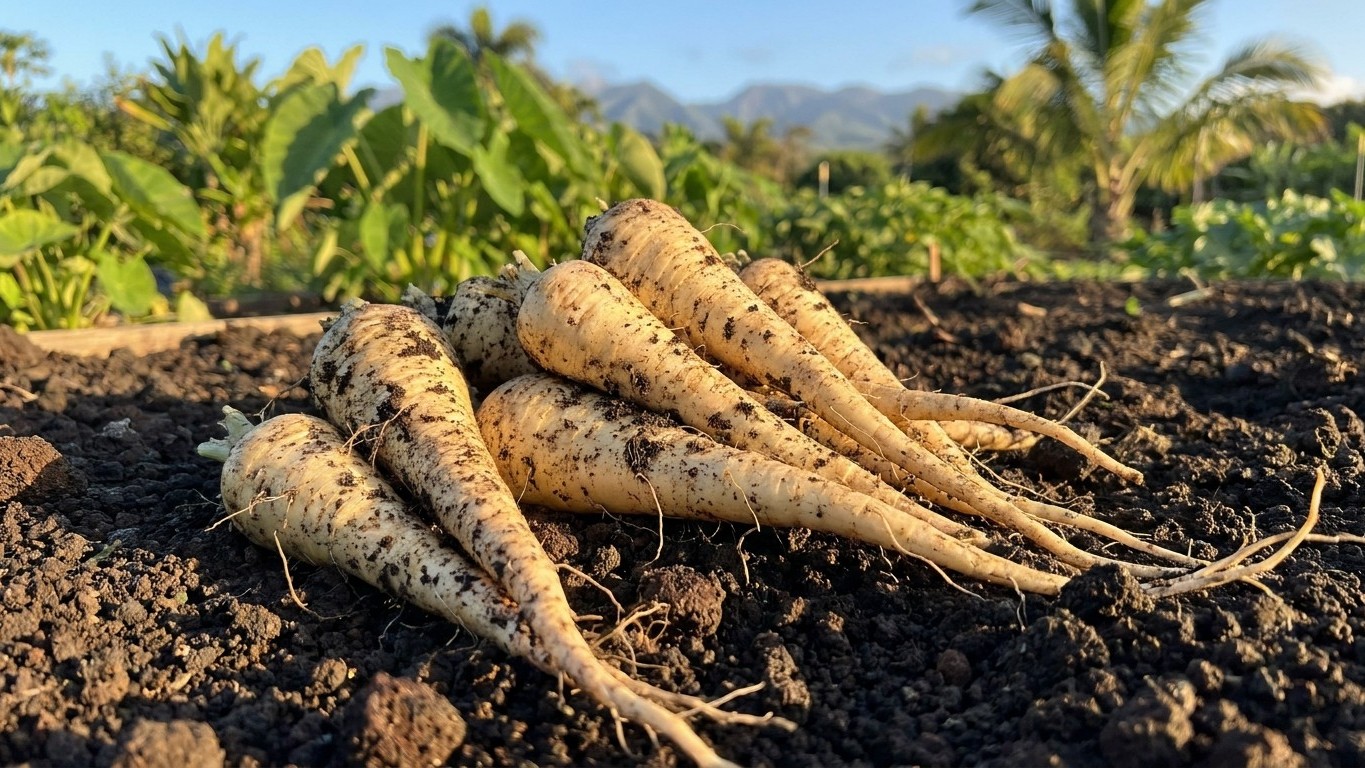

Lift parsnips in Quebec after the first fall frost, and give them several frosty weeks before you dig. The frost is what turns starch to sugar, so the date matters less than the cold. Once they’re out, tops off but crowns uncut, they can keep four to six months at 0 to 1 °C with very high humidity. Keep them away from apples. Details on each point follow.
The short answer
Does Quebec deliver several frosty weeks? Yes. At the Montreal reference station, the mean daily minimum of the coldest month is -14.1 °C, according to Environment and Climate Change Canada’s climate normals. That is an average night in the deepest part of winter, not a record low, and it sits far below freezing. A parsnip grown here will sweeten, not merely grow, provided you leave it in the ground long enough to get the benefit.
The mechanism is simple. Utah State University Extension notes that parsnips taste best after several weeks of cool, frosty weather, which converts stored starch to sugar. The word that matters is exposure. A comfortable hardiness zone does not tell you how many nights a root actually spends near or below freezing, and a mild-winter garden can grow a perfectly good parsnip that never turns sweet. Quebec doesn’t have that problem. For the full chemistry and what to expect at the table, see Will Parsnips Sweeten in Quebec?
So the practical rule is to start counting from the first fall frost, not from a calendar date. At the Montreal/St-Hubert station that frost arrives on average on October 5. Add three to four weeks of real cold and a typical year puts the first good digging in late October or early November. Dig a test root, taste it, and decide from there.
Treat both frost dates as midpoints. They are means, so in one year out of two the first frost lands later than October 5, and in one year out of two the last spring frost lands later than May 6. They also come from one station. Quebec is not one climate, and northern or upland districts run weeks behind Montreal. The normals Environment and Climate Change Canada publishes cover an older 30-year period than the one used for US figures, which is worth remembering if you compare with a Vermont or New York garden.
Storage is where a good crop goes wrong. The USDA’s Agricultural Handbook 66 puts the storage life of parsnip roots at 4 to 6 months at 0 to 1 °C (32 to 34 °F) with 98% relative humidity (USDA Handbook 66). That is a long keeper by any standard, but the figure assumes those conditions held steady, which almost no house manages. Parsnips are not chilling sensitive, so cold is not the danger. Ethylene is. Even low levels, from apples or any ripening fruit, cause bitterness, likely through a compound called xanthotoxin. Store roots in their own space, never in the crisper next to the fruit bowl. The handbook also says to top parsnips after harvest but not to trim into the crown.
For the wider picture of sowing, soil and varieties of attention, start at Growing Parsnips in Quebec.
Does the season fit?
Parsnips need 100 to 120 days from seeding, and they are sown in place, so the clock starts the day the seed goes into the row. The usual advice is to sow two to three weeks before the last spring frost. Here is the arithmetic for Montreal/St-Hubert, step by step.
- Find the sowing window. The mean last spring frost is May 6. Two to three weeks earlier is roughly April 15 to April 22. In practice the soil often isn’t workable that early, and that is the first thing to check in your own garden.
- Allow for germination. Parsnip seed takes 14 to 21 days to come up. A row sown on April 15 may show nothing until early to mid May. Bare soil for two or three weeks is normal, not a failure, and re-sowing too soon wastes seed and muddles your count.
- Count 100 to 120 days from seeding. From April 15, that lands between about July 24 and August 13. From April 22, between about July 31 and August 20. Either way the roots reach full size in late summer.
- Compare with the first fall frost. The mean date is October 5. The latest of those finish lines, August 20, leaves about 46 days of slack. The earliest, July 24, leaves about 73. That slack is the cushion for a cool summer or slow growth.
- Test a late sowing. If the garden isn’t ready until mid-May, 120 days from May 15 ends around September 12. If it slips to May 31, the long end of the range reaches September 28, only a week ahead of the mean frost. That is the point where the season turns tight.
The verdict is that the season fits comfortably for a spring sowing and tightly only for a very late one. The sweetening step comes after this arithmetic, not inside it: the roots finish growing in late summer, then wait for the cold. In the north or at elevation, shift every date later by the weeks your district runs behind Montreal and recount. Frost dates are midpoints, so build in extra days instead of planning to the average.
What goes wrong here
Quebec’s cold is on your side. The failures come from the ground, the calendar and the storage shelf.
- Forked roots from heavy or stony ground. A root that hits clay, compaction or a stone splits or twists. Utah State University Extension recommends deep sandy soil and says heavy soil must be double dug. Dig deep before sowing, pull out stones, and don’t assume your soil is fine because it grows other vegetables. A state or provincial soil description is a starting point, not a diagnosis of your own bed.
- Forked roots from overwatering. This is a separate cause with a separate remedy, and the ground can be perfect when it happens. Water evenly and let the top of the soil dry between waterings instead of keeping the bed soggy. If you find forked roots in loose soil, look at the hose before you blame the soil.
- A season that runs out. A sowing that drifts toward the end of May has little cushion left before October’s frost. Sow as soon as the ground can be worked, count 100 to 120 days from seeding, and remember that germination alone takes 14 to 21 days.
- Digging too soon. The roots are full size in late summer, and the temptation is to pull them then. They will be edible but starchier. Wait for several frosty weeks. Lifting before that gives up the one thing that makes the crop worth growing in a cold province.
- Bare soil mistaken for a failed sowing. Nothing visible after ten days is on schedule. Wait out the full 21 days before you rake and re-sow.
- Bitter roots in storage. Ethylene from apples or any ripening fruit causes the bitterness, even at the right temperature. Keep parsnips in a separate cold space and check the humidity, since the 4 to 6 months figure depends on 98% relative humidity held steady. Cut tops off, but leave the crown intact.
- Damage that isn’t the soil or the weather. Chewed or tunneled roots point to something else. What Eats Parsnip in Quebec, and When covers what to look for and when it shows up.
Common questions
Can I lift parsnips before the first frost?
You can, and they will be edible, but they won’t have been through the cold that converts starch to sugar. Utah State University Extension describes the best flavor as following several weeks of cool, frosty weather. Pulling a few early roots to check size is fine. For the main harvest, wait.
How long do parsnips really keep?
Four to six months is the figure from USDA Handbook 66, at 0 to 1 °C (32 to 34 °F) and 98% relative humidity. That is a commercial storage standard. A home setup that swings in temperature or humidity will do worse, and the handbook does not give a shorter figure for it. Top the roots but don’t cut into the crown.
Can I store parsnips next to apples?
No. Parsnips make very little ethylene themselves, but low levels from nearby ripening fruit cause bitterness in cold storage. Parsnips are not chilling sensitive, so a cold shelf isn’t the problem. Giving them their own container or room is the fix.
I sowed ten days ago and nothing has come up. Should I re-sow?
Not yet. Germination takes 14 to 21 days, so a bare row at ten days is normal. In a cold spring, the long end of that window is the likelier one. Mark the row so you don’t dig it up, and give it the full three weeks before deciding anything.