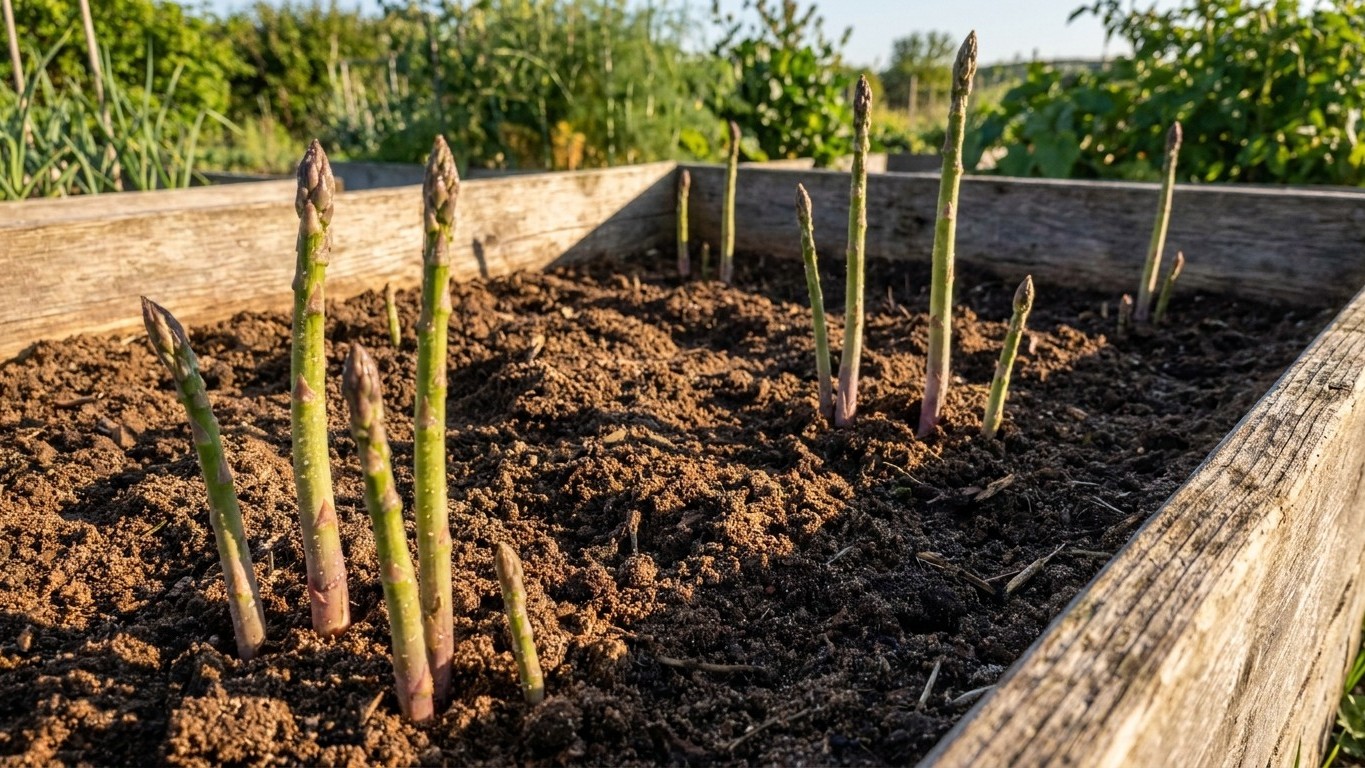

Stop cutting when most of the spears coming up are thinner than a pencil. A mature bed can be cut for up to eight weeks, and the pencil rule sets the end of that window. Spears you have already cut keep best between 32°F and 35.6°F, with air close to saturated and the cut ends kept wet. A warm counter or a freezing back wall ruins them quickly.
Keeping it, and for how long
The UC Davis Postharvest Technology Center gives the optimum for green asparagus as 0°C to 2°C, which is 32°F-35.6°F. It pairs that with a relative humidity of 95 to 100 percent and says high humidity is essential to prevent desiccation. That is a narrow target. The spear is a young shoot, still growing and still losing water, and it loses the most through the freshly cut end.
| Temperature | What happens to the spears |
|---|---|
| Above 50°F | Toughening, and it happens rapidly |
| 32°F to 35.6°F | Optimum range, with 95 to 100 percent humidity |
| 30.9°F or lower | Freezing injury, a water-soaked look that leads to extreme softening |
How warm is too warm for cut asparagus?
UC Davis puts the line at 10°C, or 50°F. Above it, spear toughening occurs rapidly. A bundle left on the kitchen counter while you finish the rest of the harvest is already on its way to stringy. Fiber builds in the stalk as it sits warm, and cooking won’t soften it again.
How cold is too cold?
The other edge is just as sharp. At -0.6°C (30.9°F) or lower, freezing injury is likely. The spear looks water-soaked, then collapses into mush once it thaws. A cold spot in a refrigerator can reach that range, so a bundle pushed against the back wall can freeze while the shelf looks fine.
Any shelf life quoted for asparagus is a ceiling that assumes those exact conditions held the whole time. A household refrigerator rarely holds them, so the realistic window is shorter than any printed number. Cook the spears as soon as you can, the same day if possible. Before using stored spears, check three things: tips still firm and closed, cut ends still moist, stalks still snapping rather than bending.
Where in the house that actually is
A domestic refrigerator runs warmer than the 32°F-35.6°F optimum, and the door runs warmer still because it opens all day and sits next to the room. You will not match the lab. The goal is to get as near as the appliance allows and to keep the air around the spears damp.
Which shelf in the fridge is best for asparagus?
The lowest shelf, toward the back but not touching the back wall, comes closest. Cold air settles low, and that spot swings less than the upper shelves. A crisper drawer that closes tightly works too, since it traps moisture. Skip the door and skip the top shelf near the light. Because the very back can dip toward freezing, leave a finger’s width between the spears and the wall.
How do you get near-saturated air in a home fridge?
Ninety-five to 100 percent humidity sounds like a lab setting, but a kitchen can approximate it with simple moves. A refrigerator’s own air is dry, so the spears need a small humid space of their own. There are three common ways to build one:
- Stand the bundle upright in a jar or glass with water covering the cut ends.
- Wrap the cut ends in a damp paper towel and slip the bundle into a bag.
- Loosely cover the tips with a bag so the moist air stays close without sealing them in.
Of the three, stand the cut ends in water and loosen a bag over the tips. Skipping it costs you the spears, because the cut end is where they lose moisture fastest. Left dry, they shrivel and turn rubbery within days even on the right shelf. Change the water if it clouds, and trim a sliver off the butts before cooking.
How long can you cut asparagus each year?
Nothing gets cut for the first two seasons. Utah State University Extension has gardeners plant crowns in 8-inch furrows in early spring and leave the bed uncut until year 3. After that the planting produces for 10 to 15 years. Burying the crowns at once would smother them.
The harvest window then grows with the bed:
- Third season and every one after: 8 weeks.
Those are the lengths to hold, even when the bed looks productive and tempting. Taking more in a young bed pulls energy out of crowns that are still building their reserves for the years ahead.
The weeks set the outer limit. The end of the season is set by the spears. Once most of the new shoots are thinner than a pencil, the crown has little left to give, and every spear you cut after that costs it. Let those thin shoots grow into ferns, which feed the crown for next spring. Watch the ferns for chewing damage too; What Eats Asparagus in Michigan, and When covers the beetles that show up and when.
Spring frost matters at the other end of the season. The last frost comes around April 30 in the Detroit area and early to mid May across most of the Lower Peninsula, and spears that emerge before then can be nipped. A frost-blackened spear is spoiled, so cut it off and let the crown send up others.
Will Michigan’s sandy ground suit a bed that stays put?
A bed is a fifteen-year decision, so drainage comes before everything else. Utah State University Extension says most soils will do, provided they are well drained. Michigan’s state soil, the Kalkaska series, is a good picture of what a lot of the ground tends to do. It is a sandy, strongly leached Spodosol, typically under conifers, with a surface of 86 percent sand, 5 percent clay and 9 percent silt, and it is classed as somewhat excessively drained. Its surface is strongly acid at about 4.7. That describes the series, and it stands for the state, not for every back garden in it. River bottoms, hill country and any lot a builder has scraped or filled can be very different.
Where ground drains that freely, standing water is rarely the problem. Drying out is. The Detroit reference station records about 10.0 inches of rain across June, July and August (34.3 inches for the year). June and August each get 3.26 inches and July 3.51. Those are usual conditions, not a forecast. On sand, an inch of rain can pass through within a day, and a summer thunderstorm on hot ground tends to run off. A fern-growing bed on that kind of soil may need watering even in a wet summer. A rain gauge on your own plot tells you what actually landed.
If your ground is heavy clay that stays wet, the choice cannot be undone later. Build a raised, well-drained bed before planting. Will Michigan Soil Hold an Asparagus Bed for Fifteen Years? goes through that decision, and a soil test from your county extension office gives your own pH and texture. The full planting picture is in Growing Asparagus in Michigan.
Which asparagus varieties are available for a Michigan bed?
Nothing it says ranks them on flavor or yield, so choose without expecting one to out-perform another.
| Variety | Plant type |
|---|---|
| Jersey Giant | All-male |
| Jersey Knight | All-male |
| UC 157 F1 | Male and female |
| Purple Passion | Male and female |
Common questions
Can I cut asparagus the year I plant the crowns?
No. Nothing is harvested until year 3. Cutting earlier robs crowns that are still building the roots they will rely on for 10 to 15 years of production.
How do I know it is time to stop cutting for the season?
Look at the spears. When most of them are thinner than a pencil, make your last cut and let the rest grow into ferns. In a mature bed the season also tops out at 8 weeks.
Can I leave cut asparagus on the counter?
Only briefly. Above 50°F, spear toughening occurs rapidly. Get the bundle into the refrigerator with its cut ends in water as soon as you can.
Can I store asparagus in the coldest part of the freezer?
Fresh spears should not go there. At 30.9°F or lower, freezing injury is likely, and the spears turn water-soaked and extremely soft. The target is 32°F to 35.6°F with 95 to 100 percent humidity, which is a refrigerator, not a freezer.