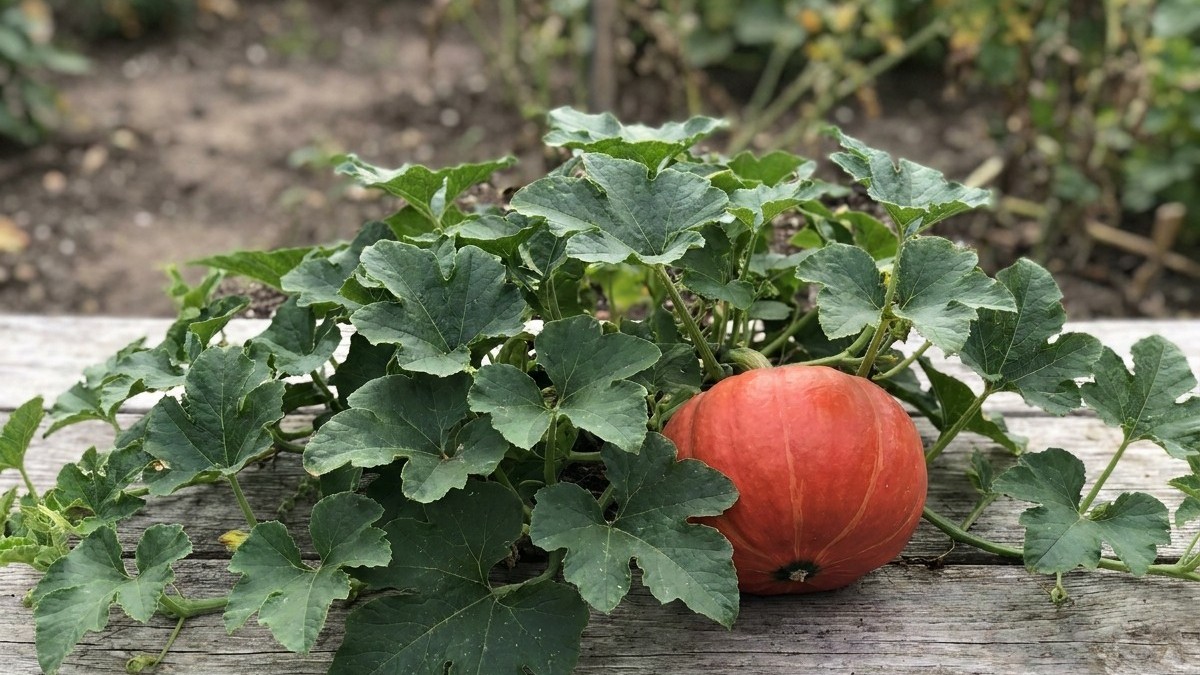

In Michigan, the biggest threat to a pumpkin crop is the calendar. Frost ends the season in fall, and cold soil delays the start in spring. Squash bugs and cucumber beetles feed on the vines too, but they have their own pages on this site, so this one stays on timing. Everything below builds on Growing Pumpkins in Michigan, and it starts with a countdown.
The short answer
MSU Extension’s Michigan Garden Calendar puts the first fall frost between October 6 and October 21 in zone 6a. Utah State University Extension says a pumpkin needs 45 to 55 days to mature after flowering. Subtract that span from the frost window and you get the latest a flower can open and still give a ripe pumpkin here: roughly August 12 to September 6.
Counting back from the first frost
Here is the arithmetic in words. Take the earliest frost, October 6, and back up 55 days for a slow pumpkin: you land on about August 12. Take the latest frost, October 21, and back up 45 days for a quick one: you land on about September 6. The two ends of that window are about three and a half weeks apart, which is why the answer has to be a window and not a single day.
Which end applies to you depends on two things you cannot know in advance. One is how early the frost actually arrives (the dates above are the typical window, not a promise). The other is how fast your particular pumpkin colors up. Without a way to know either, the cautious move is to treat the early end of the window as your deadline. A flower that opens in the second week of August has the best odds. One that opens in the first week of September needs a late frost and a quick variety, and that is a bet.
The 45 to 55 days is roughly six and a half to eight weeks. Think of a pumpkin flower as a kitchen timer you can’t reset. Once it opens, the countdown starts, and the first frost doesn’t care whether the timer has run out.
Why the seeding date is the wrong starting line
The clock runs from flowering. It does not run from seeding or transplanting. This is the mistake that wrecks the whole calculation. A gardener who reads “45 to 55 days,” counts from the day the seed went in, and sees a comfortable finish in late summer is looking at a number that describes something else. Vines need time to sprout, run, and set flowers before the countdown even begins. The source doesn’t publish how long that stretch takes, so this page won’t invent one.
What you can do is watch the vine. Note the date the first female flower opens and add 45 to 55 days. If the result runs past the frost window, you already know that fruit is a long shot, and you can decide what to do about it while there is still time. Utah State University Extension’s advice for the finish is simple: harvest with the stem attached, before frost.
One more caveat. The October 6 to October 21 figure is for zone 6a. Michigan has colder pockets, especially up north, and no verified figure for them appears here. If you garden outside zone 6a, check your own local frost date before using the back-count.
When to sow here
The sowing rule is a temperature, not a date. Utah State University Extension says pumpkins are sown when the soil reaches 65 F. That moment comes well after the last spring frost, because soil lags the air by weeks. Here is how the numbers line up.
- Find the last spring frost. MSU Extension lists it as around April 30 in the Detroit area and early to mid May across most of the Lower Peninsula. This marks when freezing air stops being a daily threat. It is not the sowing date.
- Add the soil lag. Soil warms more slowly than the air above it. The gap is weeks, and the source publishes no exact number for Michigan, so a firm calendar date would be a guess. Put a soil thermometer a couple of inches down and wait for 65 F.
- Apply the row-cover bonus. Row covers buy about two weeks. In plain arithmetic: take the date your bare soil reaches 65 F and move your sowing two weeks earlier under a cover. If open ground hits 65 F on the first of June, covered ground gets there around the eighteenth of May. Those dates are only an example of the subtraction, not a forecast.
- Check the finish line. Add the time from sowing to first flower, which this page cannot give you, then add 45 to 55 days. The result must land before the frost window of October 6 to October 21. If it doesn’t, sow earlier, use a cover, or pick a faster pumpkin.
- Cross-check with your own page. The calendar logic for each part of the state is laid out in When to Sow Pumpkins in Michigan.
The trap here is treating the last frost as the green light. A gardener who sows the day after April 30 in the Detroit area has not waited for the soil, only for the air. Seed in cold ground tends to sit, and every week it sits eats into a season that is already tight at the other end.
What goes wrong here
Michigan’s season length produces a short, predictable list of failures. Each one traces back to the same arithmetic.
- A late flower that never colors. A bloom that opens after the back-count deadline (roughly August 12 to September 6) can set a fruit, but the fruit won’t finish before frost. The remedy is to stop counting on it: mark the date of your last useful flower, and once the vine passes it, let the later blooms go. Your effort belongs in fruit that can still make it. The Will Pumpkins Ripen Before Frost in Michigan? page covers what to expect from the borderline ones.
- A fruit caught by frost. The first frost can arrive as early as October 6, and a frozen pumpkin does not recover. Watch the forecast from the end of September, and harvest with the stem attached before a frost night. Utah State University Extension’s guidance is explicit on both points. Anything you bring in should go where it will not freeze, because that is all the source says about storage conditions at that stage.
- A vine that dies back before the skin hardens. When the plant gives out early (from a late start, disease, or insect pressure), the fruit is still soft-skinned when its support disappears. The remedy is to count back from the first flowers so you know whether this is a timing problem, and to handle soft-skinned fruit gently and keep it from freezing. Squash bugs and cucumber beetles are a common reason vines collapse early, and both have dedicated pages on this site.
- A good pumpkin stored in the wrong spot. A whole pumpkin keeps three to six months in a cool, dark location between 45 and 50 F, according to University of Illinois Extension. The same source says to keep it away from ripening fruit and vegetables such as apples, potatoes, or tomatoes. Ripening produce gives off a gas that ages the pumpkin, so the porch next to the apple crate is the worst place for it. The 45 to 50 F range applies to a whole pumpkin only. No figure is published here for a carved one.
Common questions
How long does a pumpkin take to ripen in Michigan?
Pumpkins take 45 to 55 days to mature after flowering, per Utah State University Extension. Against a first fall frost window of October 6 to October 21 in zone 6a, that means a flower needs to open between roughly August 12 and September 6 at the very latest.
Can I count the 45 to 55 days from the day I sow?
No. The count starts when the flower opens. Time from seed to flower comes before it, and this page does not publish a number for that stretch.
Is 65 F soil the same as the last frost date?
No. The last spring frost is around April 30 in the Detroit area and early to mid May across most of the Lower Peninsula, according to MSU Extension. Soil reaches 65 F weeks after that, and row covers can pull your sowing date about two weeks earlier.
How long will a harvested pumpkin keep?
A whole pumpkin keeps three to six months in a cool, dark place at 45 to 50 F, per University of Illinois Extension, away from apples, potatoes, and tomatoes. For a carved pumpkin, no storage figure is published here.