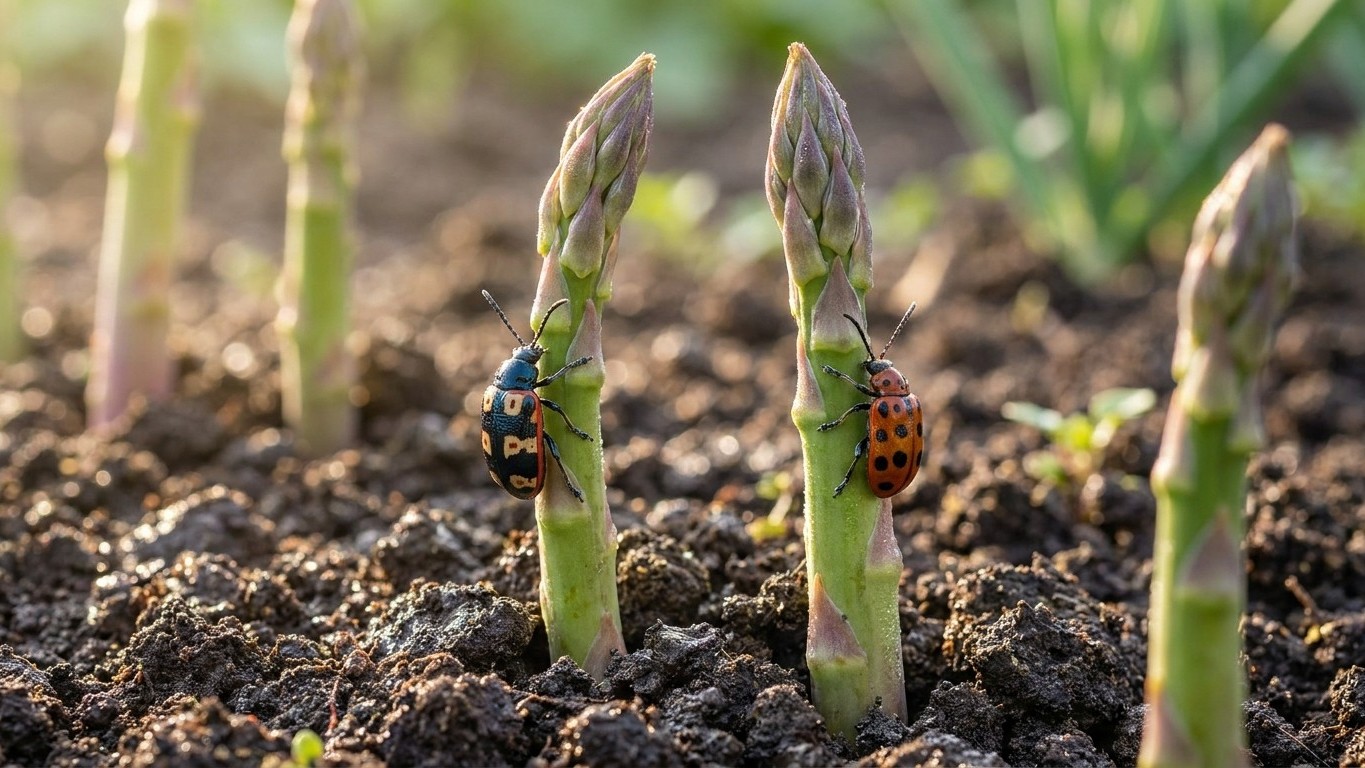

Asparagus beetles are the main insect problem in a North Dakota asparagus bed, and they arrive on a fixed schedule. Adults wake in spring as the first spears push up, larvae chew the ferns through summer, and the damage often looks like drought or disease until you check the plant closely. Timing and clean-up do more here than any spray, because the growing season is short.
Which pests attack asparagus in North Dakota
The insects that matter on asparagus across the northern states are the common asparagus beetle and the spotted asparagus beetle, with cutworms and grasshoppers as occasional chewers. North Dakota State University Extension is the service that confirms which of these are active in a given county. Treat any list, including this one, as a starting point for that conversation.
Which ones are worth worrying about?
The two beetles are the ones to expect. Both are small, hard-shelled insects that overwinter as adults in plant litter and under bark and boards near the bed, and both feed on asparagus and almost nothing else. The common asparagus beetle is slim and dark with pale markings. The spotted one is orange-red with black spots. The spotted beetle’s larvae develop inside the berries, so they only show up on female plants that set fruit. The common beetle’s larvae feed on the ferns themselves.
Cutworms and grasshoppers are generalists. Cutworms are caterpillars that work at night and hide in the soil by day, so the first sign is a spear cut off near ground level with no insect in sight. Grasshoppers strip ferns in dry stretches. Neither is specific to asparagus, so they rarely become the main problem in a bed.
The decision that matters most comes before any insect shows up. Asparagus is not harvested until year 3, so for two full seasons every fern is working to feed the crown. Chewing damage on young ferns costs a crown more than it costs a mature bed, which is why those early years are when scouting pays off. For planting dates and bed prep, see When to Plant Asparagus Crowns in North Dakota and the broader overview in Growing Asparagus in North Dakota.
When each one shows up, and what it does first
The calendar follows the frost-free window. The reference station’s last spring frost falls between May 4 and May 15, and suburban and rural gardens usually see it one to two weeks later, more at elevation. Beetles and cutworms respond to soil warming, not to dates, so an early or late spring shifts everything with it.
What do you see in spring when the spears come up?
Adult beetles come first, on the earliest spears. They chew the spear tips and the sides, leaving scarred, bronzed patches and bent tips. Look for small dark eggs standing upright on the spear surface, stuck on end like tiny pegs. This is usually visible within a couple of weeks of the spears emerging.
Cutworms act at the same time, since they are active as soon as the soil warms. A spear that is simply missing, or snipped clean at the soil line, with the bed otherwise untouched, is the usual first sign. Dig an inch or two near the stump and a curled gray or brown caterpillar often turns up.
What shows up once the ferns fill out?
After harvest ends and the ferns open, the beetle larvae arrive. They are soft, grub-like, and feed on the feathery foliage, leaving ferns that look ragged and thin. A gardener usually first notices a patch of ferns turning pale or brown, then finds the larvae underneath. In a bed with female plants, the spotted beetle’s larvae are inside the berries and show only when a berry is cut open or when the berries drop early.
Grasshoppers belong to the dry stretch of summer. August is the driest month at the reference station, with 2.6 inches of rain, after 4.29 inches in June and 3.07 in July. Dry weather pushes grasshoppers off drying grass and onto green garden plants. Stripped fern tips in late summer, with no larvae or eggs in sight, point that way.
Once harvest starts, from year 3 on, regular picking works in your favor. The rule for stopping is a physical one: stop when most spears come up thinner than a pencil, and let the ferns grow.
Telling the damage apart from everything else
Chewing damage is easy to confuse with drought, disease, hail and a hoe that slipped. The mistake that costs the most is spraying for insects when the problem is water or drainage. The table lists signs that separate these causes.
| What you see | Signs that point toward insects | Signs that point elsewhere |
|---|---|---|
| Scarred, bent or ragged spears | Upright dark eggs on the spear, chewed patches with a rough edge | Clean slashes and straight cuts suggest a tool or hail. Torn, shredded tips right after wind or hail are mechanical |
| Spears missing at the soil line | Curled caterpillars an inch or two down beside the stump | No caterpillar and no stump suggests an animal or a missed spear |
| Ferns yellow or brown in a patch | Larvae or chewed foliage under the ferns, damage spreading from one spot | Uniform yellowing across the whole bed in autumn is normal dieback. A dry bed that recovers after deep watering was short of water |
| Orange or rusty dust on the ferns | Dust that rubs off on a finger is not insect damage | That points to a fungal disease. Extension can identify it from a sample |
| Ferns wilting while the soil is soggy | No larvae or eggs present | Crowns sitting in wet ground. Dig beside a crown and look for soft, discolored tissue |
Rain adds one more wrinkle. June through August brings about 10.0 inches at the reference station, of 23.9 inches for the year, and a single thunderstorm can deliver much of it while most runs off. Ferns that wilt in a stretch of 90°F days may only need water.
Soil matters more for asparagus than for most crops, since the bed stays put for 10 to 15 years. The state’s representative soil, the Williams series, is a loam to silt with 38 percent sand, 22 percent clay and 40 percent silt, about 4.0 percent organic matter and good drainage. Your own ground can differ a lot, so read Will North Dakota Soil Hold an Asparagus Bed for Fifteen Years? before blaming insects for a struggling bed.
What actually works here, and what is a waste of time
Timing and clean-up beat products in a short season. Adult beetles spend the winter in the debris at and around the bed, so removing old fern stalks and trash and tidying the edges takes away their shelter. Do it after the ferns die back, before the soil warms in spring.
Frequent harvest from year 3 helps too. Picking spears often removes beetle eggs before they hatch, and the cut spears can be rinsed in the kitchen. Hand-picking adults and larvae off ferns works on a small bed, and knocking them into a bucket of soapy water finishes the job. A few minutes every few days in the weeks after the spears emerge keeps numbers down.
For cutworms, a physical barrier placed at the right moment beats any treatment. A stiff collar pressed into the soil around the spear stops the caterpillar from reaching the base, and it has to be in place before the damage starts. Checking at dusk with a flashlight will tell you whether they are present.
Several common habits are a waste of time. Spraying at random in the middle of summer rarely works, because eggs and larvae are protected on the plant. Spraying in bloom can harm pollinators. Letting ferns stand in a tangle all winter hands the beetles their shelter. And treating a drought-stressed or waterlogged bed for insects fixes nothing.
Pesticide choice depends on what is registered in the state, and that list changes. Only extension can say what is legal and appropriate for your bed, so ask before buying anything.
Where to check this for your own county
North Dakota State University Extension runs a county office across the state, and that is the right first stop for a pest question. The staff see samples and reports from your area. Bring a few insects in a sealed jar, a photo of the damage, and your notes.
Pest presence changes within a state, and so do frost dates. A species documented in one part of North Dakota may be absent in your county. Statewide documentation tells you what could be around, not what is eating your plants. Your own records fill the gap: note the date the first spears emerge, the date you first see eggs or chewing, and the date the ferns start to look ragged.
Your next step is to call or visit your county extension office before the spears emerge, ask what it has seen on asparagus in recent seasons, and set up your scouting around that.
Common questions
Do asparagus beetles come back every year?
Adults overwinter in nearby debris and the bed’s old stalks, so they return in spring unless the shelter is removed. Clearing fern stalks and tidying the edges before the soil warms reduces the number that survive the winter.
Can I harvest spears that have beetle eggs on them?
Spears are not harvested at all until year 3. After that, rinse or rub off eggs in the kitchen. Regular cutting removes eggs before they hatch.
Is yellow fern in late summer always a pest problem?
No. Yellowing across the whole bed in autumn is normal dieback. Patchy yellowing with larvae present suggests insects, while yellowing with dry ground suggests drought and yellowing with soggy ground suggests poor drainage.
Which pesticide should I use on my asparagus?
Ask your county extension office. What is registered in North Dakota changes, so check with your local extension office for what is currently approved for asparagus in the state.