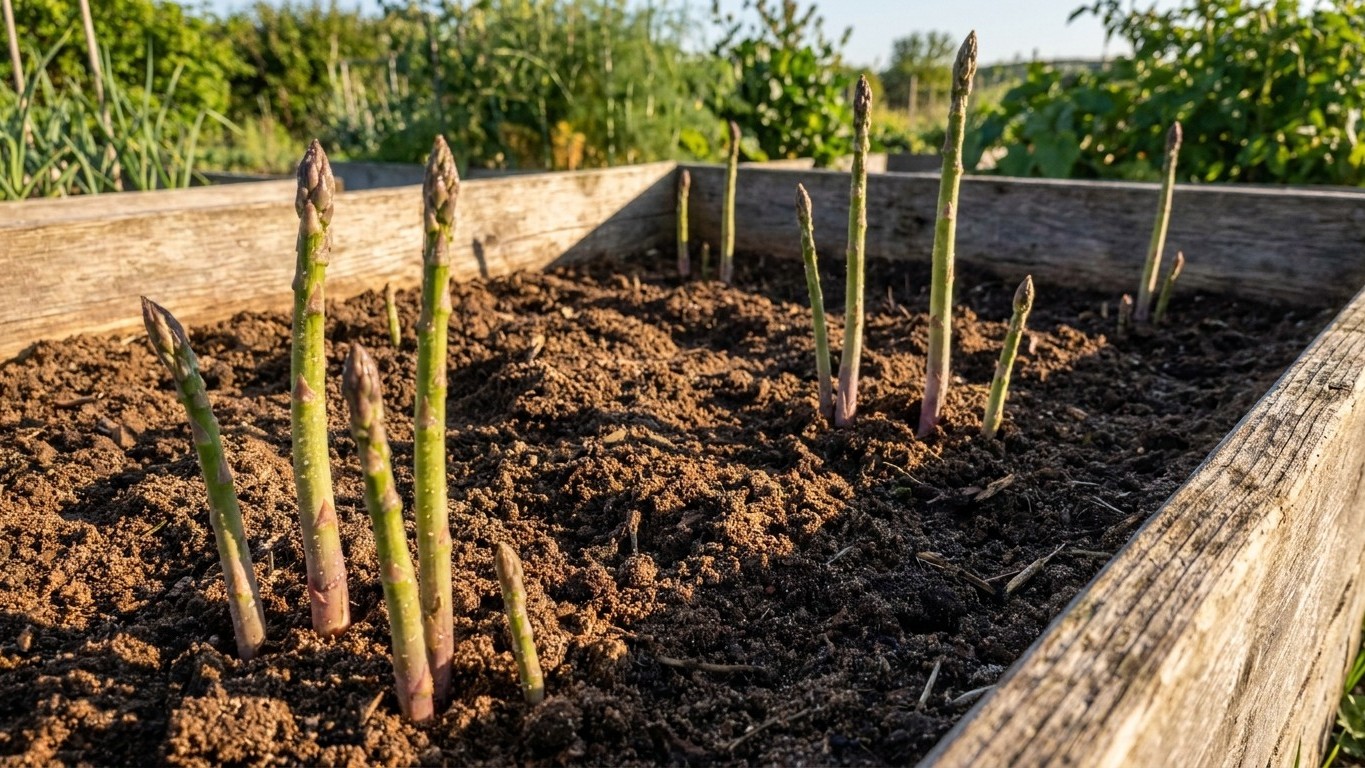

In Nova Scotia, asparagus gets eaten in three places and at three times: the spears in spring, the ferns through summer, and the crown and roots out of sight all year. The damage tells you which group you are dealing with long before you need a species name. The calendar starts at the last spring frost, which averages May 7 at the Halifax Stanfield station and falls later in one year out of two.
Which pests attack asparagus in Nova Scotia
The species list that counts is the one kept for your district by the provincial agriculture department’s extension staff. They record what has turned up on vegetable crops around the province, and a name pulled from a book written for another region can send you after the wrong insect. What you can do on your own is sort the damage into groups, because each group points to a different part of the plant and a different time of year.
Chewing insects work on the spears in spring and on the ferns in summer. Sap-feeding insects sit on the ferns and leave them speckled, curled or sticky. Feeders in the soil cut spears off at ground level or work on the crown. Grazing wildlife can also strip tender spears, though that leaves clean, torn cuts rather than the small bites an insect makes.
Some insects on a provincial pest list have no business in an asparagus bed. Anything that feeds on bark, wood, buds or tree fruit lives in orchards and woodlots, and asparagus offers none of those tissues. If a name from a general list belongs to a tree, set it aside.
The ferns deserve the most protection in a new bed. The crowns go in as crowns, set in 8-inch furrows in early spring, and asparagus is not harvested until year 3. Until then the ferns are the only way the plant feeds its roots, so a fern stripped in its first or second summer costs the bed more than the same damage later. After that first harvest, a well-sited bed produces for 10 to 15 years (Utah State University Extension), which is a long time to carry a weak start.
When each one shows up, and what it does first
Start counting from the last spring frost, not from the calendar. Environment and Climate Change Canada’s Canadian Climate Normals put the mean date at May 7 for the Halifax Stanfield station. It is a midpoint, so in one year out of two the last frost comes after it. Northern and upland districts run weeks behind that station, and a garden on the Atlantic shore can sit on a different schedule from one inland.
What do you see on spears in spring?
Spears are the first thing to push through once the soil warms, and the first sign of trouble is usually a spear that looks wrong rather than an insect. Look for notched or scarred skin, nibbled tips, spears bent into a crook, or a spear that was standing yesterday and is cut clean at the soil line today. A severed spear points toward something working at night in the soil or at the surface. Scarring and crooked growth point toward something feeding on the spear as it rises. A bed in its first two years has few spears to show you, so you may only notice a gap where a crown failed to send one up.
What do you see on ferns in summer?
Once the spears open into ferns, the symptoms move up the plant. Ragged or stripped fronds suggest chewers. A fine speckle, a sticky film or curled tips suggest sap-feeders. Summer rainfall across June, July and August adds up to about 284 mm (11.2 inches) at the reference station, with the driest month, August, still receiving about 93 mm (3.68 inches). A summer that wet keeps ferns lush, which hides early damage until a whole stem goes thin. Walk the bed and turn a few fronds over every week or so in the first half of summer.
What happens at the crown?
Trouble at the roots shows up slowly. Fewer spears each spring, spears that come up thinner than the year before, and ferns that yellow early all point downward. Nothing about this follows the frost date, which is why it gets mistaken for something else, as the next section explains. If you are still choosing planting dates, When to Plant Asparagus Crowns in Nova Scotia covers how the spring window sets the whole first season.
Telling the damage apart from everything else
Many things that look like insect feeding are not. Before you reach for any treatment, match what you see against the usual look-alikes. The table gives the sign that separates them, and your provincial extension office can confirm a diagnosis from a sample.
| What you see | Other causes to rule out | What settles it |
|---|---|---|
| Ragged or notched fronds | Wind whipping, hail, a mower or trimmer pass | Insect feeding is scattered and uneven; mechanical damage runs in one direction or one side of the row |
| Limp, dark spear tips | A cold night after emergence | Frost hits every exposed spear in the same part of the bed; insects pick individual spears |
| Yellowing ferns | Dry spells, soggy ground, disease, natural fall color | Dig down beside the crown and feel the soil; check the date against the season |
| Thin, spindly spears | Young crowns, harvesting too long, crowded plants | Count the years since planting and note when you stopped cutting |
| Fewer spears each year | Crown rot, poor drainage, root-zone feeders | Dig one weak crown and look at the roots; send a sample for identification |
Check the soil before you blame an insect. The province’s most common soil is an imperfectly drained Podzol, 53 percent of the mapped surface in Agriculture and Agri-Food Canada’s Canadian Soil Information Service, and imperfect drainage keeps crowns wet. A crown sitting in wet ground declines the way a bitten one does. Your own ground may be nothing like that median, which is exactly why a hands-on look matters more than the average. Will Nova Scotia Soil Hold an Asparagus Bed for Fifteen Years? walks through that question for a bed meant to stay put.
Keep one more rule in mind for ferns that yellow late in the season. That is how asparagus normally ends its year, and cutting it early starves the crown. If the yellowing arrives while neighbors’ ferns are still green, or comes with chewed fronds, take it to extension.
What actually works here, and what is a waste of time
On a short season, timing does more than any product. Put a physical barrier over the bed before the first spears break the surface, because by the time you see the damage the feeding has already happened. A lightweight cover held down at the edges keeps flying insects off the spears and costs nothing after the first purchase. It has to come off for harvest and pollination is irrelevant for spears, so the only trade-off is the extra handling.
Hand-picking works on a small bed and works best when you walk it often. Pair it with clean-up of the old fern debris at the end of the season, since dead stems can shelter what overwinters near the crown. Cut spears promptly during harvest, because a spear left to stand is a spear left to feed on. Stop cutting once most spears are thinner than a pencil, and let the ferns grow. A bed that is allowed to rebuild is more tolerant of leaf damage than one that was pushed too hard.
Several common habits are a waste of time. Spraying on a guess misses the insect and may harm the beneficial ones feeding on it. Treating ferns after harvest without an identification wastes the effort, because several look-alike problems share the same symptoms. Treating a wet bed for insects when the real trouble is drainage does nothing, and no product fixes ground that holds water for weeks. Planting crowns in poorly drained spots and hoping a treatment will compensate is the most expensive version of this mistake, since the bed stays for years.
What is registered for use on a food crop in the province changes, and your provincial extension office is the only place that can tell you what is currently permitted and how to apply it safely.
Where to check this for your own county
Start with the agriculture department’s extension office for your area and ask for the county-level contact. Staff there track which insects are active on vegetables in your district and which ones have been quiet, and they can tell you what has actually been found near you this season. Pest presence varies inside the province, so a record at the provincial scale does not tell you what lives in a particular garden.
The May 7 mean frost date, the summer rainfall and the soil profile come from a single reference station and from province-wide mapping. A river bottom, a slope facing the sea, a lot that a builder scraped and filled, or a garden on higher ground can all sit weeks off those averages. A rain gauge on your own plot gives you a truer picture of watering needs than any station reading.
For the full picture of bed layout, variety choice and years of care, Growing Asparagus in Nova Scotia is the parent guide.
The next step is simple. The next time you find damage, cut one affected spear or frond, seal it in a jar or bag, and bring the sample itself to your extension office rather than relying on a photo alone.
Common questions
Will pests kill an asparagus bed?
Established beds rarely die from leaf or spear feeding alone. The risk is highest in the first two years, when ferns are the only source of energy for the crowns. Root-zone trouble and wet ground are more likely to cause lasting loss than a chewed frond.
When should I start checking for damage?
Begin when the first spears emerge after the last spring frost, which averages May 7 at the Halifax Stanfield station and comes later in half of all years. Keep checking through summer, when ferns are in full growth.
Does a wet summer mean more damage?
Rain changes how the bed looks and behaves, and it keeps ferns lush enough to hide early feeding. Whether it changes pest numbers in your garden is a question for local extension staff.
Who can identify what is eating my asparagus?
Your provincial agriculture department’s extension office, through its county-level contact. Take a sample of the damaged plant and note when you first saw it.
Sources : saltwire.com | halifaxseed.ca | agriculture.canada.ca