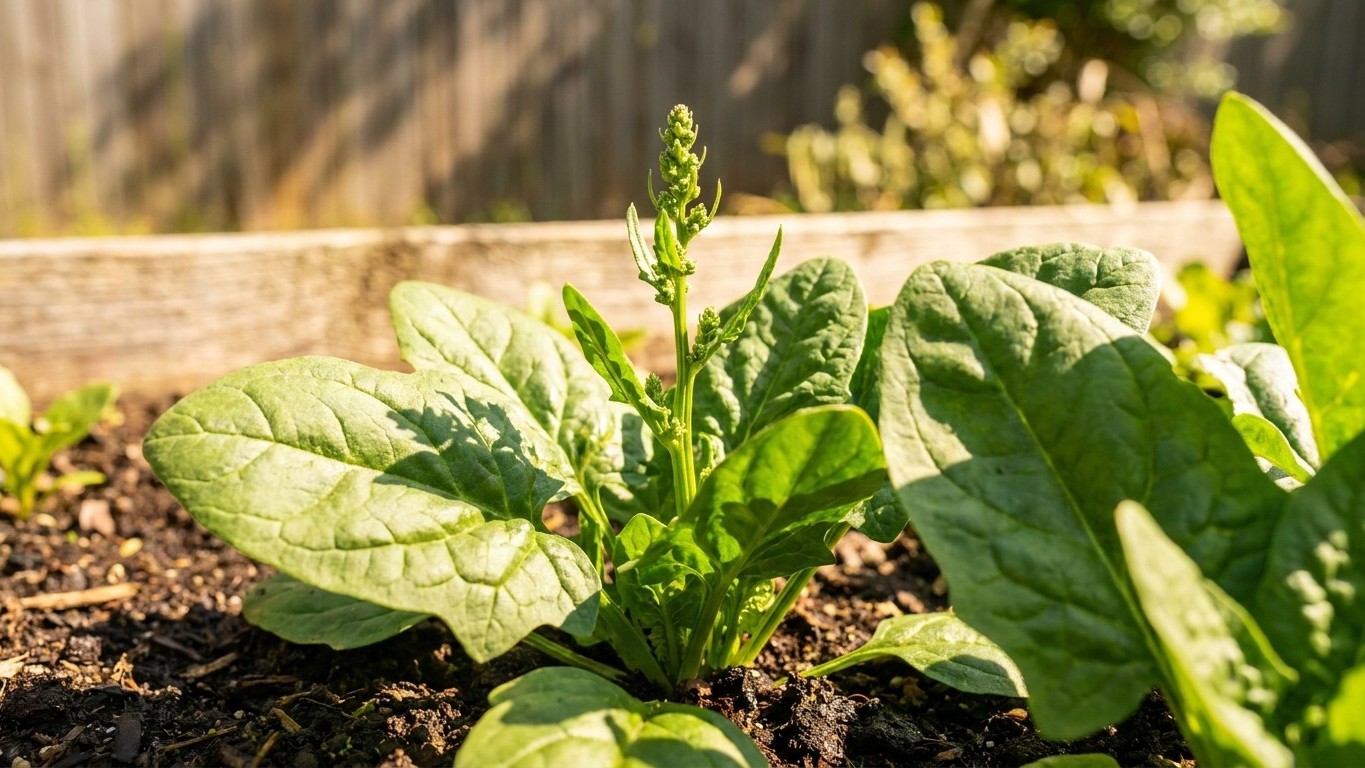

Cut spinach young, while the leaves are broad and the center of the plant is still flat, and plan to eat it within days. Two weeks is the most a cold, very humid fridge can stretch it, and a kitchen refrigerator usually falls short of that. For sowing and growing, start with Growing Spinach in Illinois.
When spinach is ready in Illinois
Spinach is ready when the rosette holds a full ring of broad, flat leaves and the center is still low, with no stalk rising. At the Chicago reference station the last spring frost falls between April 11 and April 22. Spring-sown plants generally reach cutting stage from May into early June, depending on how early the seed went in.
That window is short because spinach answers to the sky as well as the thermometer. Utah State University Extension says spinach bolts during long days and warm temperatures, and grows best where temperatures do not exceed 75°F. The longest day at the reference station brings 15 h 04 of daylight, so a cool summer buys no extra weeks. Long days alone can trigger flowering. The 75°F line is also where leaves start to turn bitter. Much of spring and autumn runs below it. Summer does not, and the station averages 14.0 days a year at 90°F or more.
Watch the plants for these signals:
- A full ring of leaves, wide and flat, with a tight low center
- Leaves that taste mild when you nibble an outer one
- No central cone or stalk lifting out of the rosette
- Warm days approaching, with highs creeping toward the mid-70s
Once the center starts to rise, cut the whole plant. The leaves only get more bitter from there, and Will Spinach Bolt Early in Illinois? explains what pushes that timing earlier.
When does fall spinach get cut?
For a fall crop, check with your local county extension office for the right planting date. The first fall frost at the reference station comes between October 24 and November 3. Counting back puts sowing roughly in mid-August to mid-September on paper. Warm soil is what holds that back. Seed germination drops once the soil is above 80°F, so the window opens when the soil cools, however the calendar reads.
| Season | What starts it | What ends it |
|---|---|---|
| Spring crop | Workable soil, around the April 11 to April 22 last-frost range | Long days and warmth, which send up a seed stalk |
| Fall crop | Soil cooling below 80°F, sown 50 to 75 days before the target harvest | A hard freeze after the October 24 to November 3 first-frost range |
These dates are for the airport station. Suburban and rural gardens usually see the last spring frost one to two weeks later and the first fall frost one to two weeks earlier, so check your county extension office for your own dates. Ask your local county extension office which varieties they recommend for your area.
Keeping it, and for how long
The UC Davis Postharvest Technology Center gives the benchmark in its spinach produce fact sheet: optimum temperature 0°C (32°F) and optimum relative humidity 95 to 98%. It calls spinach “highly perishable” and says it “will not maintain good quality for more than 2 weeks.” Treat that as a ceiling for ideal conditions. A home kitchen rarely matches them.
The same sheet says wilting, yellowing and decay are likely to increase once storage goes past 10 to 14 days. The pattern is also faster at common distribution conditions of 5 to 10°C (41 to 50°F). A couple of degrees above freezing is the difference between a crop that holds and one that slumps. The best case is 32°F with 95 to 98% relative humidity, and that is about as much as the leaf can ask of a fridge.
| Condition | Temperature | What UC Davis says |
|---|---|---|
| Optimum | 32°F (0°C), 95 to 98% humidity | Will not keep good quality beyond 2 weeks |
| Storage past 10 to 14 days | Optimum or near it | Wilting, yellowing and decay likely to increase |
| Common distribution | 41 to 50°F (5 to 10°C) | Decline comes faster |
How long does cut spinach really keep?
Plan on days, and count anything past that as a bonus. Spinach cut from the garden starts its clock the moment the knife goes in, and a bunch that has sat warm in a basket has already used some of it. Cool the leaves quickly, keep them damp but not soaking, and eat the oldest first.
Humidity matters nearly as much as cold. At 95 to 98% the air around the leaf is almost saturated, so the leaf loses little water. In a dry fridge the thin blades wilt long before they rot. The reverse also happens: standing water in a closed bag helps decay take hold. The goal is a damp leaf in cold air, not a wet one.
Harvest timing feeds into this. Leaves cut in the cool of morning, before the day warms them, start the clock with less field heat to shed. A spring plant already stressed by warm weather is a poor candidate for long storage. If a stalk is rising and heat is coming, eat that spinach first.
Where in the house that actually is
A household fridge runs warmer than 32°F, and the door runs warmer than the shelves because it opens and closes all day. That puts the door far from the optimum and near the 41 to 50°F range where decline speeds up. The closest match is the back of the bottom shelf, or the crisper drawer with its humidity vent set to closed.
Closed is the right setting here, since vent settings on most drawers control how much moisture escapes. For leafy greens you want it kept in. If you have no drawer, a bag does the same job. Put the leaves in a loose bag with a slightly damp paper towel, or wrap the bunch in a damp cloth first. A whole bunch with the cut ends in about an inch of water also works, with a loose bag over the top. Either way, keep the leaves from sitting in a puddle.
Skip this, and it costs you: spinach left in the door or in an open container will wilt and yellow in days rather than lasting toward two weeks. A fridge thermometer left on the bottom shelf overnight shows how close you are to the 32°F target. If leaves turn dark and glassy near the back wall, that spot is too cold, so slide the bag forward.
Chewed or damaged leaves go slimy first, so use those up early. What is eating them, and when, is covered in What Eats Spinach in Illinois, and When.
Common questions
Can I still cut spinach after it bolts?
You can, but the leaves turn bitter and the plant puts its energy into a seed stalk. Pull it and sow again when the soil cools.
Can I cut a plant more than once?
Take the outer leaves and leave the center intact, and the plant keeps producing until heat and long days push it to bolt. Cut the whole rosette once the stalk begins to rise.
Should I wash spinach before storing it?
Wash only what you will eat soon. Extra water in the bag speeds decay, so dry the leaves well, or leave them damp but not wet, and wash the rest just before using it.
Will frost hurt my fall spinach?
A light frost usually leaves spinach fine, and the first fall frost at the reference station comes between October 24 and November 3. Cut a bed ahead of a hard freeze if you want to keep the leaves, and check your county extension office for local dates.