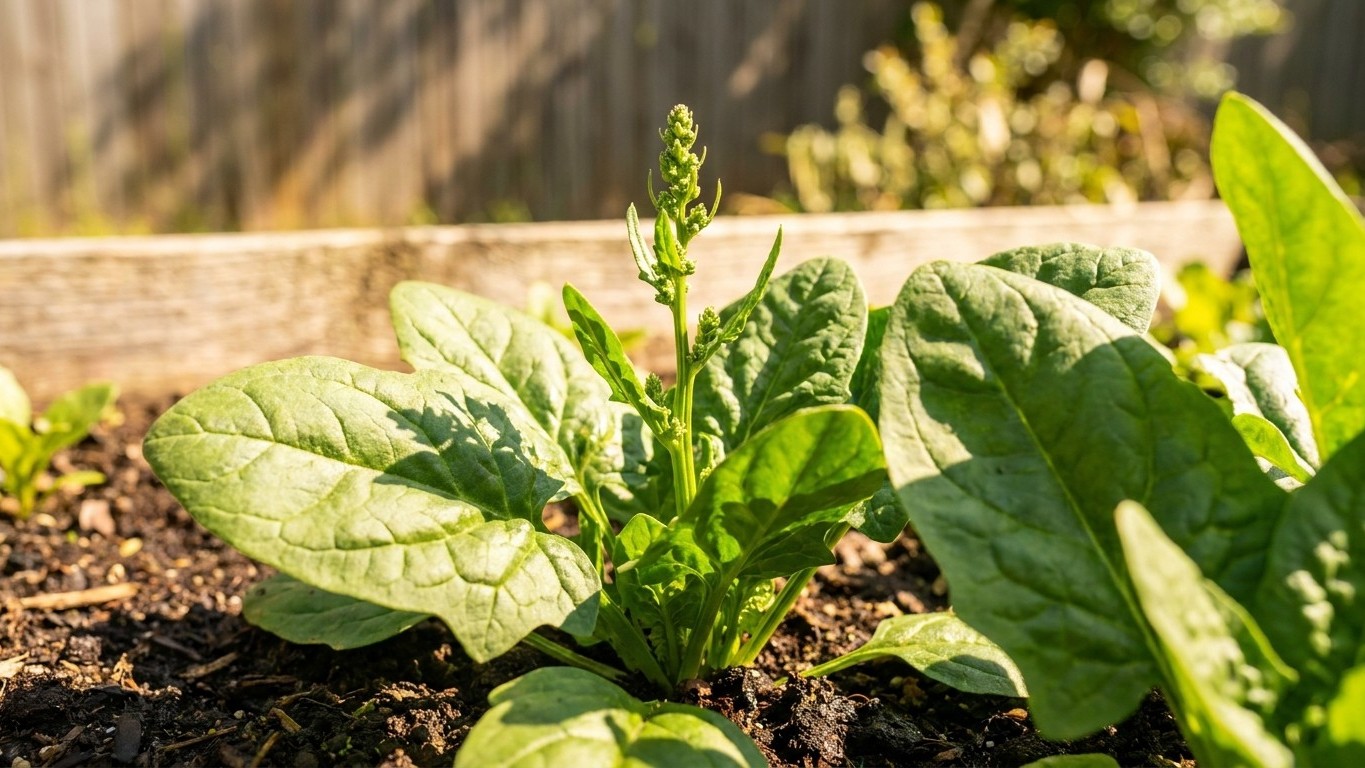

Cut spinach when the outer leaves are about the size of your hand and the center of the rosette is still low and flat. In central Indiana that means late April through May in spring, and from the last days of September until the first hard frost in fall. After cutting, spinach is a short-lived crop: at best it holds up to two weeks, and only in a cold, humid fridge.
When spinach is ready in Indiana
The plant tells you before the calendar does. Spinach is ready when the outer leaves are big enough to eat and the center is still a tight crown of small leaves. The window closes when that center starts to stretch upward into a stalk. Utah State University Extension notes that spinach bolts during long days and warm temperatures, and that it grows best where temperatures stay at or below 75 F. Both triggers matter in Indiana. At the Indianapolis reference station the longest day of the year brings 14 h 49 of daylight, and the station averages 14.6 days a year at 90 F or higher. A cool June does not cancel the long days. Once they arrive, bolting is on the table whatever the thermometer says.
Three signs tell you a plant is at its cutting best:
- Outer leaves are roughly palm-sized, smooth and dark green.
- The center is still low, with no raised bud or thickening stem.
- A leaf tastes mild and slightly sweet, with no sharp bitterness.
Bitterness is the early warning. The same 75 F that caps good growth is also where flavor turns. Leaves grown in a warm spell can be edible and still taste harsh, so cut them before the weather gets worse. A plant that has already sent up its stalk is nearly always past its best. The full story is in Will Spinach Bolt Early in Indiana?
The spring window
Indianapolis has a last spring frost between April 9 and April 21 (NOAA NCEI 1991-2020 Climate Normals, 30-70% probability band), and the first fall frost falls between October 21 and October 30. Spring spinach goes in as soon as the soil can be worked, so it starts growing well before that last-frost range ends. Cutting usually begins in late April and runs through May. When daytime highs start flirting with the upper 70s and the days stretch toward their longest, the crop is on borrowed time. Southern Indiana runs a fortnight or more ahead of the north in spring, so adjust the whole window earlier there and later in the northern counties.
The fall window
Fall is the better season. For a fall crop, Utah State University Extension says to plant 50 to 75 days before the date you want to harvest. Count back from the first fall frost range of October 21 to October 30, or check with your local county extension office for a sowing window. The obstacle is warm soil, not cold. Seed germination drops above 80 F soil, and Indiana’s early August ground often sits above that. Shade the bed, water it well, or hold off a week or two. Check with your local county extension office for recommended spring varieties. Seedlings and pests are covered in Growing Spinach in Indiana and What Eats Spinach in Indiana, and When.
Keeping it, and for how long
Spinach is one of the least forgiving vegetables once it is cut. The UC Davis Postharvest Technology Center gives its optimum storage conditions as 0°C (32°F) and 95 to 98% relative humidity. It calls spinach “highly perishable” and says it “will not maintain good quality for more than 2 weeks.” That is a ceiling for the best case. It is not a plan for the week ahead.
The same sheet says wilting, yellowing of leaves and decay are likely to increase after storage beyond 10 to 14 days. At common distribution conditions of 5 to 10°C (41 to 50°F), they come faster. A fridge running in that range is normal for a home kitchen. So spinach that has traveled in a warm car and sat in a door bin may start yellowing within days. Leaves bought from a store have already used up part of their allotment before they reach your counter. Leaves cut that morning start the clock at zero.
Here is what the figures mean side by side:
| Condition | Temperature | What to expect |
|---|---|---|
| Optimum storage | 32°F, 95 to 98% humidity | Good quality for up to 2 weeks at most |
| Beyond 10 to 14 days | Any | Wilting, yellowing and decay likely to increase |
| Common distribution conditions | 41 to 50°F | Deteriorates faster than at 32°F |
Plan for the cold, humid, tightly managed case and treat anything past it as a bonus. The target to write down is 32°F with 95 to 98% relative humidity, because every degree above it shortens the clock. A reasonable rule at home: plan to eat cut spinach within the first week, and treat the second week as a margin for the leaves that were in the best shape on day one.
Harvest timing feeds into this too. Leaves cut when the plant is young and growing steadily hold better than leaves cut from a plant about to bolt, which are already coarse and often bitter. Cut in the cool hours, handle the leaves gently, and chill them quickly. Every hour at room temperature uses up some of the shelf life the cold would have given you.
Where in the house that actually is
A domestic fridge is warmer than the laboratory optimum, and its door is warmer still. Every time you open it, the door shelves catch the warm air from the room. The back of the bottom shelf is the closest a home unit comes to 32°F. The crisper drawer is the other good spot if it has a humidity slide and you close the vent. Avoid pressing leaves against the back wall if the fridge freezes anything there. Ice crystals turn spinach limp and dark when it thaws.
The 95 to 98% humidity figure sounds like a fish tank, but it is easy to approximate in a kitchen. You are trying to hold moisture around the leaves without leaving them wet. Soggy leaves rot quickly, and dry leaves wilt just as fast. Most gardeners manage it in one of three ways:
- A loosely closed bag with a slightly damp paper towel tucked in.
- A lidded container lined with a damp towel, leaves resting on top.
- For bunches with stems, a jar with a little water under the cut ends and a loose bag over the leaves.
Dry the washed leaves well first, or hold off washing until you are ready to eat them. Excess water in the bag speeds up decay faster than the lost humidity would. Wrap the leaves loosely in a damp towel, bag them, and keep them on the back of the bottom shelf, away from the door. Skipping that step can cost you several days of quality. Spinach stored in a door bin at fridge-door temperatures behaves much like the 41 to 50°F case, with yellowing and slime arriving well inside the two-week ceiling.
Check the bag every couple of days. Remove any leaf that has turned slimy or yellow, since decay spreads to the leaves around it. Squeeze out extra air, and keep the bag away from ripening fruit like apples, which can speed yellowing.
Common questions
Can I cut spinach more than once?
Yes, if the plants are not yet bolting. Take the outer leaves and leave the center crown intact, and it keeps producing new leaves. Once the center rises into a stalk, harvest the whole plant.
Does southern Indiana cut earlier than the north?
Yes. The frost dates quoted here come from the Indianapolis station. Southern Indiana runs earlier in spring and later in autumn by a fortnight or more, so the cutting window opens sooner there and the fall harvest can run longer. Your county extension office can tell you the local dates.
How do I know stored spinach has gone bad?
Look for wilting, yellowing leaves and slimy patches, which are the signs UC Davis lists as storage extends past 10 to 14 days. A sour smell or slick texture means it should go in the compost.
Is bitter spinach safe to eat?
Bitter spinach is safe, only less pleasant. Bitterness usually shows up as temperatures climb past the 75 F range spinach prefers. Cooking softens it, but a plant that tastes sharp and has a rising center is nearly finished, so cut it and replant for fall.