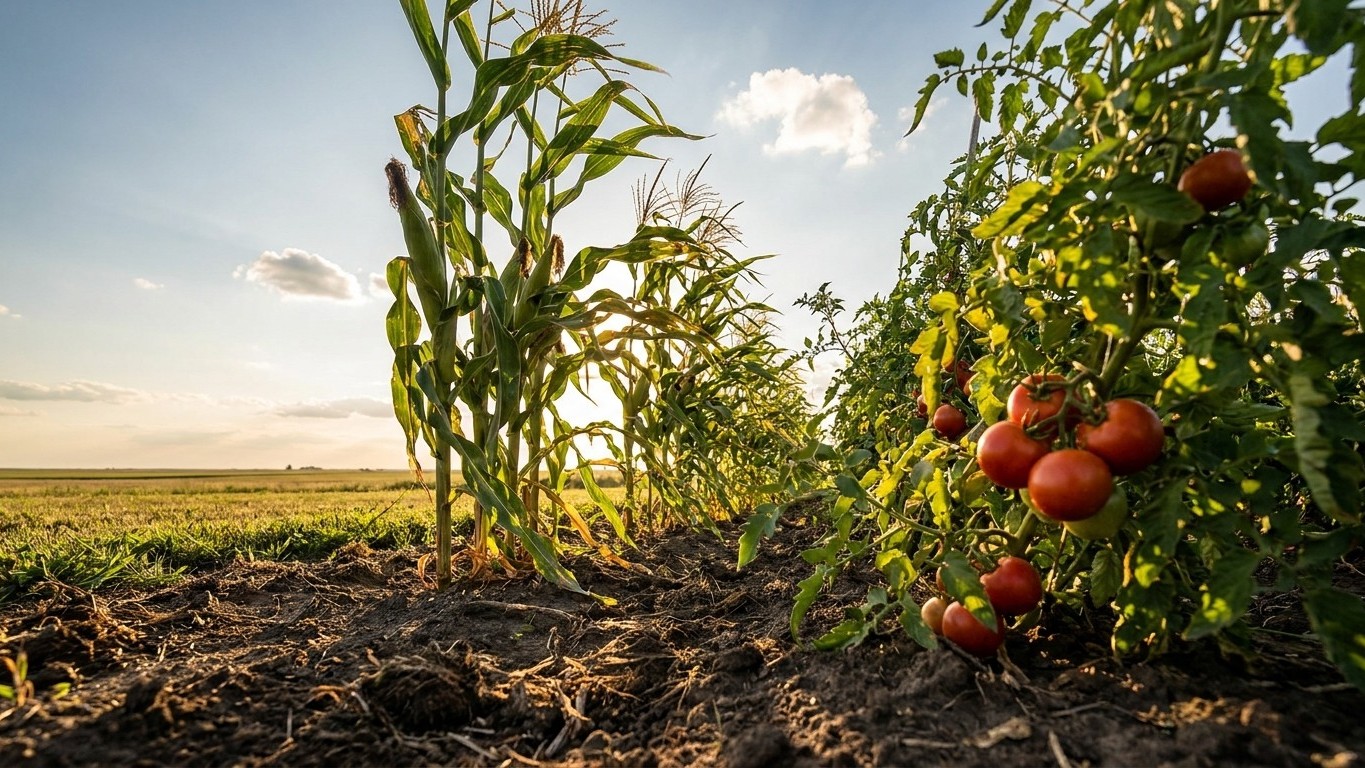

Sweet corn tells you when it is ready: the silks dry to brown, the husk stays green and moist, and a punctured kernel leaks milky juice. In West Virginia that lands somewhere between mid-summer and early fall, depending on planting date and elevation. Once an ear comes off the stalk, sugar starts draining from the kernels, and heat speeds the loss. The best ear is the one eaten or chilled the same day.
When sweet corn are ready in West Virginia
Watch the plant, because the calendar drifts: ears are ready when the silks have dried brown, the husk is still green and moist, and a punctured kernel gives milky juice. Most gardens in the state see that from mid-summer into early fall, and the exact week depends on when the corn went in and how high the garden sits.
The three signs only work as a set. Each one alone can mislead:
- Silks that are dry and brown, with no green or sticky strands left near the tip.
- A husk that is still green and moist. A husk drying to straw means the ear has gone past its best.
- Milky juice when a thumbnail breaks a kernel near the top of the ear. Clear juice means too early, and a thick paste means too late.
How many days from silk to harvest?
Once the first silks appear, watch the ears closely and pick them when they are full. Start testing at the early end of that stretch. This clock tells you which week to pick, and it is separate from the one that decides whether a variety suits the season at all.
The season clock runs from planting. Utah State University Extension says sweet corn needs soil above 60 F and 60 to 90 days from planting. Soil reaches 60 F well after the last spring frost, which at the Charleston reference station falls between April 9 and April 23 (NOAA NCEI climate normals). Clemson Cooperative Extension gives a floor for sowing: do not plant before the soil temperature at the 4-inch depth is at least 50 ºF, and wait until soil reaches 65 °F for extra-sweet varieties.
The first fall frost at the same station falls between October 18 and November 1. A 90-day variety planted once the soil has warmed has room in a valley like Charleston. Higher elevations freeze noticeably earlier in fall, so a late variety there can run out of season before the ears fill. Choose an earlier variety on a ridge, or ask the county extension office what has worked locally. The timing question is covered in When to Sow Sweet Corn in West Virginia.
Do neighbors change the harvest?
They change what the harvest tastes like. Sweetness is lost if su, se and sh2 types tassel at the same time. Staggered plantings help because the types then tassel in different weeks, and they spread the harvest over a longer stretch. Utah State University Extension also says to plant in blocks of three or more rows, so pollen drops where it should. A single long row is a poor shape for corn.
Keeping them, and for how long
Sugar is the thing that fades. Clemson Cooperative Extension puts it this way in its sweet corn factsheet: “Sweet corn loses sugar from the kernel rapidly at high temperatures… Sweet corn can be stored under optimal conditions for about five days, but will lose sweetness with each day of storage.” That passage is the real basis for the old advice about running from the garden to the pot.
Read the quote closely. About five days is a ceiling that applies under optimal conditions, and the second half of the sentence says sweetness drops with every day along the way. Day one is better than day three, and day three is better than day five. An ear left in a warm spot loses sugar faster than the quote’s best case, because heat is what speeds the loss.
Which type holds sweetness longest?
Genotype changes the pace. Standard su types lose sugar fastest, se types hold it longer, and sh2 types hold it longest. That is the practical reason to pick a variety by type rather than by the picture on the packet. If you cannot eat the corn within a day of picking, an sh2 type forgives more. It also asks more of the soil at planting.
| Type | Sugar after picking | Soil at the 4-inch depth when sowing |
|---|---|---|
| su | Loses sugar fastest | At least 50 ºF |
| se | Holds sugar longer than su | At least 50 ºF, or 65 °F if sold as extra-sweet |
| sh2 | Holds sugar longest | 65 °F, the extra-sweet threshold |
The two soil numbers cannot be swapped. Seed sown at 50 ºF is fine for ordinary sweet corn, but an extra-sweet seed in the same cold soil is likely to rot before it germinates. That explains how one gardener can succeed one year and fail the next after changing only the variety.
Some corn also sets the pace before it reaches your kitchen. Sweet corn sold at a roadside stand may already be a day old, so ask when it was picked. The full growing picture is in Growing Sweet Corn in West Virginia.
Where in the house that actually is
Heat is the enemy, so the question for any spot in a house is how warm it runs over the next few hours. The refrigerator comes closest to the cold storage Clemson has in mind. The crisper drawer is the gentlest spot in most models because it holds steady and carries some humidity. Dense, wet ears sitting against the back wall can run colder than the rest of the shelf, so check there too.
A heated kitchen is too warm, and a counter next to a stove or sunny window is worse. A garage or porch swings with the weather. At the Charleston reference station an average year includes 16.0 days at 90 F or higher (NOAA NCEI climate normals), and a garage can run hotter than the outdoor air on a summer afternoon. A cool basement beats the kitchen but still runs warmer than the fridge, so it buys you hours, not days.
Put a plain thermometer in the crisper drawer overnight and read it in the morning. If the reading is high, move the corn to a colder shelf before the next harvest. Skipping the check means guessing, and a guess that runs warm costs you sugar every day the ears sit.
Common questions
How can I tell if the corn is ready when the silks are brown?
Brown silks are the first sign of three. Feel the husk, which should still be green and moist, and break a kernel with a thumbnail. Milky juice means pick it. Clear juice means wait a few more days, and a thick paste means the ear is past its peak.
Will picked ears keep getting sweeter on the counter?
No. Clemson Cooperative Extension says sweet corn loses sweetness with each day of storage, and the loss is faster at high temperatures. Eat the ears the day you pick them, or get them into the refrigerator quickly.
Does the first fall frost matter for harvest?
It matters most for late plantings and late varieties. At the Charleston reference station the first fall frost falls between October 18 and November 1, and higher elevations freeze noticeably earlier. Sweet corn needs 60 to 90 days from planting, so a late-sown or slow variety on a ridge can miss the window. Your county extension office can tell you what finishes in your area.
Why was my corn bland even though I picked it on time?
The usual causes are types tasseling together and ears sitting too long after picking. Sweetness is lost if su, se and sh2 types tassel at the same time. Planting each type in a separate stretch of time, in blocks of three or more rows, protects it. Eating the ears the same day protects what sugar the kernels still have.