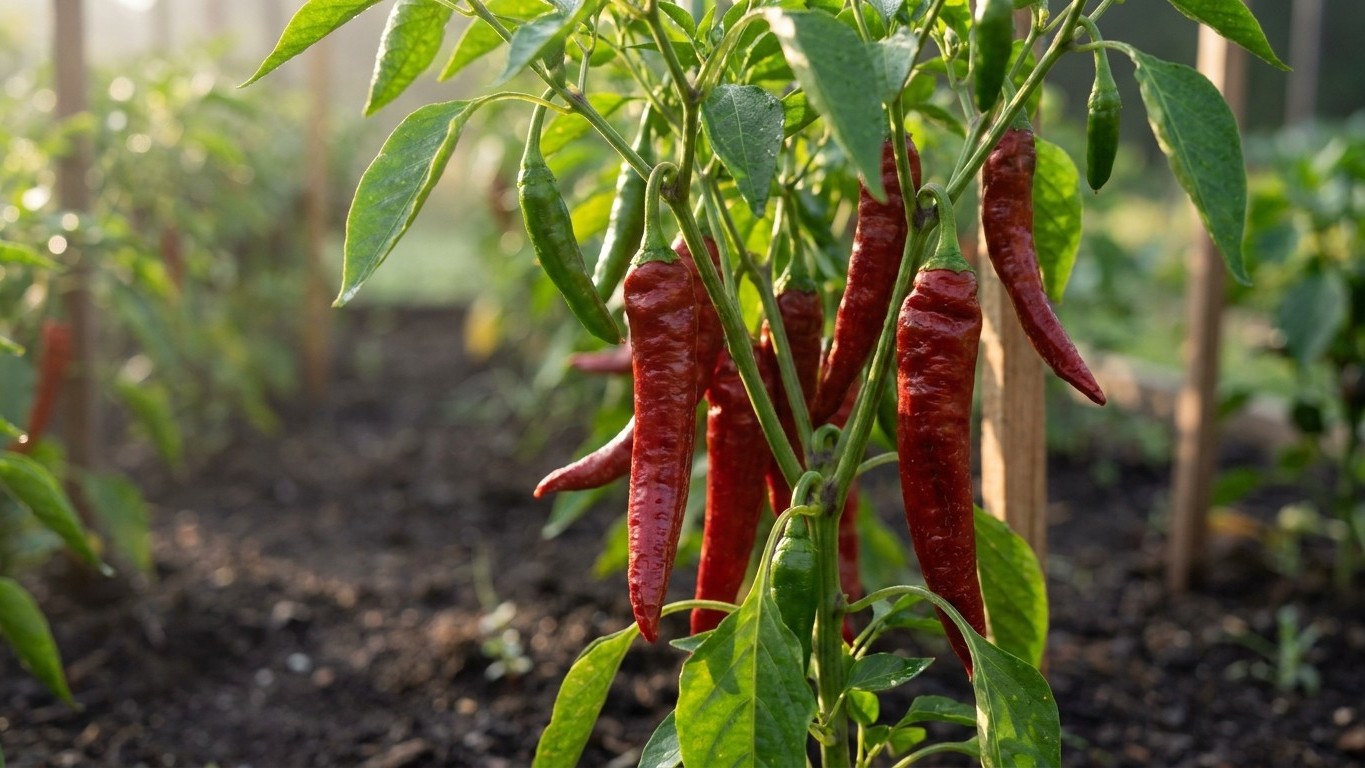

Pick peppers once the fruit is full size, firm and glossy, whether it is still green or has started to color, and get everything off the plant before the first frost. Then keep them out of the refrigerator. Peppers store best at 45 to 50 °F, and a refrigerator runs colder than that, so the skin pits and goes soft. Most Colorado gardeners get the picking right and the storing wrong.
When are peppers ready to pick in Colorado?
Clemson Cooperative Extension says peppers should be ready for harvest about 70 to 85 days after transplanting. Those transplants have already spent 8 to 10 weeks indoors, and Utah State University Extension says to set them out when the soil reaches 60 F, after the last frost. At the Denver reference station, NOAA’s latest 30-year climate normals put the last 32 F freeze between May 1 and May 11 (the 30 to 70 percent probability band). A transplant set out in mid-May therefore reaches its first harvest in late July at the earliest, and more often in August, since cool weather slows ripening.
Denver sits at 5,280 feet on the plains. Mountain towns have far shorter seasons and can frost in July, and the western slope runs on a different calendar again. In those places the 70 to 85 day count may not fit inside the season at all, and your county extension office can tell you what is realistic for your elevation. If you are still planning the bed, Growing Peppers in Colorado covers the planting side.
The count that matters most late in the season starts at the flower. Utah State University Extension puts fruit development at roughly 35 to 45 days from flowering, so a blossom that opens within about six weeks of your first frost is unlikely to become a usable pepper. Plan on picking those late fruits small, or let them go.
Heat and cold both interfere with the flowers. Pepper fruit set fails when nights drop below 55 F or days climb above 90 F. The Denver reference station averages 39.6 days a year at or above 90 F, so blossoms drop during hot spells and the crop arrives in waves instead of all at once. I can’t tell you what your summer nights do, because that varies from one yard to the next. Keep a thermometer near the bed and watch the lows. Why Peppers Fail to Set Fruit in Colorado goes through both ends of that range.
Ripeness shows in the fruit itself. The pepper has reached the full size its variety is supposed to reach, the walls feel firm, and the skin is glossy. Green peppers are fine to eat, but most types left on the plant turn red, yellow or orange and get sweeter. The trade-off is time, since fruit that hangs for weeks is exposed longer to whatever is feeding on it. What Eats Pepper in Colorado, and When lays out who shows up and in which months. Cut peppers with pruners or scissors and leave a short stem, because the branches snap easily when you pull.
Keeping them, and for how long
Clemson Cooperative Extension’s Home & Garden Information Center gives the storage conditions plainly: “The optimal conditions for storage are temperatures of 45 to 50 °F and 80- to 90-percent relative humidity for two to three weeks.” You can read the full factsheet for yourself. The number to write down is 45 to 50 °F.
How long do harvested peppers last?
Two to three weeks is the ceiling, and you only reach it when both the temperature and the humidity are right. A pepper picked at the peak of firmness, stored in the right range, and checked every few days can get there. A pepper that was already soft from the garden, or sat in a warm kitchen for a day first, will not. Treat the range as the best case.
Humidity is the half people forget. A relative humidity of 80 to 90 percent is damp air, and Colorado air is dry, even more so in a heated house through the colder months. Peppers lose water through the skin and wrinkle. A loosely closed container or a perforated bag slows that loss without trapping so much moisture that the fruit rots. Skip washing until you are ready to use them, since wet skin invites mold.
Look through the stored peppers every few days and pull any with a soft spot, because one bad pepper will take its neighbors with it. Once you are past two weeks, move whatever is left into the freezer, or slice and cook it.
Why does the refrigerator ruin peppers?
A refrigerator is colder than the 45 to 50 °F range, and below about 45 °F peppers suffer chilling injury. The skin develops small sunken pits, the flesh softens, and the fruit breaks down faster than it would on a counter. The damage often shows up after the pepper comes back out to room temperature, so the fridge seems fine until a day later. This is the mistake nearly everyone makes, because the crisper drawer looks like the obvious place for vegetables.
Chilling injury builds with time. A cut pepper you will cook tonight is fine in the fridge, and so is a half pepper wrapped for tomorrow’s lunch. Whole peppers you hope to keep for weeks are the ones that suffer.
Where in the house that actually is
The 45 to 50 °F range does not match any standard spot in a house. The refrigerator runs colder, the heated living space runs warmer, and the garage depends on the weather. That leaves a short list of candidates, and the right one differs from house to house.
| Spot | What it does to peppers | Verdict |
|---|---|---|
| Refrigerator, including the crisper drawer | Colder than 45 °F, so pitting and softening | Fine for cut peppers, poor for whole ones |
| Kitchen counter or heated room | Too warm, so the fruit dries and wrinkles quickly | A few days at most |
| Garage | Swings with the weather, from sun-warmed afternoons to freezing fall nights | Unreliable |
| Unheated basement room or cool interior closet | Often closest to the range, and steadier than the others | Best candidate, once you measure it |
In a Colorado house, a basement room away from the furnace usually comes closest, because the ground keeps it steadier than the rest of the house. That is a tendency, though, and some basements run warm from a water heater or ductwork. An unheated spare room on the north side or a cool pantry can work as well. A garage looks tempting in October, but a Colorado fall can run from a warm afternoon to a hard freeze overnight, and a frozen pepper thaws into mush.
Guessing is what costs you the harvest. Leave a thermometer in the spot for a couple of days before you put a basket of peppers there, and read the low as well as the high. A min-max thermometer is cheap and does this on its own. If you can add a hygrometer, check that the humidity lands near 80 to 90 percent. A spot that reads 55 F or 60 F will not ruin the fruit, but it will shorten the keeping time.
If no place in the house comes close, plan around it. Pick what you will eat within a few days and keep it on the counter. Freeze, dry or cook the rest the same day, and use the refrigerator only for cut peppers you plan to eat soon.
Common questions
Should I leave peppers on the plant until they turn red?
You can, and most types get sweeter as they color. The cost is time. A pepper still hanging in September has to survive pests, heat and a possible early frost. If the season is running short, pick the full-size fruit and let the plant put its energy into the ones that are closest to ripe.
What should I do if frost is in the forecast and the peppers are still green?
Pick every pepper that has reached full size and firmness before the frost, because a frost-killed plant gives you nothing more. Fruit that has already started to show color will usually keep coloring indoors, while fully green fruit is better used green. Your county extension office can give you the typical first fall frost date for your elevation, which varies widely across Colorado.
Can I put peppers in the refrigerator for a day or two?
A short stay does less harm than a long one, since chilling injury builds up over time. Still, pitting can appear after the pepper has warmed back up, so use it quickly. If you must refrigerate whole peppers, keep them in the warmest part of the fridge and plan to use them within a few days.
Why are my peppers flowering but not producing fruit?
Heat is a common cause on the hot end, since fruit set fails when days climb above 90 F. The cool end matters too: nights below 55 F cause the same failure. Check your own nights with a thermometer. If a hot spell is the culprit, new flowers open once the weather settles, and those still have time to make fruit if they open at least 35 to 45 days before frost.