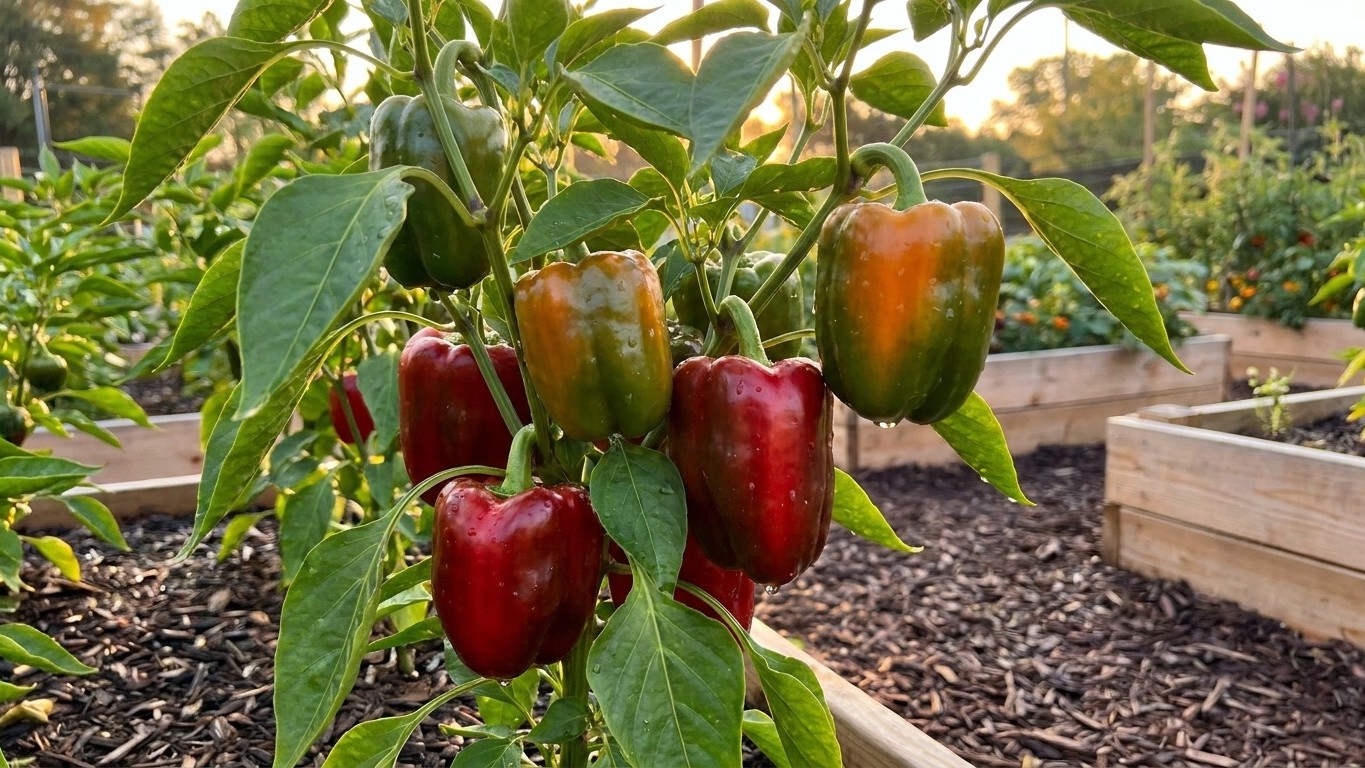

Pick peppers when the fruit has reached full size and feels firm, which for transplants usually means 70 to 85 days after they went into the ground. Then keep them out of the refrigerator. Cold storage is where many good harvests are wasted. A crisper drawer is colder than peppers tolerate, and the fruit pits and softens. A cool, humid spot in the house treats them far better.
Keeping them, and for how long
Why does the refrigerator damage peppers?
Peppers are a warm-season crop, and their skin and flesh are injured by cold even when nothing is freezing. Below about 45 °F the cells in the wall of the fruit start to break down. This is chilling injury. It shows up as small sunken pits on the skin, then as soft, watery patches. The sunken spots give rot an easy way in, so a pepper that looked perfect on the counter can turn slimy a few days after a stint in the cold.
A home refrigerator is set to keep milk, meat and leftovers safe, which puts it colder than 45 °F. The crisper drawer is gentler than the main shelves, but it is not a solution. Nearly everyone stores peppers there out of habit, since that is where store-bought produce lives. The habit is the mistake.
What conditions do peppers actually want?
Clemson Cooperative Extension, through its Home & Garden Information Center, gives the storage target. It says peppers should be ready for harvest in about 70 to 85 days after transplanting, and that “the optimal conditions for storage are temperatures of 45 to 50 °F and 80- to 90-percent relative humidity for two to three weeks.”
The humidity number matters as much as the temperature. Peppers are mostly water, and in dry air they lose it through the skin and wrinkle. If the air is saturated and the fruit is damp, mold takes over. A range of 80 to 90 percent keeps the skin plump without leaving it wet.
How long do picked peppers really last?
Two to three weeks is the ceiling, reached only when the temperature and humidity above are held steadily. It is not a shelf life you can count on. The fruit also has to start in good shape: picked at the right stage, dry, and free of cracks, insect holes, sunscald patches or soft spots. A pepper with any of those will break down well before the three-week mark, and one bad fruit can spoil its neighbors.
In a typical kitchen or garage, expect much less. Peppers that sit somewhere warm lose firmness quickly, and peppers kept too cold decline for a different reason. Use the ones with blemishes first, and check the rest every few days, pulling anything that has started to soften.
Where in the house that actually is
Which room comes closest?
The target of 45 to 50 °F sits in an awkward gap. The refrigerator is too cold. Any room kept comfortable for people, with the air conditioner running through an Arkansas summer or the heat on in winter, is warmer than 50 °F. A garage is the wild card. It may sit in range on a mild fall morning and then swing well above or below it with the weather. In a place that sees about 69.2 days a year at 90 °F or more, according to NOAA’s climate normals for Little Rock, a garage or shed can be hot for a good part of the pepper season.
The best bet is usually the coolest interior space you have: a basement, a cellar, an unheated pantry, a closet on an inside wall away from the sun, or a utility room that stays cooler than the living area. Most Arkansas homes are built on slabs or crawlspaces and have no basement, so the answer is often a cool interior room or a closet far from the water heater, oven and sunny windows. None of these will hit the range every day, but a spot that holds close to it beats a drawer that overshoots in the cold direction.
What should you check with a thermometer?
Guessing at room temperature is unreliable, because a spot that feels cool to your hand can still run well above 50 °F. Put a thermometer where the peppers will sit and read it for several days, ideally one that records the high and low. If you skip this, you may store the whole harvest somewhere that quietly sits 10 degrees off, and you will not know until the fruit softens. A cheap humidity gauge placed next to the thermometer tells you whether you are near the 80 to 90 percent range.
If the spot reads dry, a loosely closed perforated bag or a lidded container with a few holes slows moisture loss without trapping water against the skin. Leave the stems on, keep the fruit dry, and do not wash the peppers until just before you use them.
How do you know when peppers are ready to pick in Arkansas?
How do you tell a pepper is ready?
Watch the fruit rather than the calendar. A pepper is ready for the green stage when it has reached the full size typical of its variety, the walls feel thick and firm, and the skin is glossy. Leaving it longer lets it color up to red, yellow or orange, which is sweeter but takes more time and keeps the plant from putting energy into new flowers. Hot peppers follow the same logic: size and firmness first, color if you want a riper flavor.
Cut the stem with pruners or scissors instead of pulling, since pepper branches snap easily. Picking often encourages more flowers. If something is chewing on the fruit before you get to it, check What Eats Pepper in Arkansas, and When and pick any damaged fruit early so the rest stay clean.
When does the first harvest arrive?
The count of 70 to 85 days starts at transplanting, not at sowing. The seed itself needs 8 to 10 weeks indoors before the plant is ready to move, according to Utah State University Extension, and the transplants should go out when the soil reaches 60 F, after frost. NOAA NCEI puts the last spring freeze at 32 °F somewhere between March 12 and March 28 at Little Rock. Peppers are tender, though, and NWS Little Rock gives April 3 as the date for the 36 °F light-frost threshold, so waiting for the soil to warm usually pushes planting into April. Transplants set out in mid-April would begin yielding from late June into mid-July.
Individual fruit moves faster than the plant overall. Green fruit generally takes about 35 to 45 days to size up, counted from flowering, so a flower that opens now will not give you a pepper next week.
What does Arkansas heat do to the timing?
Fruit set fails at both ends of the temperature range. Utah State University Extension says it falters when nights drop below 55 F or when days rise above 90 F. The hot end is a real factor in Arkansas, given the roughly 69 days a year at that level. Flowers that open during a heat wave may drop, and the harvest then arrives in waves, often with a gap in midsummer and a second flush when conditions ease. The cool end matters in spring and fall, so watch your own nights with a thermometer, since local night lows vary and cannot be guessed from a regional average. If flowers are dropping and you cannot tell why, Why Peppers Fail to Set Fruit in Arkansas walks through it. For the broader season, see Growing Peppers in Arkansas.
Before the first fall frost, pick everything that is full size. NWS Little Rock gives October 31 for the 36 °F light-frost threshold, and a cold night in the 30s can mark the skin and shorten storage even if the plant survives. Fruit that is mature and undamaged goes to your storage spot. Fruit that is small, soft or marked goes into the kitchen first.
Common questions
Can peppers go in the refrigerator for a day or two?
A short stay does less harm than a long one, but the cold still starts the pitting, and below about 45 °F the fruit softens. If you have cut peppers, or the kitchen is hot and you have nowhere cooler, the refrigerator beats leaving them out. For whole, fresh fruit, a cool room does better.
How long will picked peppers keep?
Under ideal storage, 45 to 50 °F with 80 to 90 percent humidity, Clemson Extension says two to three weeks. That is the upper limit. Fruit with damage, or kept somewhere warmer or drier, lasts a shorter time, so check them every few days.
Do I need to pick peppers before the first frost?
Yes, if they are full size. Peppers are tender plants, and a frost can mark the skin and ruin the fruit. Watch the forecast in late October, and pick mature fruit ahead of any cold night.
Why are my plants not making peppers to pick?
Heat and cold are the usual causes. Flowers drop when nights fall below 55 F or days climb above 90 F. Check the weather on the nights and days when blooms opened, and look at your own night temperatures. Your county extension office can help you narrow down local conditions.