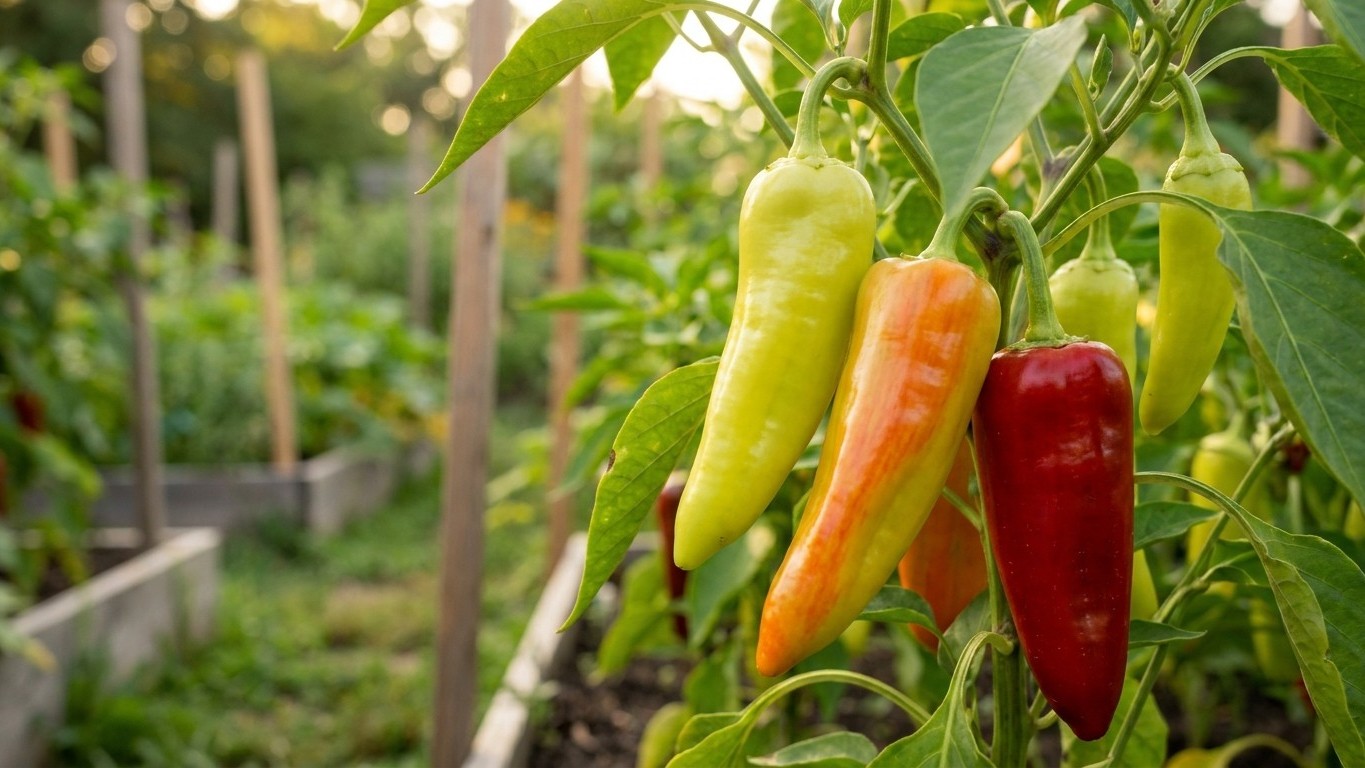

Pick peppers once the fruit is full size, firm and glossy. Clemson Cooperative Extension places that at about 70 to 85 days after transplanting. Green fruit is ready to eat, and fruit left on the plant goes on to color. After picking, peppers keep best at 45 to 50 °F (about 7 to 10 °C), which is warmer than a refrigerator runs. Below about 45 °F the skin pits and softens. For the whole season, start with Growing Peppers in British Columbia.
How do you know a pepper is ready to pick?
When do peppers ripen after transplanting in British Columbia?
Seedlings set the schedule. Utah State University Extension says transplants need 8 to 10 weeks indoors and should go out when the soil reaches 60 °F (about 16 °C), after frost. At the Vancouver Int’l A station, Environment and Climate Change Canada gives March 18 as the mean last spring frost. A mean is a midpoint, so in one year out of two the last frost falls later. Northern and upland districts run weeks behind that coastal station. Push a soil thermometer in before planting and let it, rather than the calendar, make the call.
From transplanting, Clemson counts about 70 to 85 days to harvest. Each fruit also runs its own clock. Utah State University Extension counts 35 to 45 days from flowering, so flowers that open late in the season may not have time to finish.
Fruit set fails at both ends of the thermometer: nights below 55 °F (about 13 °C) or days above 90 °F (32 °C). At Vancouver Int’l A, a day reaching 32 °C turns up 0.07 days a year on average, and a day above 30 °C turns up 0.29 days a year. Heat seldom interrupts fruit set at that station. Nights are another matter, and only a min-max thermometer in your own bed will show what they do. The details are in Why Peppers Fail to Set Fruit in British Columbia.
How do you tell a ripe pepper by sight and feel?
Four checks cover it:
- Size: the fruit has reached the full size shown on the seed packet or plant tag.
- Skin: taut and glossy. Dull, wrinkled skin means the fruit is past its best.
- Walls: firm under gentle pressure, with no soft spots.
- Color: green is a fine stage to pick. Fruit left on the plant turns to its mature color, which takes extra weeks.
Pepper branches snap easily, so cut the stem with pruners and leave a short piece attached to the fruit. Fruit that hangs for weeks also gives pests more time to find it, and What Eats Pepper in British Columbia, and When covers who tends to show up.
Keeping them, and for how long
How long do peppers keep after picking?
Clemson Cooperative Extension’s Home & Garden Information Center gives the optimal storage conditions for peppers as 45 to 50 °F (about 7 to 10 °C) and 80- to 90-percent relative humidity, for two to three weeks. Treat that as the ceiling. It is what a sound, uncut pepper can reach when the temperature and humidity are both right. A bruised fruit, a warm room or dry air will cut it short.
The humidity number matters as much as the temperature. Air at 80 to 90 percent is damp, and in drier air a pepper loses water through its skin and shrivels. A loosely closed bag with a few holes slows that loss without trapping drips. Leave the stem on and skip washing until you are ready to eat, because water sitting on the skin invites rot.
Why does the fridge ruin peppers?
A domestic refrigerator runs colder than the 45 °F floor of that range. Below about 45 °F, peppers suffer chilling injury: the skin pits, the walls soften and the fruit breaks down faster than it would on a cool shelf. It is the mistake nearly everyone makes, because the crisper drawer looks like the natural home for a vegetable.
The limit applies to whole, raw fruit. Once a pepper is cut or cooked, the question changes, and the fridge is the right place for leftovers.
The practical goal is a spot that holds steady in the 45 to 50 °F band. For a fruit picked at the right stage, that steadiness does more than any trick with bags or wraps.
Where in the house that actually is
Which room comes closest to 45 to 50 °F?
Few houses have a room at that temperature on purpose, so the job is to find the nearest approximation. The usual candidates fall short in different ways:
| Spot | What goes wrong | Verdict |
|---|---|---|
| Refrigerator crisper | Colder than 45 °F, so chilling injury | Too cold |
| Kitchen counter or any heated room | Warmer than 50 °F and dry | Too warm, short life |
| Garage or shed | Follows the weather: sun-warmed afternoons, cold clear nights | Unreliable |
| Unheated basement, cold room or pantry on an outside wall | Often the steadiest and coolest indoor space | Closest to the target |
Of these, an unheated basement room or a cool pantry against an outside wall comes closest in most houses. Both are shielded from the weather swings that make a garage unpredictable, and neither gets the furnace or the oven warming the air. Damp basements also tend to have the humidity peppers like, though a damp wall that grows mold is a poor shelf.
How do you check the spot with a thermometer?
Guessing is how peppers end up pitted. Put a min-max thermometer where the peppers will sit and leave it for a couple of days before you trust the spot. Read the lowest and highest values, since the average hides the swings that do the damage. If the low drops under 45 °F, the fruit will pit. If the high climbs past 50 °F, the peppers will not last anywhere near three weeks.
A small hygrometer, the same kind used for cigars or musical instruments, shows whether the air sits near 80 to 90 percent. If a shelf misses on temperature by a few degrees, try a different height or a spot closer to an outside wall and read the thermometer again.
Common questions
Can I pick peppers while they are still green?
Yes. Once the fruit has reached full size and feels firm, it is ready to eat. Leaving it on the plant lets it ripen to its mature color, which takes extra weeks, and the plant stays busy with that fruit in the meantime.
What should I do if cold weather arrives before the peppers finish?
Watch your local forecast through late summer and into fall. When a cold night is coming, pick every full-size fruit before it arrives. Small fruit will not ripen much more, and it is better to enjoy what is ready than to risk it.
Can I keep peppers in the fridge for just a day or two?
Chilling injury starts below about 45 °F, and the fridge runs colder than that, so a cool pantry or basement shelf is the safer choice even for a short stay. If shelf space is the problem, cut the pepper and use it up. Cut or cooked pepper belongs in the fridge.
Why are there no peppers to pick on my plants?
The usual cause is a failure of fruit set, which happens when nights fall below 55 °F (about 13 °C) or days climb above 90 °F (32 °C). Check your own nights first, then see Why Peppers Fail to Set Fruit in British Columbia.