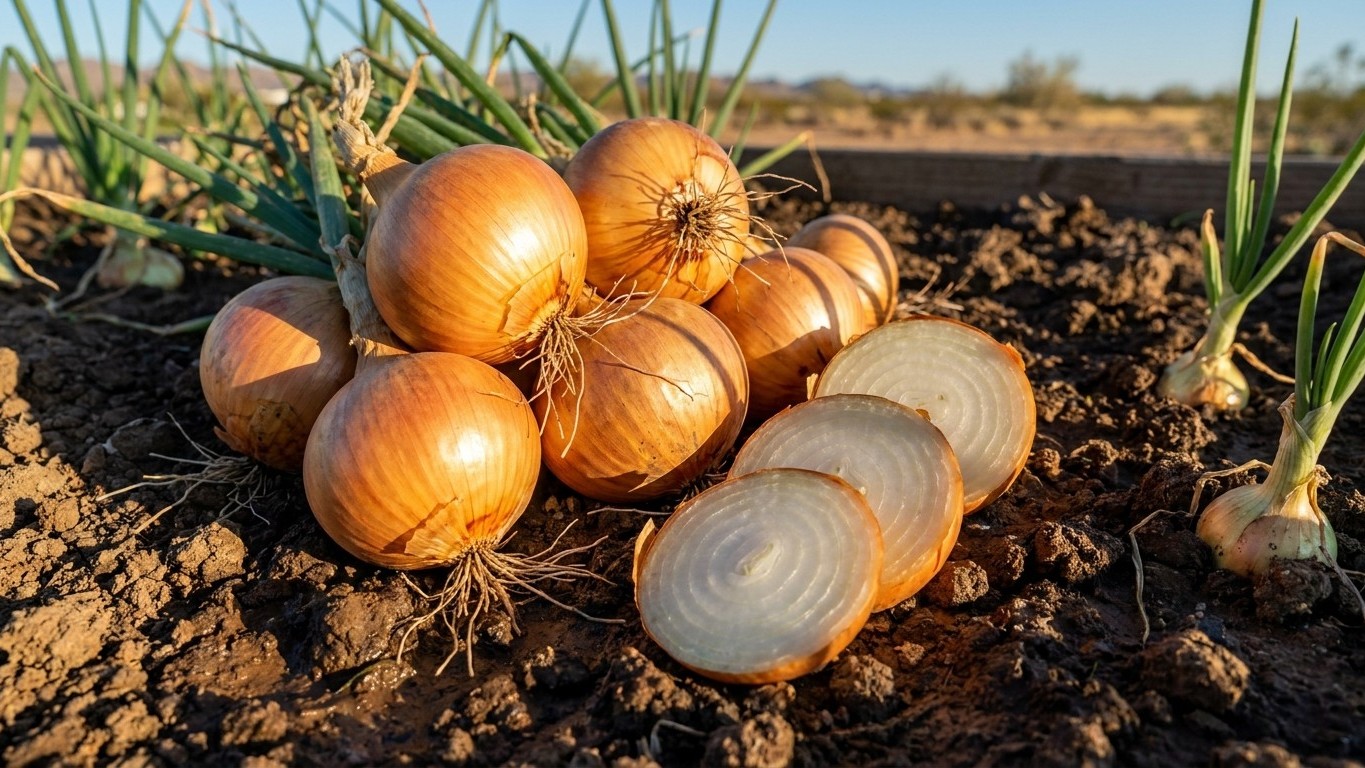

Lift onions once most of the tops have fallen over and yellowed, which in Ontario usually falls somewhere between August and September. Don’t carry them straight to the cellar. Spread them somewhere warm, dry and airy until the necks are tight and the skins papery, then move them to a cool, dry spot. Skip the curing and the necks stay wet, so rot starts inside the bulb where you can’t see it.
When do you lift onions in Ontario, and how do you cure them?
How do you know onions are ready to lift?
Day length, not warmth, tells an onion to stop making leaves and start swelling a bulb. At the Toronto Buttonville station, 43.86 degrees north, the longest day of the year brings 15 h 17 of daylight (calculated from the station’s latitude, before atmospheric refraction adds a few minutes). Long-day onions wait for 14 to 16 hours before they bulb, so they suit southern Ontario well. Short-day types start bulbing at about 12 hours, according to Clemson Cooperative Extension, which means they bulb early and stay small this far north. If your garden sits well north or south of Toronto, check your own latitude before choosing a variety. The The Best Onion Varieties for Ontario page sorts this out in detail.
The plant tells you when the bulb is done. The necks soften, the tops flop over on their own, and the leaves turn yellow. When most of the row has gone down, stop watering and let the soil dry out. Then lift on a dry day. Loosen the soil with a garden fork rather than yanking by the tops, and handle the bulbs gently, because a bruise is where storage rot starts. Leave the tops on for now.
How do you cure onions?
Curing dries the neck and the outer skins so the bulb is sealed. Lay the onions in a single layer on screens, slatted crates or a clean rack. Pick a spot that is warm, shaded from direct sun and sheltered from rain, such as a covered porch, a shed with the door open or a garage with good airflow. A damp Ontario fall stretches the process, so don’t set a date. Judge by the bulb instead: the neck should be tight and dry, with nothing moist when you squeeze it, and the outer skins should rustle like paper.
Once the bulbs pass that test, trim the roots and cut the tops down to a short stub. Brush off loose soil without washing anything. Any bulb with a soft spot, a thick green neck or tunneling from What Eats Onion in Ontario, and When goes to the kitchen first. It will not keep, and it can spoil the bulbs around it.
Keeping them, and for how long
Clemson Cooperative Extension’s Home & Garden Information Center puts it this way: “Ideal conditions are between 45 °F and 55 °F, and 50 to 60 percent humidity.” Write those two ranges down. Cooler than 45 °F and the bulbs struggle. Warmer than 55 °F and they tend to soften and sprout sooner. Above 60 percent humidity the skins pick up moisture, and mold and neck rot follow.
Dry air is the opposite of what carrots, beets and other root crops want. They store best in cold, damp conditions, which is why one cellar cannot hold both well. If your only cool space is a damp root cellar, the onions need a separate spot upstairs, or a shelf in the driest corner with plenty of air around the bulbs.
The source gives conditions, not a number of months, and that is the honest way to read any storage claim. Any length of time you see quoted for onions is a maximum under those ideal conditions. In a real house it is shorter, and it depends on the variety. Pungent, thick-skinned storage types hold longer than sweet, mild ones, which are best eaten in the first weeks after curing. The Onions in Ontario overview explains how that choice fits into the growing season.
How you pack them matters nearly as much as the room. Use mesh bags, open crates, baskets or old nylon stockings, anything that lets air move through. Sealed plastic bags and closed boxes trap moisture and invite rot. Keep the layers shallow so one bad bulb doesn’t touch many others.
Check the stored onions every week or two. Squeeze each bulb gently, sniff for a sour smell, and look for sprouting at the neck. Pull out anything soft right away. A sprouting bulb is still safe to eat, though it has begun using up its own reserves, so use those first. Onions that look fine in November can turn in January, and a quick weekly scan is the cheapest insurance you have.
Where in the house that actually is
The refrigerator is the obvious cool place, and it is wrong for whole onions. A domestic fridge runs well below the 45 °F floor, and the crisper drawer is humid, which is the opposite of 50 to 60 percent. Keep a cut onion there, wrapped, but not the main crop.
A heated room fails the other way. Living areas in an Ontario house sit well above 55 °F all winter, and the bulbs soften and sprout early. The kitchen counter is fine for the few onions you will use this week and nothing more.
The garage looks promising until you read a thermometer in it. It runs mild in September, then swings with the weather. Ontario cold snaps can push an attached garage below freezing, and frozen onions turn to mush when they thaw. A warm October afternoon can also push it past 55 °F. A garage works only if it holds steady, and most don’t.
The room that usually comes closest is a cool, unheated space inside the thermal envelope of the house: a back bedroom with the vent closed, a closet on an interior wall, or the driest corner of a basement. Basements are cooler but often damp in late summer and fall, so humidity is the thing to check. Run a dehumidifier if the reading climbs past 60 percent, and keep the crates off the concrete floor and away from the outside walls.
Before you commit the crop, put a thermometer with a humidity reading in the spot you’ve picked and leave it there for a week, checking morning and evening. Skipping that step is how a whole harvest ends up in a room that runs 60 °F at night or 75 percent humid. A basic digital thermometer-hygrometer costs little compared with a crop you spent the summer growing.
If the numbers fall inside the range, the spot works. If they don’t, move the thermometer to the next candidate and try again. Cures and storage rooms differ from house to house, and your county extension office or a local master gardener group can tell you what is typical for your area.
Common questions
Can I store onions in the fridge?
Not the whole crop. A fridge is colder than the 45 °F lower limit and humid besides, so onions soften and get moldy. Cut onions are different: wrap them tightly and use them within a few days.
Do onions have to be cured before storage?
Yes. Bulbs go into storage only once the necks are tight and the skins papery. Straight from the ground, the neck is an open wound full of moisture, and rot enters there.
What if frost is coming and the tops haven’t fallen?
Lift the bulbs and cure them under cover rather than leaving them in cold, wet soil. Bulbs with thick, green necks won’t keep as long, so eat those first. Most onions that haven’t finished maturing will still cure acceptably, though they won’t match the rest of the harvest.
Do short-day onions work in Ontario?
They grow, but they are a poor fit. Short-day varieties begin bulbing at about 12 hours of daylight, while Toronto’s longest day gives 15 h 17. They bulb early on small plants and give small bulbs. Long-day varieties suit southern Ontario better. Growers far north of Toronto get even longer summer days and should still check the variety’s day-length needs.